We offer a strong research environment with active projects on biogeography, evolution, climate change, and biological invasions on islands. There is flexibility to shape your own research program within this framework, and support to develop ideas that align with our ongoing projects
18.11.2025 10:55
👍 0
🔁 0
💬 1
📌 0
Key eligibility criteria:
• PhD timing, must hold a PhD obtained between 1 Jan 2024 – 31 Dec 2025
• Apply to a research centre different from where you did your PhD
• Not applying to Ramón y Cajal 2025
• Not previously funded by a Juan de la Cierva / Formación Posdoctoral program
18.11.2025 10:55
👍 0
🔁 0
💬 1
📌 0
🚀 We’re looking for a Juan de la Cierva candidate!
Our #iEcoEvoLab is seeking an early-career researcher to apply with us to the Juan de la Cierva 2025 call. If you work on island plant biogeography and conservation, we’d love to hear from you! 🏝️🌿🌍
18.11.2025 10:55
👍 2
🔁 1
💬 1
📌 0

El turismo de sol y playa acelera la extinción de plantas en la costa de Canarias
Un estudio realizado por investigadores del IPNA-CSIC revela que al menos ocho especies vegetales endémicas del archipiélago han desaparecido de la faz de la Tierra desde 1750
Our study is already receiving great regional coverage! Check out this interview in Spanish by @veropaves.bsky.social discussing our findings:
👉 www.epe.es/es/espana/ca...
The impact of coastal tourism and land-use changes on plant extinctions in the Canary Islands is a key takeaway! 🧵 7/8
10.03.2025 23:15
👍 2
🔁 1
💬 1
📌 0

These findings underscore why islands need urgent conservation efforts. Studying life-history traits can help predict and prevent future losses, before more species vanish unnoticed. Photo credit: #JavierMartínCarbajal 🧵 6/8
10.03.2025 23:15
👍 1
🔁 0
💬 1
📌 0

Lotus gomerythus. Photo credit: Javier Martín Carbajal
A striking example? Lotus gomerythus, a plant species that exhibited many of the traits associated with high extinction risk, went extinct in nature during our study’s publication process. Photo credit: #JavierMartínCarbajal 🧵 5/8
10.03.2025 23:15
👍 1
🔁 0
💬 1
📌 0

What drives extinction events? Key factors include: Invasive herbivores, island age, elevation, and human population pressure. Certain traits also increase extinction risk: Endemism, vertebrate pollination, nitrogen-fixation and zoochory (seed dispersal by animals) are among thse key traits 🧵 4/8
10.03.2025 23:15
👍 1
🔁 0
💬 1
📌 0

These figures of plant extinction are well above the expected global background extinction rate. Extinction patterns aren’t random. We detected a recent coastal extinction hotspot linked to socioeconomic changes since the 1960s, which have reshaped and treated island ecosystems 🧵 3/8
10.03.2025 23:15
👍 0
🔁 0
💬 1
📌 0

New Paper 🚨 Are species extinctions accelerating in the Anthropocene? And why are some species more at risk than others? Our latest research, published in @globalchangebio.bsky.social explores plant extinctions in Macaronesia, one of the world's most biodiverse island regions. A thread 🧵👇
10.03.2025 23:15
👍 10
🔁 7
💬 1
📌 0

Exciting milestone for the #iEcoEvoLab! Our first post celebrates the first PhD paper of #RaúlOrihuela-Rivero, congratulations for great work and leadership! Stay tuned for more on the paper and other lab updates in the coming days! @ipna.csic.es
01.03.2025 21:48
👍 9
🔁 2
💬 0
📌 0
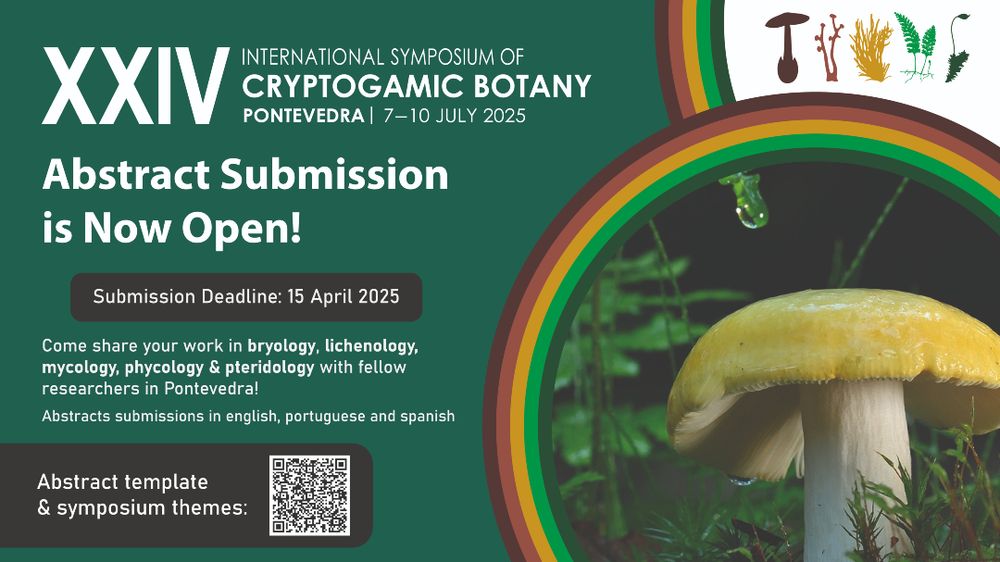
Calling all researchers!🌿
Abstract submission for #ISCB2025 is now OPEN!
Share your work in mycology, lichenology, phycology, bryology and/or pteridology with fellow researchers, this July in Pontevedra (Spain)
🗓️Submit by April 15th
Check our website!
24.02.2025 09:01
👍 6
🔁 7
💬 0
📌 1


