
Looks like a great paper! Added to my reading list!
06.03.2026 14:33
👍 0
🔁 0
💬 0
📌 0
Looks like a great paper! Added to my reading list!

New decomposition method to quantify how specific subpopulations drive demographic gaps. E.g., estimating how foreign-born populations by race and ethnicity contribute to the gap between total and native-born life expectancy.
@eugeniopaglino.bsky.social
👉 www.demographic-research.org/articles/vol...

My favorite paper of 2019 has just been conditionally accepted at AER (lmao)
The Voting Rights Act rapidly increased Black wages in the South via public employment & redistribution
static1.squarespace.com/static/59dc0...

Today, in honour of WEB DuBois's birthday in 1868, the @publicdomainrev.bsky.social features the hand-drawn infographics DuBois made with his students to depict the conditions of African-American life in 1900.
Arts-based pedagogy all those years ago!
buff.ly/3kdWqRD
White folks get all upset at the notion of “reparations” but don’t seem to mind that we continue to have what are essentially reverse-reparations in this country, especially in much of the South, where folks whose wealth came from slavery continue to strip Black families of land and property. 1/2


In “Limits of Predicting Individual-Level Longevity,” Badolato et al. assess a range of classic statistical & machine learning survival analysis models. @nickirons.bsky.social @monjalexander.bsky.social @ugobas.bsky.social @ezagheni.bsky.social @mpidr.bsky.social read.dukeupress.edu/demography/a...
Our paper “Inferring fine-grained migration patterns across the United States” is now out in @natcomms.nature.com! We released a new, highly granular migration dataset. 1/9

On this day in 1959, Richard and Mildred Loving were convicted of interracial marriage in Virginia, given a one-year suspended sentence, and banished from the state.
Indeed! I made Saag w/ chicken last night and it was the perfect antidote to the snow.
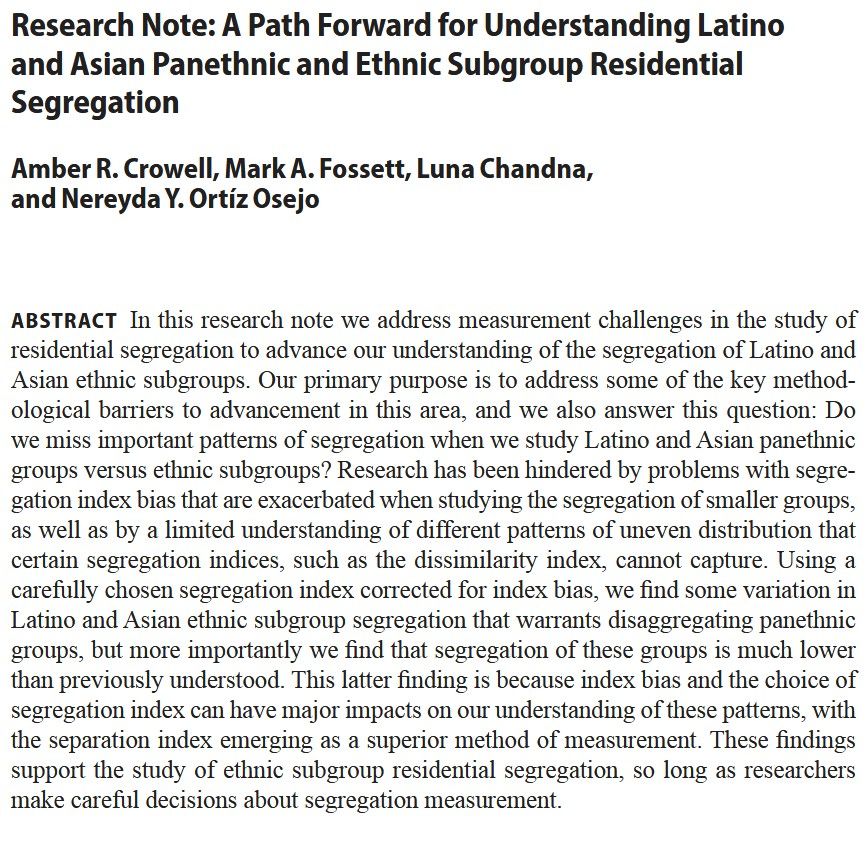
“Understanding Latino & Asian Panethnic & Ethnic Subgroup Residential Segregation”: @acrowell.bsky.social et al. recommend that researchers adopt the described measurement practices "to accurately assess patterns of ethnic group segregation.” @tamusoci.bsky.social read.dukeupress.edu/demography/a...

"Captain Gains" on Capitol Hill Shang-Jin Wei & Yifan Zhou WORKING PAPER 34524 DOI 10.3386/w34524 ISSUE DATE November 2025 Using transaction-level data on US congressional stock trades, we find that lawmakers who later ascend to leadership positions perform similarly to matched peers beforehand but outperform them by 47 percentage points annually after ascension. Leaders' superior performance arises through two mechanisms. The political influence channel is reflected in higher returns when their party controls the chamber, sales of stocks preceding regulatory actions, and purchase of stocks whose firms receiving more government contracts and favorable party support on bills. The corporate access channel is reflected in stock trades that predict subsequent corporate news and greater returns on donor-owned or home-state firms.

令 1 1 -9 -8 -7 -6 -5 -4 -3 -2 -1 1 2 3 4 5 7 8 9 Year Figure 2: Estimated dynamic quasi-difference-in-differences coefficient, di, of equation(3), with vertical dashed lines representing 90 percent confidence intervals. The point estimate of the year in which the lawmaker became a congressional leader (Year 0) is normalized to zero. BHAR over the 250 days following each trade is the dependent variable and calculated using the Fama-French five-factor plus momentum as the benchmark model.
After becoming a congressional leader, a politician’s stock portfolio beats out those of peers by 47 (!!!) percentage points a year through trades timed around bills and firms that later get government contracts
www.nber.org/papers/w34524
via @florianederer.bsky.social
Looks like a super interesting paper! Looking forward to reading.
🧵/ Perceptions of falling #status have been hypothesized as a driver of worsening #mortality among #White adults in the U.S. over the last few decades.
Testing this #hypothesis is difficult.
But we think we have some #evidence in favor of it.
ICYMI: New paper for causal effects with panel data, subsuming other approaches. We generate realistic synthetic data based on commonly studied datasets, showing our method substantially outperforms others and providing insight about what in the data-generating process corresponds to gains.
That seems totally plausible. N=1, but I know that Light Rail development in Seattle faced major opposition for years from different citizen’s groups which could be bc of perceived problems.

New working paper up on SocArxiv! osf.io/preprints/so.... I use the 1940 Census and linked mortality records in combination with an IV-design to study the causal effects of racial segregation on longevity. I show that segregation reduces both Black and White longevity.

So grateful for this office view!

Excited to post a new working paper with @instrumenthull.bsky.social and Michal Kolesár: arxiv.org/abs/2511.03572
Will post a thread on it soon, but if you're interested in judge/examiner designs, I think you'll find this guide very helpful!
A huge congratulations to DOCTOR Haowen Zheng, who defended a fantastic dissertation on how changes in family formation and in the spatial distribution of jobs in US affects who moves, where they move to, & who benefits most from moving.
Haowen starts a post-doc at Michigan's Stone Center in Jan.
Other academics are fighting (sometimes literally) one another to publish Nature papers. But I am just sitting here writing abstraction layers for probabilistic programming frameworks.

New @pnas.org paper constructing subnational estimates of internet and mobile adoption by gender, including gender gaps, for 117 low- and middle- income countries from 2015 through 2025.
www.pnas.org/doi/10.1073/...
The pronatalists have done an excellent job of using bad demography to convince the legacy media that low birth rates are a crisis.
They are using bad demography to whitewash their sexism, racism, Christian nationalism, classism, & anti-LGBTQ sentiments.
It’s why my colleagues & I wrote this:
Congrats! This is huge! 🥳
Both the Brown and Columbia agreements require the universities to report the test scores and GPAs of applicants, admits, and matriculating students by race *and color,* among other attributes.
Wait, what? What's "color" doing in there?
A sociologist weighs in.
1/9
Used this as a reference for a working group discussion on family FE designs. Great paper and led to a generative discussion!
the destruction of chattel slavery is one of the great accomplishments in our nation's history and the reason conservatives hate celebrating it is because doing so legitimizes the black counter-narrative of the united states
I want to highlight 3 things from this excellent report:
1) Women's reproductive labor is too often the solution to "population problems."
2) Low birth rates aren't a rejection of children & parenthood.
3) Supporting families is a worthy goal in itself, even if policies don't raise birth rates. 1/
Sad that this has to be my first post here, but the gutting of the FSRDC program is disastrous for demographic research.

Internal migration in early adulthood, a critical life stage marked by frequent job transitions and demographic events, contributes to income disparities between married men and women. This study adopts a life course perspective to elucidate the development of this gender inequality pre- and post-migration. Using the NLSY79 data from 1979 to 2018 and an event studies model that leverages within-individual variations in both pre- and post-migration income trajectories relative to non-migrants, I observe a steadily growing migration premium for men over 15 years post-migration. By contrast, I show a prolonged migration penalty for women that peaks around five years after migration and lasts for a decade. While improved employment status accounts for about half of men’s migration income premium consistently over time, detachment from the labor market explains a smaller proportion of women’s migration income penalty mostly in the short term. Although occupational changes and fertility do not impact men's gains from migration, they account for women’s migration penalty in the long run. Ignoring pre-migration income trends underestimates income gains among male migrants and overestimates income losses among female migrants. These results emphasize the importance of temporal dynamics in family migration and gender inequality studies.
The honorable mention goes to Haowen Zheng, “Diverging Trajectories: Gendered Income Dynamics Pre- and Post-Family Migration.” 2/3
