1:16:35 Who the liars are and what we need to do about them. The whole video is basically a political statment, about the connection between techology and partisanship politics. A good one.
31.01.2026 23:30
👍 0
🔁 1
💬 0
📌 0

A composite statistical visualization comparing three student profiles—Disengaged (green), Utilitarian (orange), and Active (blue)—across ten engagement indicators. The chart utilizes box plots overlaid with jittered raw data points to show the distribution of 193 observations. The Y-axis represents a normalized scale (POMS) from 0.00 to 1.00. The X-axis displays ten variables: Attempts, Successful attempts, Unique days, Consecutive days, Use of compete/battle modes, Early start, Late finish, Maximum time, Mean time, and Minimum time.
Key trends show that Active learners generally display higher median values and wider distributions in volume-based metrics (like Attempts and Unique days) compared to Disengaged learners. Three annotated arrows provide context for specific data points: one highlighting a maximum of 4090 attempts, another noting 14% of attempts in gamified modes, and a third defining "Late finish" as 2 days before the exam.
I created my most complicated visualization to show 193 observations across ten continuous and categorical axes. It is messy, but I like my arrows and Epanechnikov’s kernel.
22.01.2026 13:26
👍 0
🔁 0
💬 1
📌 0
That was the longest road I have taken so far. Five years have passed since I first saw the data, and even longer since it was collected. Conceptually, I have moved from a classical "squeeze the maximum out of the data" mindset to a more transparent post-positivism. The data was still tortured.
22.01.2026 13:26
👍 1
🔁 0
💬 1
📌 0

Hi. I have a poster about a framework to design digital experiments with open science practices. If you do experiments, let's talk. #ic2s2
24.07.2025 11:23
👍 28
🔁 3
💬 0
📌 1
Hi @dncwn.bsky.social, could you please delete the link to the poster awards poll? We were trying to limit voting to only in-person participants
23.07.2025 19:02
👍 0
🔁 0
💬 1
📌 0
But funding...
23.07.2025 15:28
👍 0
🔁 0
💬 0
📌 0


How opinion dynamics scholars see humans when they use the percolation model. #IC2S2 poster session day 2.
23.07.2025 14:54
👍 9
🔁 0
💬 0
📌 0


Seat selection at #IC2S2 De Geerhallen during keynotes is not normal. Bimodal, perhaps? Talks are uniformly excellent and properly powered
22.07.2025 15:00
👍 9
🔁 0
💬 0
📌 0

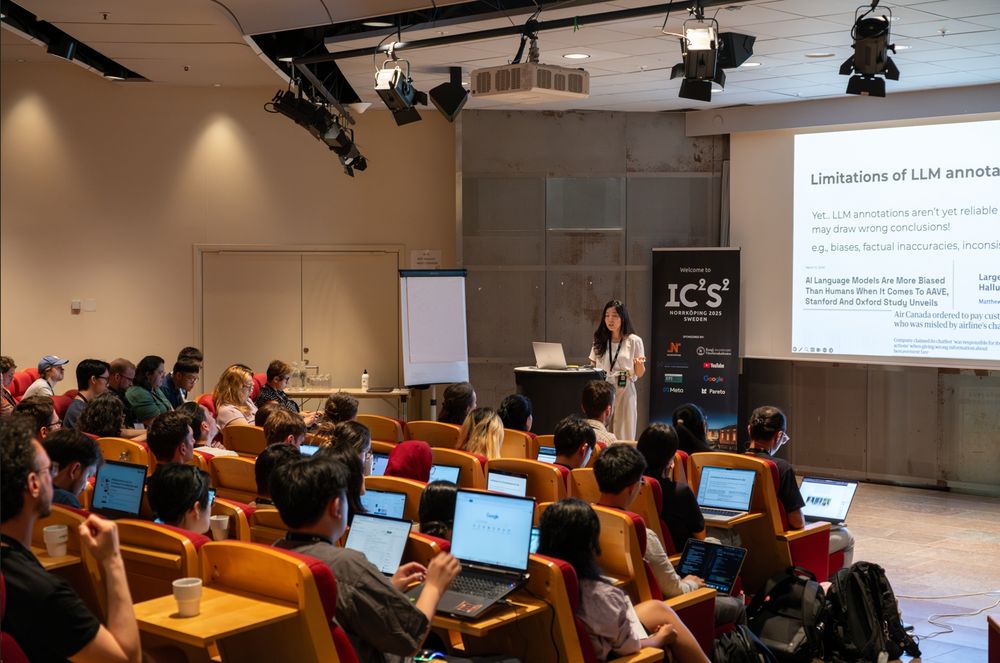
Happy to be at @ic2s2.bsky.social
So excited to see amazing keynote speakers, given how hard it is to travel to the Norrköping #IC2S2
21.07.2025 13:44
👍 12
🔁 2
💬 0
📌 0
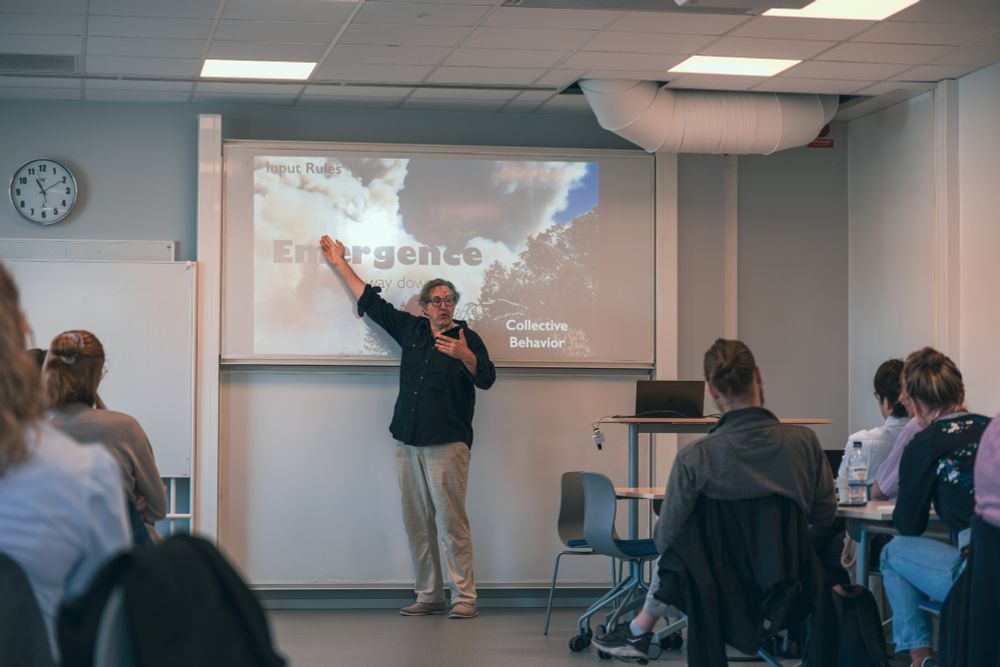
James Evans discussed Generative Social Science with Large Models at @iasliu.bsky.social. Culture as a multidimensional bias and how (computational) social science changes from hypotheses to hunches: from precise models to feeling about how X influences Y.
19.06.2025 10:14
👍 5
🔁 0
💬 0
📌 0
I just completed the SICSS-IAS 2025 digital traces lab hosted by @iasliu.bsky.social. I made this tweet using the bskyr library in R. Kudos to @chriskenny.bsky.social for creating and maintaining it! I will leave all hashtags here: #SICSS #SICSS-IAS #IAS.
10.06.2025 08:38
👍 5
🔁 0
💬 0
📌 0

PhD student -> PhD candidate
16.05.2025 16:11
👍 3
🔁 0
💬 0
📌 0
Hello world! I posted this via the R httr2 package. Please ignore
12.05.2025 20:17
👍 2
🔁 0
💬 0
📌 0

A great talk by @davidlazer.bsky.social & Scott Cambo (TSB alum yay) on the National Internet Observatory and observational science as a service.
25.04.2025 01:19
👍 3
🔁 0
💬 0
📌 0
@northwestern, pretty please. Can you do one cool thing with your $14.3 billions of endowment? I did all my antisemitism training, if that helps
16.04.2025 05:25
👍 3
🔁 0
💬 0
📌 0

I'm In This Photo and I Don't Like It
12.12.2024 05:50
👍 2
🔁 0
💬 0
📌 0

Neelam stands infront of slides at Nico basement
Neelam Modi (neelamjmodi.com) talked about modelling the “Who” and “How” of Social Influence at Northwestern NICO lighttight talk series. The presentation was Woohoo! I definitely had not seen the same talk the day before.
20.11.2024 21:22
👍 2
🔁 0
💬 0
📌 0
Repost if you’ve participated in a Summer Institute in Computational Social Science. Let’s get #SICSS Bluesky going!
08.10.2023 19:49
👍 51
🔁 63
💬 0
📌 3
If computational social science is so good, where is computation social science 2. Oh wait
15.11.2024 05:27
👍 4
🔁 0
💬 1
📌 0
So far, the best part of migrating to the blue sky is the glaring absence of AI experts, promoting the next big wrapper for gpt
15.11.2024 02:58
👍 2
🔁 0
💬 0
📌 0
Sharing my first Computational Social Science starter pack! Will grow with time, feel free to nominate and self nominate!
go.bsky.app/CYmRvcK
13.11.2024 02:05
👍 96
🔁 41
💬 61
📌 3