

And then, after tracing several billion more rays, the resulting film looks like this 🤯🤩
20.05.2025 21:34
👍 2
🔁 0
💬 0
📌 0
And then, after tracing several billion more rays, the resulting film looks like this 🤯🤩

Running the simulation for several million photons, you can start to see the Dino resolving (upside down!) on the simulated film

Here’s the view of the Dino from each of several thousand pixels: can you start to see its shape if you hold the phone far away? 🤓

Heuristically , we expect a "blurry" image to form: a bright outline of the dino on the area exposed to einstein rings, and a decaying green 'halo' as the lensed dino moves outside the black holes line of sight.
Here’s the light contributing to several hundred pixels

When a piece of the film is not lined up directly with a portion of the dinosaur, it does not form a ring, and so contributes less overall light

The intuition: when a piece of the film is cloned with the dinosaur and black hole, from that point on the films perspective the dinosaur will be distorted into an einstein ring, taking up a large portion of the field of view, imparting that pixel with extra green light
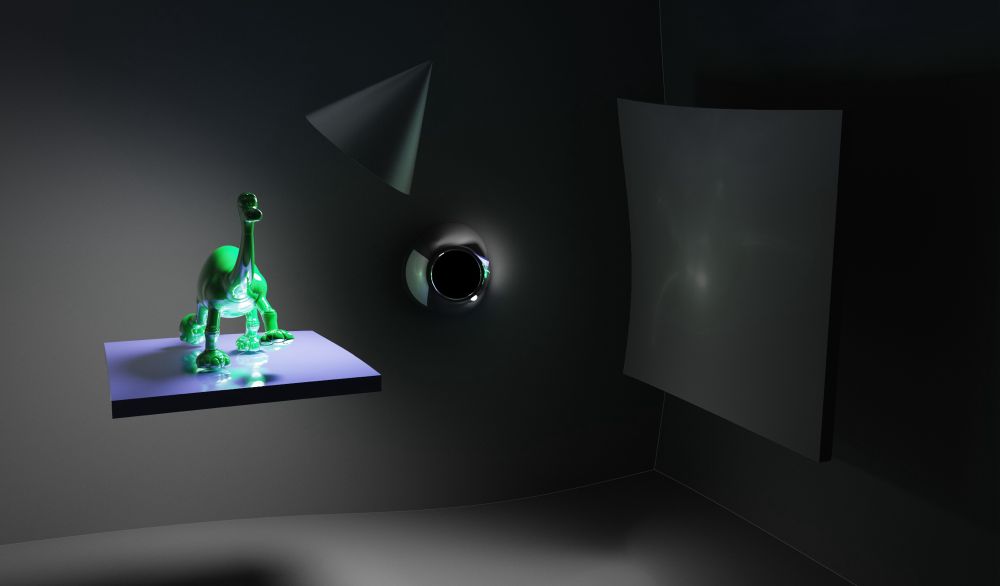
I had to know if it worked, so I built a little simulator! Here's the setup: a little toy dinosaur and a conical spotlight, then a black hole, then a simulated piece of film (that will record when a simulated photon hits it, and accumulate them)
Summers here - time to catch up sharing some of what I’ve been up to! First up - *gravitational photography* - using (simulated) black holes instead of lenses to focus an image onto a screen. Can you see the ghostly dinosaur? 1/n
Also @motivickyle.bsky.social - my collaborator Nadir Hajouji is a Reed alum! (Jerry Shurman was his ugrad advisor 😁)
We’re going to make the website better (ie, actually informative 🤓) soon! For now just threw up a bunch of beautiful renders that came out of writing the paper!
Not that I can think of - they both involve Tori but are *very different* incarnations of Tori. Ours here is the 2d surface with its conformal geometry, SLView is a solid Torus with the geometry of SL2R (but this viz is closely related to the “starscapes” project of me Edmund and Kate)

I actually recently drew some of these slices! Here’s the real points, and what they look like on the complex elliptic curve (well, a surface in R3 whose conformal structure gives a Riemann surface isomorphic to the complex elliptic curve)


The regular hexagon can be rolled up isometrically into a flat torus in 4 dimensional space: here’s a stereographic projection of the result. (Can you see the hexagonal pattern in the spheres covering its surface? 😁)
Thanks Robbie!!!!! 😁

Here’s a cute lil donut!

Fun pic from a new project! Drawing lots of donuts today 😁
Best of luck to all taking the Putnam today, from our team here at USF! 🤓🤘
If I do this I'll send you the pic :)
I like this idea!! I wonder if there's any nice math to compute the area (complex dynamics isn't my field of research so I only know the very basics). Otherwise could just estimate it computationally (draw the Julia set, count the black pixels...ha)

The mandelbrot fractal: a black collection of circles with infinite complexity leading to jagged edges, on a white backgroound
The parameter space of "c" for which the Julia set is "big" (connected) is the famous Mandelbrot Fractal - visible as an emergent image here from the collective behavior of tens of thousands of Julia sets.

Its clear theres some sort of region containing all the "big" Julia sets, and outside that in all directions they burst into dust (mathematically - into totally disconnected cantor sets). But to get a better view we need to zoom out
Some Julia sets are "large" and some are "small": can we tell which values of "c" lead to which? One way to try and get a sense of this experimentally is by just drawing a lot of Julia sets! Let's draw the Julia set for "c" right where "c" is in the complex plane
Something strange is going on at a couple points along the animation: near the center the fractal's roughly disk like (recall its a perfect disk at c=0), but if c strays too far in certain directions it bursts into a constellation of tiny dots and almost disappears
Indeed, we can associate every point c in the complex plane to a fractal in this way, by drawing the Julia set corresponding to z^2+c. Here's a quick animation moving through these (the red dot shows the associated point c)

And here's the Julia set for f(z)=z^2-1

But things quickly get more interesting: here's the Julia set for f(z)=z^2-1/2

A black disk on white background
The set of all points that stay bounded is the (filled) Julia set for the function f. Let's start with a boring example - if f(z)=z^2, then points inside the unit disk stay bounded (in fact, they converge to zero) and points outside go to infinity: the Julia set is a disk
Complex dynamics is all about taking a complex function f(z) and looking at what happens when you iterate, computing f(f(z)), f(f(f(z))) and so on. For any given starting number z, this produces a sequence, and this sequence can either blow up to infinity, or stay bounded.


