Michelle Scriver's Avatar

Michelle Scriver

@mscriver-edna

Molecular biology scientist with interest in advancing eDNA/eRNA and next-gen sequencing πŸ§¬πŸŒŠπŸ‘©πŸ»β€πŸ”¬ Currently: Research Scientist at Sequench, Nelson, NZ

205
Followers
178
Following
4
Posts
26.11.2024
Joined
Posts Following

Latest posts by Michelle Scriver @mscriver-edna

Preview
e-DNA surveys could improve marine biosecurity – Australian Antarctic Program (News 2026) Antarctic scientists have trialed a DNA β€˜barcoding’ technique that could improve biosecurity measures that help protect polar ecosystems from invasive marine species.

Another belated "new paper". We used passive #eDNA sampling to evaluate the risk of biofouling species being introduced to Macquarie Island (and other Antarctic / subantarctic locations) by ships.
Story from AAD: www.antarctica.gov.au/news/2026/ed...
and link to paper: doi.org/10.1016/j.sc...
🧬πŸ§ͺ

06.03.2026 02:17 πŸ‘ 14 πŸ” 3 πŸ’¬ 0 πŸ“Œ 0
Post image Post image

Another day, another estuary. Sampling #eDNA to better understand biodiversity in Tilba Tilba Lake

An important aspect our work is communication with local stakeholders, such as the farmers around this estuary

Visits from cute echidnas is an added bonus

#eDNAinFocus @sednasociety.bsky.social

06.03.2026 03:26 πŸ‘ 7 πŸ” 2 πŸ’¬ 0 πŸ“Œ 0
Post image Post image Post image Post image

Photos for the #eDNAinFocus photo competition πŸ“Έ
@sednasociety.bsky.social

The Sequench team testing our #eQuip PK1 cordless stick samplerβ€”one of our easy, cost-effective devices for collecting eDNA πŸ§¬πŸ’§ Essential testing that keeps the eDNA community moving forward.

Show your #eDNA adventures 🧬🌏

05.03.2026 23:54 πŸ‘ 7 πŸ” 3 πŸ’¬ 0 πŸ“Œ 0
Post image

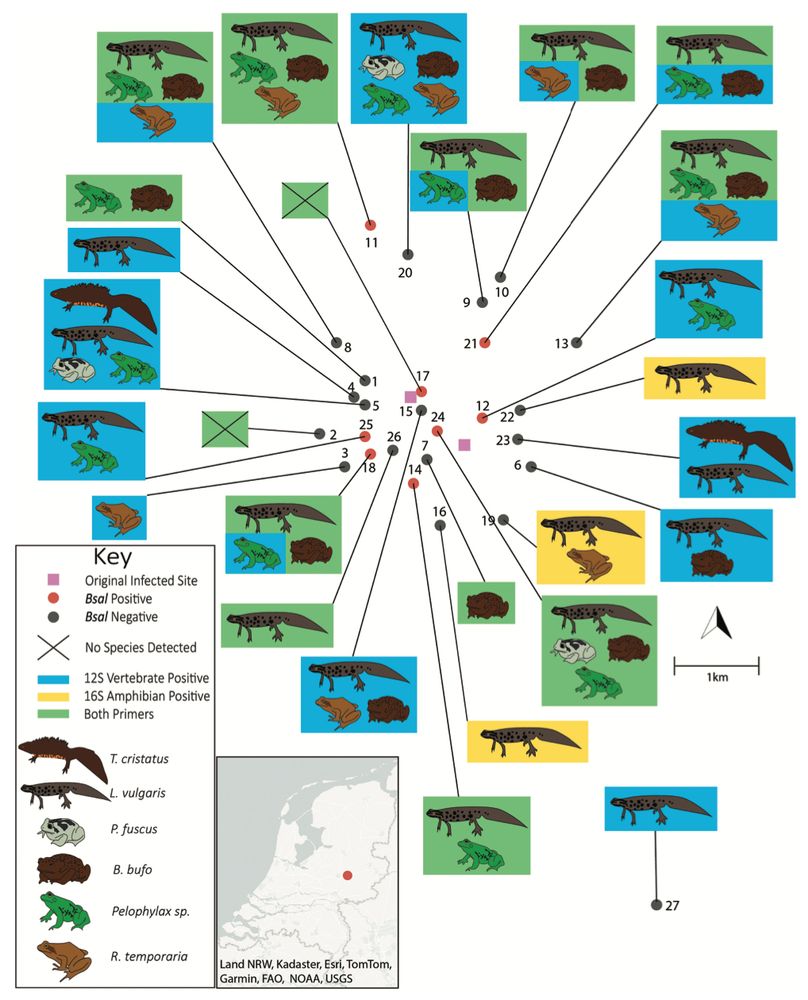
New paper out from our crew on using #eDNA to detect the pathogenic chytrid fungus (Bsal) and characterise the surrounding amphibian community from pond samples in the Netherlands. Small number of samples but highlights the potential of eDNA for routine monitoring of both. bioone.org/journals/jou...

24.06.2025 10:47 πŸ‘ 21 πŸ” 10 πŸ’¬ 0 πŸ“Œ 0
Preview
The biodiversity of aquatic ecosystems reflected by eDNA in the middle reaches of the Yangtze River after drought Extreme climate events, such as droughts, are increasingly threatening freshwater biodiversity. The middle Yangtze River, a vital biodiversity hotspot…

The biodiversity of aquatic ecosystems reflected by eDNA in the middle reaches of the Yangtze River after drought

#eDNA #environmentalDNA

www.sciencedirect.com/science/arti...

21.06.2025 13:09 πŸ‘ 2 πŸ” 1 πŸ’¬ 0 πŸ“Œ 0
Post image

β€ͺ
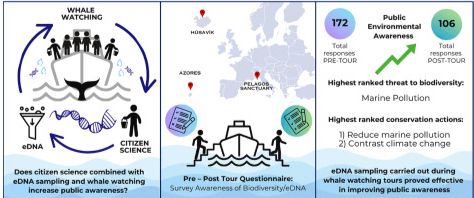
New @ewhale-dna.bsky.social publication led by Eleonora Barbaccia & published in Ocean & Coastal Management! πŸ‹πŸ’™

#WhaleWatching, #citizenScience, and #eDNA sampling can foster public awareness and engagement in #marine #biodiversity #conservation

doi.org/10.1016/j.oc...

20.06.2025 14:00 πŸ‘ 9 πŸ” 5 πŸ’¬ 0 πŸ“Œ 1
Post image

#newepisode just dropped!
Environmental #DNA or #eDNA is the study of genetic material in the #environment.
How can we apply it to the #deepsea? Revealing the hidden majority, changes through time and community structure, the possibilities seem endless.

open.spotify.com/episode/2XQv...

06.06.2025 22:06 πŸ‘ 13 πŸ” 6 πŸ’¬ 1 πŸ“Œ 0

1/4 A major scientific breakthrough happened during the last VendΓ©e Globe! ⛡️ Fabrice Amedeo collected environmental DNA (eDNA) for 114 days, documenting marine life across 3 oceans, 100 degrees of latitude, and 360 degrees of longitude for the first time. #eDNA #OceanBiodiversity

07.06.2025 17:03 πŸ‘ 4 πŸ” 1 πŸ’¬ 1 πŸ“Œ 0
Preview
Research Officer, Environmental DNA Laboratory - Townsville, QLD, Australia James Cook University (JCU) is creating a brighter future for life in the Tropics and beyond, through education and research that makes a difference locally and globally.Β  We now have an opportunity a...

πŸ“£ Postdoc opportunity!

Join absolute #eDNA legend @ceciliavr.bsky.social at JCU and take the next step in your career!

careers.jcu.edu.au/jobs/researc...

10.06.2025 04:10 πŸ‘ 5 πŸ” 1 πŸ’¬ 0 πŸ“Œ 0
Preview
A Metadata Checklist and Data Formatting Guidelines to Make eDNA FAIR (Findable, Accessible, Interoperable, and Reusable) Environmental DNA (eDNA) has emerged as a transformative tool for biodiversity monitoring and species detection, yet inconsistent metadata practices hinder data interoperability and reuse. To address...

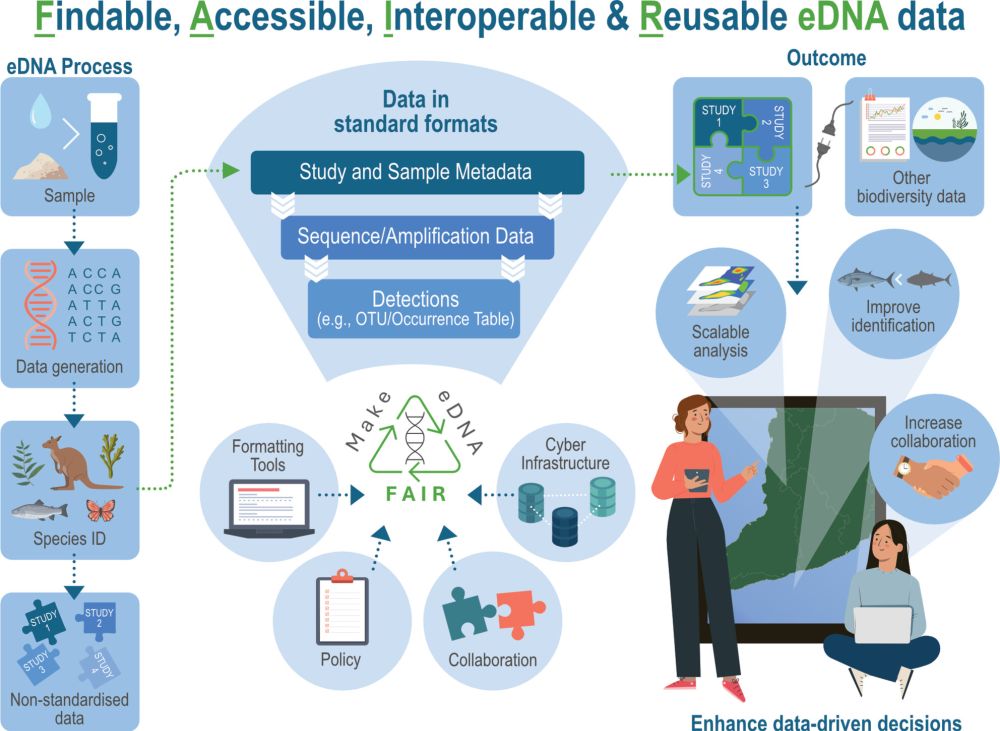
🚨 Out now in #EnvironmentalDNA led by #MiwaTakahashi: Results of a huge, global effort to facilitate the publication of raw and processed #eDNA data & ensure that dataset we are currently generating, adhere to the #FAIR principles & won't be lost. @gbif.org, #ENA,
doi.org/10.1002/edn3...

10.06.2025 09:17 πŸ‘ 47 πŸ” 21 πŸ’¬ 1 πŸ“Œ 0
Preview
Robotic environmental DNA bio-surveillance of freshwater health - Scientific Reports Scientific Reports - Robotic environmental DNA bio-surveillance of freshwater health

Autonomous water sampling tech like MBARI's ESP can revolutionize long-term river monitoring by automating #eDNA collection offering cost-effective, high-frequency detection of pathogens & invasive species.

Read more: bit.ly/45YBE0o

#Innovation #Tech #Monitoring #Science

06.06.2025 07:38 πŸ‘ 5 πŸ” 2 πŸ’¬ 0 πŸ“Œ 0

Proud of this new publication demonstrating #eDNA as a useful accessory to invasive species management in practice. In this case, we observed eDNA declines coinciding with community-led apple snail removal from an Austin, Texas pond. www.reabic.net/journals/mbi...

04.06.2025 21:09 πŸ‘ 19 πŸ” 7 πŸ’¬ 2 πŸ“Œ 0
Preview
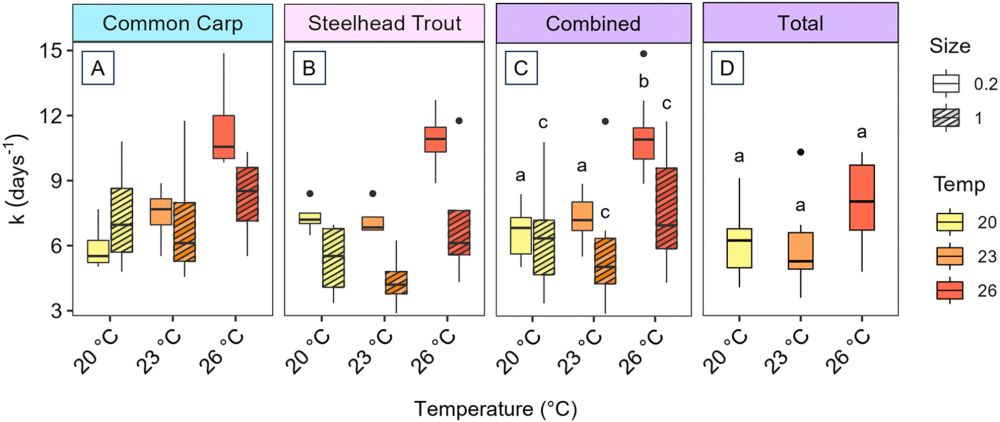
Warming Increases Environmental DNA (eDNA) Removal Rates in Flowing Waters This study experimentally investigated how warmer water temperatures impact eDNA removal rates in flowing waters. Using recirculating mesocosms with varying water temperatures (20Β°C, 23Β°C, and 26Β°C) ...

New paper out today!!

We know warming speeds up eDNA removal in lakes and ponds, but what about streams and rivers where physical removal may obscure the impact of decay?
onlinelibrary.wiley.com/doi/10.1002/...

03.06.2025 19:46 πŸ‘ 11 πŸ” 5 πŸ’¬ 1 πŸ“Œ 0
Post image

New #sharkscience led by Jorge Valerio-Vargas in @esr-ir.bsky.social
Using #eDNA to find remnant sawfish populations in Costa Rica to aid in prioritizing conservation efforts.
@saveourseas.bsky.social @iucnshark.bsky.social
www.int-res.com/abstracts/es...

06.06.2025 04:32 πŸ‘ 20 πŸ” 4 πŸ’¬ 0 πŸ“Œ 0
Preview
First national survey of terrestrial biodiversity using airborne eDNA - Scientific Reports Scientific Reports - First national survey of terrestrial biodiversity using airborne eDNA

UK runs worlds first national airborne eDNA terrestrial survey 🧬 🌍

1,100 taxa identified!

#Biodiversity #eDNA #Ecology

www.nature.com/articles/s41...

02.06.2025 12:04 πŸ‘ 13 πŸ” 8 πŸ’¬ 1 πŸ“Œ 0
Preview
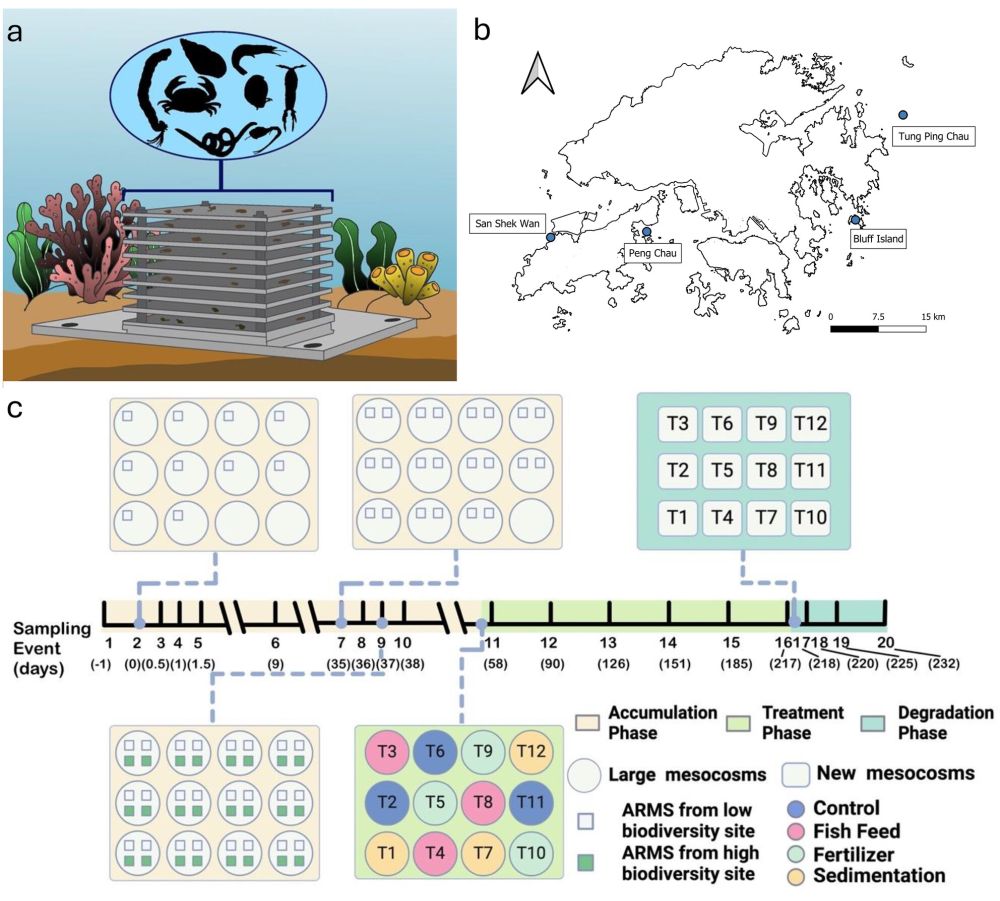
Quantifying the Temporal Dynamics of Marine Biodiversity Under Anthropogenic Impacts Using eDNA Metabarcoding This study uses eDNA to explore marine biodiversity changes under anthropogenic impacts, with a focus on marine community dynamics. Through the use of eDNA metabarcoding, the research identified 814 ....

Our new study shows how eDNA can track fine scale marine biodiversity loss under human impacts. Using a large scale mesocosm experiment we monitored temporal dynamics in bio-accumulation, response to stressors and eDNA degradation #eDNA #MarineBiodiversity onlinelibrary.wiley.com/doi/full/10....

03.06.2025 02:02 πŸ‘ 17 πŸ” 7 πŸ’¬ 0 πŸ“Œ 0
Preview
Evaluation of community science monitoring with environmental DNA for marine fish species: β€œFish survey project using environmental DNA” We evaluated a community science program with environmental DNA (eDNA) for marine fish biodiversity. A cumulative total of 168 volunteers (84 pairs) participated in the program and collected 572 taxo....

πŸ”¬πŸŒŠ This program saw 168 volunteers detect 572 fish taxa, enhancing their understanding of biodiversity and marine environments. 🌍

Read more: bit.ly/3xcmOGn

#eDNA #CommunityScience #MarineBiodiversity #CitizenScience #EnvironmentalEducation #MarineConservation

30.05.2025 07:15 πŸ‘ 4 πŸ” 1 πŸ’¬ 0 πŸ“Œ 0
Post image

🌿 #InternationalDayBiologicalDiversity

At Genome BC, we’re investing in #genomics research that helps protect and preserve biodiversity β€” from tracking endangered species with #eDNA to understanding how microbes support ecosystem health.

22.05.2025 22:08 πŸ‘ 3 πŸ” 1 πŸ’¬ 1 πŸ“Œ 0
Preview
Citizens of the Sea partners with Minderoo Foundation β€” Citizens of the Sea Citizens of the Sea has been given a significant boost from Minderoo Oceanomics from Western Australia. β€œWe are thrilled to welcome Minderoo to our family of supporters,” says Adele Fitzpatrick, Execu...

Excited to announce that we're collaborating with Citizens of the Sea!
www.citizensofthesea.org/news/citizen...
It's an amazing citizen science effort to equip ocean cruisers, racers, commercial vessels with #eDNA collection devices. So much data from so many vessels and locations!

23.05.2025 05:27 πŸ‘ 9 πŸ” 3 πŸ’¬ 0 πŸ“Œ 0
eDNA Surveillance

eDNA Surveillance

πŸ“’ JUST ANNOUNCED: Genome Canada invests in #eDNA surveillance to safeguard health, environmental protection and Canadian industries.

πŸ“² bit.ly/4kk2buX

14.05.2025 16:42 πŸ‘ 14 πŸ” 5 πŸ’¬ 0 πŸ“Œ 0

Our review is finally here! We include all the terrestrial and semi-aquatic mammal-focused #eDNA and #iDNA studies available up to Jan 2025! It's amazing to see how far this field has come 🧬🦦

05.05.2025 11:43 πŸ‘ 17 πŸ” 10 πŸ’¬ 0 πŸ“Œ 1
OceanOmics - Registry of Open Data on AWS

Our OceanOmics AWS Open Data repository is now live!
registry.opendata.aws/oceanomics/

It holds all of our #eDNA data and all of our curated marine vertebrate genome assemblies.

There's so far only a single assembly in there - I'm currently gathering all the eDNA raw reads for upload.

02.05.2025 02:12 πŸ‘ 8 πŸ” 2 πŸ’¬ 1 πŸ“Œ 1
Preview
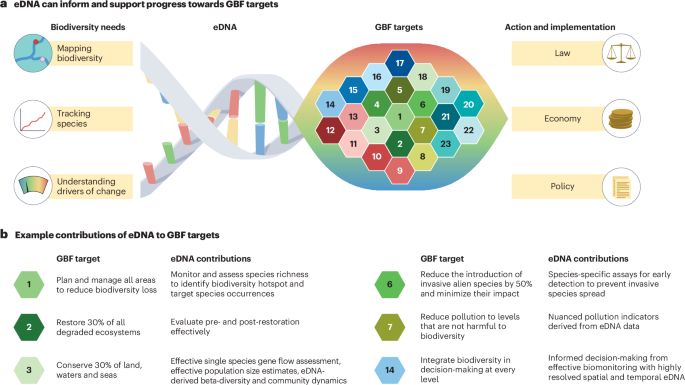
Utilizing aquatic environmental DNA to address global biodiversity targets - Nature Reviews Biodiversity Aquatic eDNA-based technologies offer the potential for universal and standardized biodiversity monitoring. In this Perspective, Altermatt et al. discuss how these technologies can help to achiev...

Utilizing #aquatic environmental DNA #eDNA to address global #biodiversity targets: www.nature.com/articles/s44...

πŸ§¬πŸ”¬πŸŸπŸ¦«πŸ‚πŸ¦πŸ§¬

We discuss how eDNA can contribute towards Kunming-Montreal Global Biodiversity Franework #GBF. Out now in @natrevbiodiv.nature.com

28.04.2025 06:54 πŸ‘ 45 πŸ” 21 πŸ’¬ 1 πŸ“Œ 2
Post image

Junior faculty job alert in Germany - Marine Evolutionary Genomics @geomarkiel.bsky.social / University of Kiel www.geomar.de/en/karriere/... Marine study system of your choice (no microbes, sorry…), excellent infrastructure and ship access, moderate teaching requirements, closing date 6 June

26.04.2025 15:10 πŸ‘ 74 πŸ” 92 πŸ’¬ 1 πŸ“Œ 4
Rediscovering Lost Amphibians: Using eDNA to Detect Critically Endangered Frogs in Área de Conservación Guanacaste, Costa Rica
Rediscovering Lost Amphibians: Using eDNA to Detect Critically Endangered Frogs in Área de Conservación Guanacaste, Costa Rica

Project description
Amphibians are among the most threatened vertebrates globally, with many species feared extinct due to habitat loss and emerging infectious diseases. However, some populations may persist undetected in remote and biodiverse regions like Área de Conservación Guanacaste (ACG), Costa Rica. This project will harness the power of environmental DNA (eDNA) to rediscover critically endangered Neotropical amphibians, including harlequin toads (Atelopus spp.), stream-breeding tree frogs (Hylidae), and elusive Neotropical salamanders (Plethodontidae).
By collecting and analyzing water samples from pristine and historically occupied streams, we will identify traces of amphibian DNA, offering a non-invasive and highly sensitive tool for species detection. The project will refine eDNA sampling methodologies for tropical environments, bridging conservation science and molecular ecology to inform targeted conservation action.
This ResM project is run in collaboration with Área de Conservación Guanacaste and the Guanacaste Dry Forest Conservation Fund (GDFCF), ensuring strong local conservation impact. The successful student will gain expertise in eDNA techniques, bioinformatics, and amphibian ecology while working in one of the most ecologically significant regions of Central America. This project has direct conservation applications, helping guide habitat protection and management strategies to safeguard rediscovered amphibian populations.

Project description Amphibians are among the most threatened vertebrates globally, with many species feared extinct due to habitat loss and emerging infectious diseases. However, some populations may persist undetected in remote and biodiverse regions like Área de Conservación Guanacaste (ACG), Costa Rica. This project will harness the power of environmental DNA (eDNA) to rediscover critically endangered Neotropical amphibians, including harlequin toads (Atelopus spp.), stream-breeding tree frogs (Hylidae), and elusive Neotropical salamanders (Plethodontidae). By collecting and analyzing water samples from pristine and historically occupied streams, we will identify traces of amphibian DNA, offering a non-invasive and highly sensitive tool for species detection. The project will refine eDNA sampling methodologies for tropical environments, bridging conservation science and molecular ecology to inform targeted conservation action. This ResM project is run in collaboration with Área de Conservación Guanacaste and the Guanacaste Dry Forest Conservation Fund (GDFCF), ensuring strong local conservation impact. The successful student will gain expertise in eDNA techniques, bioinformatics, and amphibian ecology while working in one of the most ecologically significant regions of Central America. This project has direct conservation applications, helping guide habitat protection and management strategies to safeguard rediscovered amphibian populations.

Eligibility
Applicants should have a first or upper second-class honours degree in a relevant subject such as biological sciences, molecular ecology, conservation biology, or a related discipline. A relevant Master’s qualification is desirable but not essential.
This project is primarily laboratory-based, and applicants should have experience or a strong interest in molecular techniques, particularly environmental DNA (eDNA) analysis, PCR, and bioinformatics. Experience with DNA extraction, qPCR, metabarcoding, and sequence data analysis is advantageous. A background in amphibian ecology, conservation genetics, or freshwater ecology would also be beneficial.
The ideal candidate will be highly motivated, detail-oriented, and comfortable working with environmental samples in a molecular laboratory setting. Strong analytical skills and the ability to work independently while collaborating with conservation partners are essential.
If your first language is not English, you must meet the minimum English language requirements for the programme: an IELTS Academic score of 6.5 (with no less than 5.5 in each component test area) or an equivalent qualification.
The project is supported for 1.5 years and covers full tuition fees only.
If you wish to discuss this project further informally, please contact Dr Robert Puschendorf by email: robert.puschendorf@plymouth.ac.uk.
Please see our 
apply for a postgraduate research programme
 page for a list of supporting documents to upload with your application.

Eligibility Applicants should have a first or upper second-class honours degree in a relevant subject such as biological sciences, molecular ecology, conservation biology, or a related discipline. A relevant Master’s qualification is desirable but not essential. This project is primarily laboratory-based, and applicants should have experience or a strong interest in molecular techniques, particularly environmental DNA (eDNA) analysis, PCR, and bioinformatics. Experience with DNA extraction, qPCR, metabarcoding, and sequence data analysis is advantageous. A background in amphibian ecology, conservation genetics, or freshwater ecology would also be beneficial. The ideal candidate will be highly motivated, detail-oriented, and comfortable working with environmental samples in a molecular laboratory setting. Strong analytical skills and the ability to work independently while collaborating with conservation partners are essential. If your first language is not English, you must meet the minimum English language requirements for the programme: an IELTS Academic score of 6.5 (with no less than 5.5 in each component test area) or an equivalent qualification. The project is supported for 1.5 years and covers full tuition fees only. If you wish to discuss this project further informally, please contact Dr Robert Puschendorf by email: robert.puschendorf@plymouth.ac.uk. Please see our apply for a postgraduate research programme page for a list of supporting documents to upload with your application.

πŸ§ͺ

Student Opportunity!!

Interested in using #eDNA to rediscovering lost #amphibian species in Área de Conservación Guanacaste, Costa Rica?

Check out this opportunity led by @rpuschen.bsky.social and join us working with #ACG and @gdfcf.bsky.social

πŸ”— Info: www.plymouth.ac.uk/study/resear...

πŸ§ͺ

16.04.2025 14:24 πŸ‘ 20 πŸ” 15 πŸ’¬ 0 πŸ“Œ 0
Video thumbnail

🚨 NEW PAPER 🚨

Real-Time PCR Assay and Environmental DNA Workflow for Detecting Irukandji Jellyfish, Malo bella (Cubozoa)

Led by Jess Strickland, this study presents a new #eDNA assay for detecting M. bella - a small but nasty Irukandji jellyfish found along WA’s Ningaloo Reef

tinyurl.com/3yvvnxzc

15.04.2025 01:48 πŸ‘ 31 πŸ” 10 πŸ’¬ 2 πŸ“Œ 1
Advancing molecular macrobenthos biodiversity monitoring: a comparison between Oxford Nanopore and Illumina based metabarcoding and metagenomics DNA-based methods and developments of sequencing technologies are integral to macrobenthos biodiversity studies, and their implementation as standardized monitoring methods is approaching. Evaluating ...

Our paper on molecular macrobenthos monitoring is out! Take a look ! πŸ¦€
peerj.com/articles/191...

#eDNA #macrobenthos #biomonitoring #metabarcoding

15.04.2025 04:15 πŸ‘ 2 πŸ” 1 πŸ’¬ 0 πŸ“Œ 0

Cool new aerial #eDNA preprint which shows the potential to contribute to large scale biodiversity monitoring. πŸ§ͺ🧬🌍πŸ–₯️

13.04.2025 08:27 πŸ‘ 21 πŸ” 3 πŸ’¬ 0 πŸ“Œ 0
Post image

πŸ“£Excited to share that our new #paper is out! Using #eDNA #metabarcoding to detect #elasmobranchs in #OWFs in the North Sea🦈🦈
www.sciencedirect.com/science/arti...
@reindertn.bsky.social
@nanoporetech.com

10.04.2025 05:22 πŸ‘ 9 πŸ” 6 πŸ’¬ 0 πŸ“Œ 0

Awesome to see our colleagues’ work rearing at the Sunflower lab highlighted!

We’re working with them and others echinodermologists across the West Coast to design an #eDNA assay to help find the last CA sunflower stars and enhance future monitoring efforts!

11.04.2025 15:37 πŸ‘ 40 πŸ” 12 πŸ’¬ 4 πŸ“Œ 0