Thank you!
12.01.2026 20:09
👍 0
🔁 0
💬 0
📌 0


Happy to see this @econovoau.bsky.social paper out in the new issue of Journal of Animal Ecology - higher herbivore activity is linked to greater herb diversity & plant functional redundancy besjournals.onlinelibrary.wiley.com/doi/epdf/10....
#ECONOVO #Biodiversity #savanna #SouthAfrica #Rewilding
08.01.2026 06:17
👍 27
🔁 10
💬 0
📌 0

PhD Opportunity in Plant Ecophysiology – Adelaide University
We are looking for an PhD candidate to join an exciting research project focused on understanding heat and drought combined impacts on threatened plants’ mortality.
Key Objectives:
Describe drought sensitivity in juvenile and mature individuals of threatened plant species.
Disentangle the effects of elevated temperature, soil dryness, and atmospheric water demand on the sensitivity of threatened species to hotter droughts.
Model threatened species’ risk of mortality under current and future hotter droughts.
Eligibility:
Australians and international applicants with a completed Master's degree (GPA > 5.0) and/or a completed 4-year Bachelor with Honours (GPA > 5.0) in Plant Biology or related areas;
Proof of English proficiency (e.g. IELTS score > 6.5 or equivalent qualification), only for applicants who speak English as a second language.
Strong analytical and programming skills in R or Python.
Genuine interest in studying plants with previous experience in plant ecology and/or physiology.
Effective writing skills; a passion for reading, writing, and continually improving as a communicator.
Ability to drive in Australia is desirable but not essential.
Start Date: April 2026 (negotiable)
Duration: 3.5 years
Benefits: PhD scholarship (tax-exempt stipend of $36,500 AUD p.a. + $3,000 AUD p.a. top up);
Higher stipend rate for Aboriginal and Torres Strait Islander candidates ($ 53,608 p.a.);
Relocation allowances for both domestic and international candidates;
Single Overseas Student Health cover for international applicants.
100% tuition fee waiver.
How to Apply:
Email the following documents to ilaine.matos@adelaide.edu.au before the 15th of February 2026. Women and people underrepresented in research are encouraged to apply.
1-page cover letter explaining why you are interested in this position and your previous experiences relevant for this opportunity.
Curriculum Vitae in the Adelaide University format.
✨ PhD opportunity studying drought and heatwave effects on threatened plants ✨🔥
Funded by an ARC DECRA awarded to the amazing Dr Ilaíne Matos and co-supervised by Dr Sami Rifai and me!
Limited by the character limit here, so please see the attached flyer for all the details - please share widely!
06.01.2026 00:14
👍 19
🔁 24
💬 1
📌 0

William Bond, defender of grasslands
In recent years, one of the loudest ideas in environmental policy has been that trees are the planet’s universal remedy. Plant enough of them, in enough places, and carbon will be soaked up, water wil...
"Bond’s work leaves behind an inconvenient lesson for an era of climate urgency: that speed is not a substitute for understanding, and that good intentions, applied without care, can erase ancient worlds as efficiently as neglect." A beautiful tribute to William Bond. Forever missed by many.
23.12.2025 07:31
👍 60
🔁 36
💬 1
📌 3
Super exciting PhD position on large herbivores, ecosystem functioning and biodiversity conservation in @kampjohannes.bsky.social's fantastic lab in Göttingen @consbiogoe.bsky.social.
Please share widely!
17.12.2025 07:24
👍 2
🔁 1
💬 0
📌 0


Ecosystem gas fluxes are crucial to water and energy cycling. Fluxes are measured in closed-loop chambers. But how do you deal with the data? An R package by @jogaudard.bsky.social from @unibergen.bsky.social and Bjerknes simplifies processing and comparison. Check it out! 🧪 doi.org/10.1111/2041...
17.11.2025 14:13
👍 10
🔁 3
💬 0
📌 0

🐘 New research - Large herbivores are linked to higher herbaceous plant diversity and functional redundancy across spatial scales
➡️ buff.ly/zqRgqqo
@jonastrepel.bsky.social @joe-atkinson.bsky.social @andrewabraham.bsky.social @jessekalwij.bsky.social @jcsvenning.bsky.social @econovoau.bsky.social
17.11.2025 13:02
👍 45
🔁 17
💬 1
📌 0

Does functional redundancy affect ecological stability and resilience? A review and meta‐analysis
In light of rapid shifts in biodiversity associated with human impacts, there is an urgent need to understand how changing patterns in biodiversity impact ecosystem function. Functional redundancy is...
Good question! It's essentially a metric for the functional overlap in a community (i.e., how many species share similarish traits), which is thought to link to resilience as functionally similar species may compensate for each other's loss. See e.g., doi.org/10.1002/ecs2....
15.11.2025 15:32
👍 3
🔁 0
💬 1
📌 0

Screenshot of the paper title page, showing the full authorlist: Jonas Trepel, Joe Atkinson, Elizabeth le Roux, Andrew Abraham, Marge Aucamp, Michelle Greve, Marilize Greyling, Jesse Kalwij, Steven Khosa, Lukas Lindenthal, Caroline Makofance, Londiwe Mokoena, Anika Oosthuizen, Bent Rech, Erick Lundgren, Jens-Christian Svenning, Robert Buitenwerf
Thanks to the great team, including
@joe-atkinson.bsky.social , @andrewabraham.bsky.social, @jessekalwij.bsky.social, @jcsvenning.bsky.social, @econovoau.bsky.social, Rob Buitenwerf, Liza le Roux, Londiwe Mokeona, Michelle Greve, Steven Khosa, Caroline Makofane, Anika Oosthuizen & more! (3/3)
13.11.2025 16:38
👍 22
🔁 2
💬 1
📌 0

Graphical abstract for our new paper, showing sketches of two reserves, one with and one without large herbivores. The one with large herbivores has higher herbaceous species richness and functional redundancy.
higher herbivory intensity in South African savannas increases herbaceous plant richness and functional redundancy. Effects were largely consistent across scales, but strongest at the landscape level, highlighting large herbivores’ role in promoting diversity and ecosystem resilience (2/3)
13.11.2025 16:38
👍 22
🔁 0
💬 1
📌 2

Beautiful Sunset in Kaingo Private Game Reserve, one of our fieldsites

A white rhino in Dabchick Wildlife Reserve, one of our fieldsites

Woody savanna landscape in Swebeswebe Nature Reserve, on of our fieldsites

Overview of the reserves in our study sites. Shows the location of 10 included reserves with pictograms indicating the largest herbivore in each.
Excited to share that my first PhD chapter just got published in @animalecology.bsky.social! You can check it out here: doi.org/10.1111/1365.... Based on fieldwork in the beautiful Waterberg Biosphere Reserve in South Africa, we show that.. (1/3)
13.11.2025 16:26
👍 56
🔁 13
💬 2
📌 1

Eight small histograms in two columns compare mammal body mass with extinction outcomes. Left column: “Extinctions in the Pleistocene”; right: “Risk of extinction today”. Rows show North America, Australia, Africa, and South America. X-axes are log body mass from tiny to very large.
In the past, most extinctions were among the largest mammals, while small species largely survived.
Today, threat levels still rise with body size: many large mammals are threatened—especially by hunting—while habitat loss and other pressures increasingly affect small and mid-sized species.
Australia and the Americas already lost many big mammals; Africa retains more but many are threatened.
Takeaway: big mammals went first and remain at greatest risk.
Source: Lyons et al. 2004; compiled by Our World in Data. Licensed CC BY (Our World in Data / Hannah Ritchie).
The largest mammals have always been at the greatest risk of extinction – this is still the case today. 🧵
The wipeout of the largest mammals is a global phenomenon that we see across many regions.
12.11.2025 13:04
👍 46
🔁 17
💬 4
📌 1


Please pass along, I’m recruiting PhD students to join our Macroecology Lab @uofa-eeb.bsky.social We study phys ecology, macroecology, biodiversity - spanning scaling, trait-based ecology, theory, comparative biology & ecoinformatics. Several avenues for funding. Please reach out if interested🧪🌐🌾
21.10.2025 05:13
👍 105
🔁 106
💬 2
📌 1
fluxible: An R package to process ecosystem gas fluxes from closed‐loop chambers in an automated and reproducible way
Measuring ecosystem gas fluxes is crucial to understanding the dynamics of ecosystem water and energy cycling. A common method to measure ecosystem gas fluxes (CO2, CH4, N2O) and to compare experi...
My first PhD paper is out!
It describes the fluxible #rstats package, a toolbox to process and quality check #ecosystem #gasfluxes in a reproducible and automated way.
@unibergen.bsky.social @btwnthefjords-uib.bsky.social @bjerknes.uib.no @li-corenv.bsky.social @methodsinecoevol.bsky.social
25.09.2025 11:38
👍 41
🔁 12
💬 2
📌 0

Debating the aesthetics of #wind & #solar is a luxury. The real crisis is climate change—threatening billions with deadly heat & catastrophic ecosystem breakdowns ♨️🥵🔥 Green #energy is a necessity🍃 Challenges exist (noise, land use) but are manageable - biggest risk is inaction #dkpol #climatechange
21.09.2025 09:40
👍 152
🔁 47
💬 11
📌 2

PhD Research Fellow in global change ecology (285493) | University of Bergen
Job title: PhD Research Fellow in global change ecology (285493), Employer: University of Bergen, Deadline: Wednesday, October 1, 2025
Come work with us!
Fully funded #PhD position in global change ecology - working in a cross-disciplinary cohort of 8 PhD students studying mountains in transition. 🧪🌐🏔️ @btwnthefjords-uib.bsky.social @cesam-uib.bsky.social
www.jobbnorge.no/en/available...
28.08.2025 18:27
👍 34
🔁 38
💬 1
📌 1

New paper: 3rd chapter of Anne Graser's PhD thesis now published: How #forest disturbance, post-disturbance management and wild #ungulates affect #moth communities: besjournals.onlinelibrary.wiley.com/doi/10.1111/...
@jappliedecology.bsky.social
28.08.2025 14:32
👍 22
🔁 8
💬 1
📌 0
Team: It was a pleasure working with a great team from @econovoau.bsky.social, the Bavarian Forest NP and @wild-ecol-cons.bsky.social, including @andrewabraham.bsky.social, Walter Di Nicola, Uriel Gélin, Martin Gahbauer, Marco Heurich and Elizabeth le Roux. (5/5)
17.08.2025 12:47
👍 3
🔁 0
💬 0
📌 0
Takeaway: A solution to one problem (deer-human conflict) may inadvertently shift landscape chemistry and compromise conservation goals, highlighting the need to critically evaluate all potential consequences of common management approaches such as supplementary feeding. (4/5)
17.08.2025 12:47
👍 3
🔁 0
💬 1
📌 0
Why it matters: These elevated nutrients could cascade through the ecosystem and for example affect soil microbial activity, alter plant communities, and even affect other herbivores. (3/5)
17.08.2025 12:47
👍 3
🔁 0
💬 1
📌 0

The figure shows the predicted plant nitrogen concentration in a radius of 2500m around the enclosures/feeding sites, clearly highlighting higher plant nutrient concentrations closer to the enclosures.
Setup & findings: In the Bavarian Forest NP (and many other places), managers use winter feeding to manage deer populations. We found this raises plant nutrient levels not just at feeding sites, but hundreds of meters beyond. Read the full paper for more detail!
(2/5)
17.08.2025 12:47
👍 3
🔁 0
💬 1
📌 0
Redirecting
I’m very happy to share our new paper “Intensive feeding modifies nutrient patterns in a strictly protected area” (doi.org/10.1016/j.je...), just out in Journal of Environmental Management. We explore underestimated consequences of a common management practice: supplementary feeding of deer. (1/5)
17.08.2025 12:47
👍 8
🔁 3
💬 1
📌 0
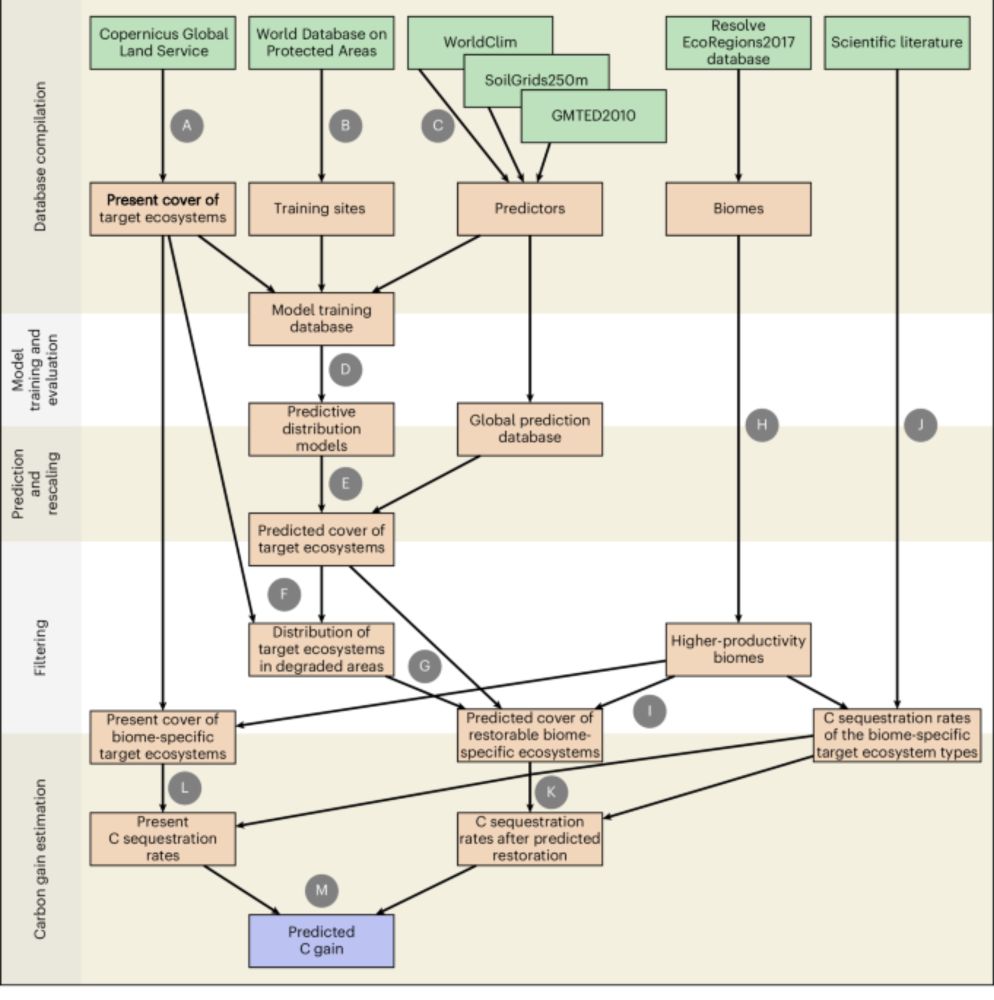
Limited carbon sequestration potential from global ecosystem restoration - Nature Geoscience
The maximum carbon sequestration potential from global terrestrial ecosystem restoration efforts until 2100 is 96.9 Gt, which is equivalent to 3.7–12.0% of anthropogenic emissions until then, accordin...
This paper is getting attention for suggesting ecosystem restoration won't help with mitigation, but restoration is still *critical* for adaptation.
Restoring coastal wetlands helps reduce risks from sea level rise and hurricanes, restoring urban forests helps reduce risks from extreme heat, etc...
01.08.2025 19:03
👍 71
🔁 35
💬 3
📌 1
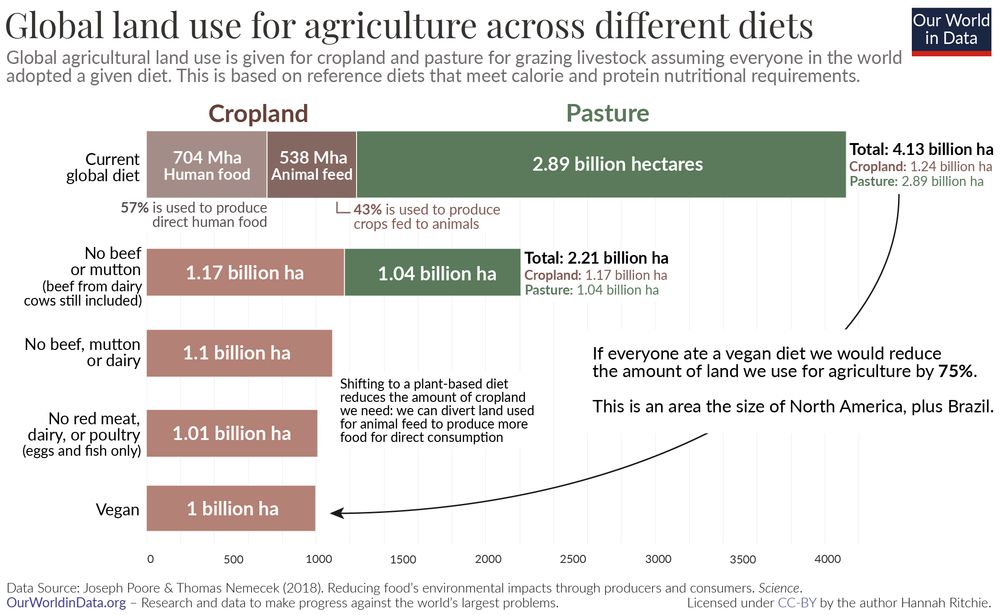
Half of the world’s habitable land is used for agriculture, with most of this used to raise livestock for dairy and meat.
How much would our agricultural land use decline if the world adopted a plant-based diet?
18.06.2025 11:01
👍 163
🔁 71
💬 8
📌 11
Standardizes CO2 fluxes at fixed PAR values — flux_lrc
Calculates light response curves for CO2 fluxes and
standardizes CO2 fluxes according to the LRC
fluxible v1.2.3 (dev)
flux_lrc: standardizes CO2 fluxes at fixed PAR values with light response curves
Experimental, feedback more than welcome!
@btwnthefjords-uib.bsky.social @hilaryrosed.bsky.social @jonastrepel.bsky.social @martabaumane.bsky.social #rstats #ecosystemgasfluxes #carbonfluxes
13.06.2025 08:17
👍 5
🔁 2
💬 0
📌 0

The illustrations from top to bottom show ocean soundscapes from before the industrial revolution that were largely composed of sounds from geological (geophony) and biological sources (biophony), with minor contributions from human sources (anthrophony), to the present Anthropocene oceans, where anthropogenic noise and reduced biophony owing to the depleted abundance of marine animals and healthy habitats have led to impacts on marine animals. These impacts range from behavioral and physiological to, in extreme cases, death. As human activities in the ocean continue to increase, management options need be deployed to prevent these impacts from growing under a “business-as-usual” scenario and instead lead to well-managed soundscapes in a future, healthy ocean. AUV, autonomous underwater vehicle.
A 2021 #ScienceReview showed how the rapidly changing soundscape of modern oceans impacts marine life globally—and how mitigating these impacts is key to achieving a healthier ocean.
Learn more on #WorldOceansDay: scim.ag/4jFFb8V
08.06.2025 14:07
👍 104
🔁 34
💬 1
📌 2
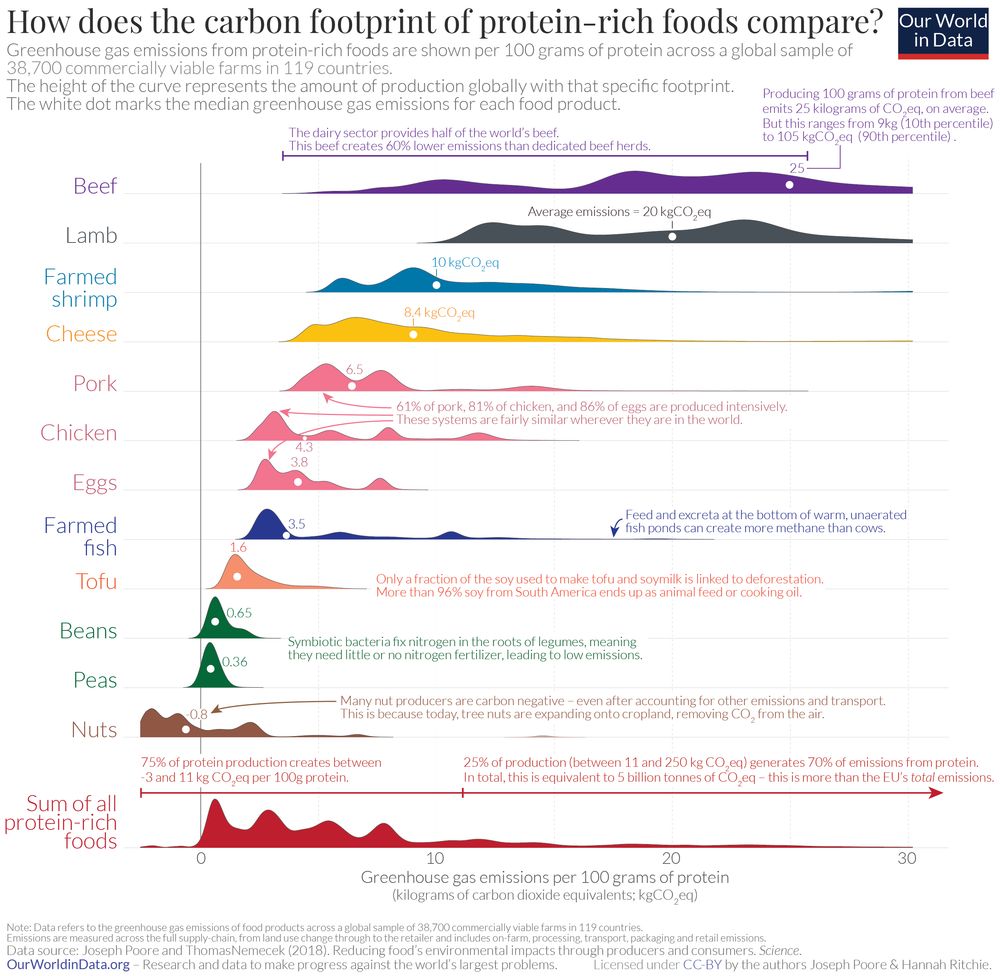
A graph comparing the greenhouse gas emissions of various protein-rich foods, measured in kilograms of carbon dioxide equivalents (kgCO2 eq) per 100 grams of protein. The chart features colorful curves representing different food items, with the height of each curve indicating the level of emissions associated with its production.
The bottom line is that plant-based protein sources still have a lower footprint than the lowest-impact meat products.
Sources are credited to Joseph Poore and Thomas Nemecek (2018) for the data and Our World in Data for the visualization
If you want to reduce the carbon footprint of your diet, less meat is nearly always better than sustainable meat.
13.05.2025 18:24
👍 197
🔁 74
💬 5
📌 12


