

🚨DISASTER BRITAIN! 🚨
40% off select books on privatisation, securitisation, neoliberalism and decay.
www.plutobooks.com/disaster-bri...
28.02.2026 09:20
👍 3
🔁 1
💬 0
📌 0
🚨DISASTER BRITAIN! 🚨
40% off select books on privatisation, securitisation, neoliberalism and decay.
www.plutobooks.com/disaster-bri...

As borders multiply, so too must resistance.
This reading list is an invitation to imagine a world beyond the violence of borders, and organize for a future where people are free to move: www.plutobooks.com/abolish-the-border-regime-a-reading-list/

"The power of the Glasgow welcome has not diminished"
An uplifting piece on hope and community 🧡
www.theguardian.com/uk-news/2026...

Thanks to everyone who has helped make this a great year for @areajournal.bsky.social! Authors, reviewers, and our intrepid managing editor!
Cc
@jonnydarling.bsky.social

A graphic showing the title page of Area on a black background with a large 'A' on the right hand page. On the left hand page are seven tiles with the names of papers in a Special Section titled 'Gender and Rewilding'. The papers are: 1) Gender and Rewilding: Introduction to the Special Section Nadia Bartolini 2) Rewilding: An emotional nature Sophie Wynne-Jones 3) Gendered, embodied knowledge within a Welsh agricultural context and the importance of listening to farmers in the rewilding debate Ffion Jones 4) Rewilding, gender and the transformation of the Côa Valley Nadia Bartolini, Bárbara Carvalho, Sarah May 5) ‘A canary is supposed to sit in a cage and look at someone else's happiness’: Domestic rewilding in fin-de-siècle St Petersburg Olga Petri 6) The politics of rewilding through an ecofeminist lens Sherilyn MacGregor 7) Rewilding Gender: Towards Relational Understandings of ‘the Wild’ Kim Ward

A graphic showing the title page of Area on a black background with a large 'A' on the right hand page. On the left hand page are nine tiles with the names of papers in the issue. The papers are: 1) Unravelling uneven livelihood transformations in China's multi-ethnic Southeast Asian borderland: Perspectives from spatial interactions Xiaobo Hua, Renshan Luo 2) Milk from the farm, the factory and the future: An ecofeminist reflection on Aotearoa New Zealand's dairy sector Milena Bojovic 3) Research methods for legal geography Francesco Chiodelli 4) Changing jobs, changing landscapes: Do land use patterns reflect occupational shifts? Armina Aktara, Manash Jyoti Bhuyan 5) Displaced attention: Bergson, attentive habits and Tony Conrad's drone music George Burdon 6) What does geography look like? Robert Shaw 7) Multispecies placemaking: Tibetan pastoralist perceptions of the COVID-19 pandemic Tsering Bum, Shuling Cheng 8) A mixed-methods approach to researching extreme heat: Insights from urban Ghana Katherine V. Gough, Ben M. Roberts, Ebenezer Forkuo Amankwaa, Karim Abdullah, Samuel Nii Ardey Codjoe, Ronald Reagan Gyimah, Raymond Kasei, Kevin J. Lomas, Frederick Wireko Manu, Peter Mensah, Eftychia Spentzou, Robert L. Wilby 9) Climate change sensing across work and home: A research diary experiment Febe De Geest, Carolina Contreras, Todd Denham, Patrick Bonney, Ashleigh Stokes, Blanche Verlie, Oluwadunsin Ajulo, Lauren Rickards

A graphic showing the title page of Area on a black background with a large 'A' on the right hand page. On the left hand page are eight tiles with the names of papers in a Special Section titled 'Participatory historical geographies'. The papers are: 1) Participatory historical geographies: Introduction Ruth Slatter, Edward Brookes 2) The Victoria County History and participatory historical geography Ruth Slatter 3) Mapping entangled mobilities: Using participatory historical geography to explore the migration of objects and people across (neo)colonial spatialities Sarah Linn, Jina Lee, Mariam Zorba, Caitlin Nunn, Jennifer Cromwell 4) Dancing in the archive: Bodily encounters, memory, and more-than-representational participatory historical geographies Lucy Thompson 5) Youth-led theatre for climate resilience and action at COP26 Kate Smith, Briony McDonagh, Sukhmandeep Dhillon 6) Participatory collaborations between geographers and performance artists: Taking urban renewal histories to the street Aled Singleton, Edward Brookes, Ruth Slatter 7) Watery archives: Reflections on doing participatory archival research for climate action and audience engagement Hannah Worthen, Claire Weatherall 8) ‘A series of abject failures’: Navigating the pitfalls of place-based participatory histories Juliette Desportes

A graphic showing the title page of Area on a black background with a large 'A' on the right hand page. On the left hand page are five tiles with the names three commentaries and two 'Ethics in/or geographical research' papers. The papers are: 1) ‘Good farming’ in a polycrisis: What could arts-led research offer? Agatha Herman, Liz Roberts 2) Reflecting on the restless volumetric place (re)naming race Sergei Basik 3) The architecture of whiteness Rhianna Garrett 4) Ethical mediation: Navigating research ethics and frictions in overseas fieldwork Sandra Hiari, Maiss Razem 5) Questions of power and ethics: Doing feminist research in methodological contexts that let the body lead Gabriel Baker
📢December Issue of Area📢
This issue features Special Sections on 'Gender & Rewilding' and 'Participatory Historical Geographies' alongside papers on topics from Tibetan pastoralist perceptions of the pandemic to research methods for legal geography ⬇️
rgs-ibg.onlinelibrary.wiley.com/toc/14754762...

Spoke to Greek newspaper @tovimagr.bsky.social about #UK asylum and immigration proposals and how they may impact non-citizens already in the UK
tovima.com/world/reforms-will-make-peoples-lives-miserable-academic-warns-as-uk-moves-toward-new-asylum-model/

Cover of Occupied Refuge: Humanitarian Colonization and the Camp in Kenya by Hanno Brankamp. The cover features a black-and-white photograph of a refugee camp with small structures that have corrugated metal roofs. In the foreground, a dirt ground stretches across the image with people walking, sitting, and standing near a vehicle. A vertical yellow line runs from top to bottom, dividing the composition. The title and subtitle appear in white text on the left side of the cover, with the author's name at the bottom right.
In "Occupied Refuge," @hannobrankamp.bsky.social challenges the view of refugee camps as indispensable safe havens, showing that humanitarian missions often function as militarized occupations that treat camp inhabitants as colonized subjects. Read the intro for free now: buff.ly/IwyWW8p

People who have been recognised as needing humanitarian protection will be under constant review.

Commentary on govt proposals to further restrict refugee protection, expand removals, and limit support. Talking tough will not fix govt failures on asylum, but it will hinder integration, cause harm, and further drive resentment towards those seeking protection theconversation.com/uk-to-overha...

Screenshot of a paper abstract in Transactions by Anna Pearce (2025) entitled: 'Asylum as Artifice: Race, Law and Capital as Regimes of Abstraction in the United Kingdom's Asylum Accommodation System' with a red banner at the top. Taking as its case study the category of the ‘asylum seeker’ in UK law, this paper develops on latent concerns in legal geographies with processes of abstraction. Following Bhandar and Toscano, race, law and capital are here understood as different, co-articulating modalities of abstraction, through which the ‘asylum seeker’ is constituted and reconstituted by spatial practice and law over time. The case study charts the history of the category in UK law with the corresponding developments in the material and spatial infrastructures of asylum accommodation, from the point at which the ‘asylum seeker’ was first codified in UK law in 1993 to the delegitimisation of asylum itself in the Nationality and Borders Act 2022 and the Illegal Migration Act 2023. As well as providing the application of Bhandar and Toscano's innovative methodology to a new empirical area, I further make the case that, as well as functioning as organisational nodes for race and capital, legal objects may also serve as conduits. In this way, these differing regimes of abstraction are put into mutually influential relationships with one another, with particularly concerning implications for the independence of law from capital. Though the case study and its legislative context are necessarily narrow in order to properly trace the contours of this particular legal object, the potential application of the theoretical arguments developed from this tight focus is broad, contributing to studies of immigration law, asylum reception and processing, as well as legal geographies more widely.
New in TIBG:
'Asylum as artifice: Race, law and capital as regimes of abstractions in the United Kingdom's asylum accommodation system' by Anna Pearce
This paper charts the history of the category of 'asylum seeker' from 1993 to 2023.
doi.org/10.1111/tran...

Timely and critical Home Affairs Committee report on asylum accommodation noting failures over costs, safeguarding, and conditions. Disappointing the report stops short of proposing an overhaul and remains accepting of mass accommodation sites as a feasible model: www.theguardian.com/uk-news/2025...

This plan for housing is:
- Better for people seeking asylum
- Better for wider communities
- Cheaper for the taxpayer
Let’s use public money to buy quality homes for all people in our communities – not to fill the pockets of the mega wealthy.
https://www.bbc.co.uk/news/articles/cdx4rrrvg8do

A graphic showing the title page of Area on a black background with a large 'A' on the right hand page. On the left hand page are seven tiles with the names of papers in a Special Section titled 'Gentle Geographies', and an editorial. The papers are: 1) Areas of opportunity Jeremy J. Schmidt, Mary Lawhon, Jonathan Darling, Eli D. Lazarus 2) Editorial: Towards more gentle geographies: Narrating a virtue turn, and possibilities for multi-tonal politics of activism and academic labour Matt Finn, Jayne M. Jeffries 3) The quiet politics and gentle literary activism behind the battle for Utah’s Bears Ears National Monument Laura Smith 4) Power in numbers/Power and numbers: Gentle data activism as strategic collaboration Jonathan Cinnamon 5) For diffident geographies and modest activisms: Questioning the ANYTHING-BUT-GENTLE academy John Horton 6) Treading carefully through tomatoes: Embodying a gentle methodological approach Laura Pottinger 7) CoPSE: A methodological intervention towards gentle more-than-human relations Suzanne Hocknell

A graphic showing the title page of Area on a black background with a large 'A' on the right hand page. On the left hand page are eight tiles with the names of papers in the issue. The papers are: 1) ‘What is visible… and what isn't’: A public art intervention for re-imagining the food system Ekaterina Gladkova, Naho Matsuda 2) Reimagining the streetscapes of Varanasi city: Public art, urban regeneration and smart city practices Iman Banerjee, Amrita Bajaj, Apala Saha 3) It takes a team to participate – Refining working participant observations through multiple researchers Maria Thulemark, Susanna Heldt-Cassel, Tara Duncan 4) Right-sizing the smart city in Southeast Asia Prerona Das, Orlando Woods, Lily Kong 5) The role of virtual field trips in Geography higher education: A perspective paper Elizabeth R. Hurrell, Simon M. Hutchinson, Lynda Yorke, Lesley C. Batty, M. Jane Bunting, Dan Swanton, Derek A. McDougall, Daniel R. Parsons 6) Is the spatial persistence of deprivation dependent on neighbouring areas? Stephen D. Clark, Fran Pontin, Paul Norman 7) ‘Backward geographies’: Contested lives and livelihoods in the tea plantation enclaves of South Asia Suranjan Majumder 8) On the forms of borderwork in public institutions: Bordering social security through conditions and tests Kathryn Cassidy, Gill Davidson 9) Navigating inequalities and shaping aspirations: The role of supplementary education in low-income immigrant youth's transition to selective secondary school Lara Landolt

A graphic showing the title page of Area on a black background with a large 'A' on the right hand page. On the left hand page are nine tiles with the names of papers in a Special Section titled 'Open Access Book Publishing: A Forum for Debate' and three 'Ethics in/of Geographical Research' papers. The papers are: 1) ‘The city is not for us’: Ethics, everyday sexism, and negotiating unwanted encounters during fieldwork Morag Rose 2) Participation, inclusion and reflexivity in multi-step (focus) group discussions Marina Korzenevica, Engdasew Feleke Lemma, Catherine Fallon Grasham, Khonker Taskin Anmol, Daniel Ekai Esukuku, Fahreen Hossain, Mercy Mbithe Musyoka, Saskia Nowicki, Dalmas Ochieng Omia, Salome A. Bukachi 3) The ‘creative thesis’ in the academic ‘anxiety machine’ Angela Last 4) Against book enclosures: Moving towards more diverse, humane and accessible book publishing Simon P. J. Batterbury, Andrea E. Pia, Gerda Wielander, Nicholas Loubere 5) Uneven geographies of power in UK higher education's conjunctural crisis: A response to Gandy Julie Cupples 6) Beyond open access: Book publishing in a metric culture Clancy Wilmott 7) Gandy & 'Books under threat': A response Frank Houghton 8) Challenges and opportunities for open access book publishing: A perspective from a society publisher in the geosciences Jenny Lunn, Kate Lajtha 9) Ex Libris: Books, creativity and academic freedom Matthew Gandy
📢September Issue of Area📢
Our latest issue features an editorial from our new team, a Special Section on 'Gentle Geographies', and a discussion forum on #OpenAccess book publishing.
Available to read here ⬇️
rgs-ibg.onlinelibrary.wiley.com/toc/14754762...

Photo of a pile of books. The books are 'Debt Trap Nation' by Katherine Brickell and Mel Nowicki. Cover image features a woman and small child in a deep concrete basin or pit with no way of climbing out as the ladder is too short.
Just arrived:
Debt Trap Nation
by @kbrickell.bsky.social & Mel Nowicki
“A compelling call to action... shows how reimagining policy could deliver economic justice.” - @nicolajanesharp.bsky.social
Author royalties will be donated to @seacharity.bsky.social
www.agendapub.com/page/detail/...
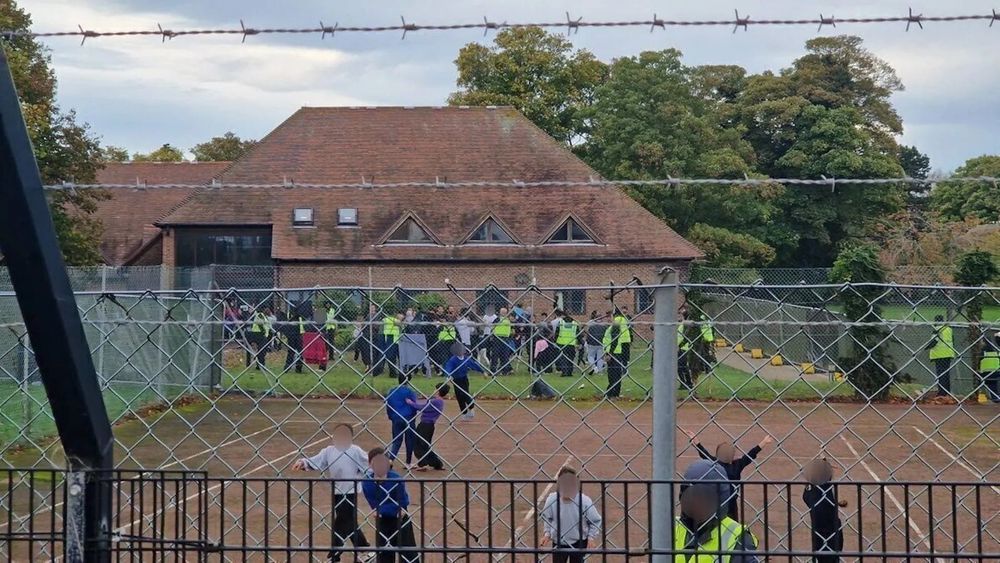
The last Government's failed experiment in asylum camps cost the taxpayer millions, all while traumatising and isolating torture survivors.
Now, Keir Starmer wants to return to this cruel and wasteful plan.
We can't go back.
#CommunitiesNotCamps
Read @jonnydarling.bsky.social's latest thoughts on #asylum housing, from @theconversation.com
@geogdurham.bsky.social

Commentary on asylum hotels considering how govt can develop dignified community-based housing that meets multiple social needs. Warehousing people in camps and continuing a failed experiment in privatisation causes nothing but further harm @geogdurham.bsky.social theconversation.com/after-the-ep...
Great stuff! Congratulations Jeremy!

It shouldn't need saying that 'military and industrial sites' are not, and never have been, 'more appropriate sites' for asylum seekers. The record of such carceral accommodation is nothing but spectacles of harm designed to appease a desire to punish refugees. www.theguardian.com/politics/liv...

rgs-ibg.onlinelibrary.wiley.com/doi/10.1111/...
Really happy to see this out "Theorising legal gaps geographically: Exploring the transition from asylum seeker to refugee in the UK"
Happy to share this piece on ethnography in political science:
doi.org/10.1017/S153...

These comments build on a recent @theconversation.com piece looking at how the UK has become reliant on hotels to accommodate asylum seekers and what can be done to fix a failing accommodation system: theconversation.com/how-the-uk-b...

I was on BBC’s AntiSocial at the end of last week discussing the growth of asylum hotels in Britain, the history of dispersal, and the importance of community-based housing for asylum seekers (at the 40min mark) @geogdurham.bsky.social @durham-university.bsky.social www.bbc.co.uk/sounds/play/...

Perfectly timed for summer reading, new book from two of my wonderful @geogdurham.bsky.social colleagues: @ajsecor.bsky.social and @benandersongeog.bsky.social. Also perfectly timed for navigating the turbulent cultural politics of the present (coffee strictly optional) @goldsmithspress.bsky.social

Important new book! Immigration Detention Inc. The Big Business of Locking up Migrants
by @nancyhiemstra.bsky.social and @drdconlon.bsky.social Buy it here: www.plutobooks.com/978074534946...
Read more from @jonnydarling.bsky.social on asylum hotels & carceral hospitality in his recently co-authored Transactions paper: doi.org/10.1111/tran... #geosky

A graphic showing the title page of Area on a black background with a large 'A' on the right hand page. On the left hand page are seven tiles with the names of papers in a Special Section titled 'Rivers as Borders'. The papers are: 1) Rivers as borders? Navigating in-between the tensions of water-state-society geographies Rebekka Kanesu, Vanessa Lamb, Eva McGrath 2) Median line: A century of border violence and the alluvial geopolitics of the Evros/Meriç/Maritsa River border Ifor Duncan, Stefanos Levidis 3) Slow violence on the Yarmouk River: Encounters from the river-border environments Muna Dajani 4) Migrating sands: Refocusing transboundary flows from water to sediment C. R. Hackney 5) Crossing riverborderscapes and a view from in-between: Passenger ferries in South West England Eva McGrath, Richard Yarwood, Nichola Harmer 6) Liquid lines: Exploring the Moselle River between France, Luxembourg and Germany Rebekka Kanesu 7) Caring for the river-border: Struggles and opportunities along the Salween River-border Vanessa Lamb

A graphic showing the title page of Area on a black background with a large 'A' on the right hand page. On the left hand page are eight tiles with the names of papers in the issue. The papers are: 1) On undevelopment and de-development: A geographical critique on perpetual growth and resource-based accumulation Gertjan Wijburg 2) Place, institutional spatiality, and the localisation of financial calculative practices Leqian Yu 3) Claim-making in hydrosocial spaces: The temporality of displacement around Kenya's Masinga Dam reservoir Arne Rieber, Benson Nyaga 4) Deliberative approaches to the climate crisis: Adapting Climathons for rural communities Philippa Simmonds, Damian Maye, Julie Ingram, Abigail Gardner, Sofia Raseta 5) Ethnographic fingerprints: Examining co-participation, positionality, and interpersonal relationships in diary method Julius Baker 6) A whole island approach to scoping renewable energy sites and yields Ben Watt, Robert L. Wilby 7) Past, present, future: The RGS-IBG political geography research group within British political geography Daniel Hammett 8) Visualising an undergraduate geography field class using generative AI: Intent, expectations and surprises about the racial depiction of students Terence Day, James Esson
📢June Issue of Area📢
This latest issue pulls together the fully #OpenAccess 'Rivers as Borders' Special Section alongside papers on topics including de-development, AI, and diary methods.
Read all the papers here: rgs-ibg.onlinelibrary.wiley.com/toc/14754762... #geosky
A short piece from me looking at the politics of 'asylum hotels' in Britain and the challenges for government in finding alternatives @geogdurham.bsky.social

