Excited to be in Cardiff this week to present at the Welsh Aesthetics Forum. I'll be talking about how we can aesthetically appreciate our own epistemic agency, how artworks can help us do this, and how this might (or might not!) boost our cognitive powers. @cardiffphilosophy.bsky.social #philsky
24.11.2025 11:28
👍 5
🔁 1
💬 0
📌 0
![[E]ven if Shakespeare could not intend to tell us anything specific about the 2016 election, he has tried and non-accidentally succeeded in providing us with prompts that can be applied to topics that, by their very nature, resonate widely in subjects far beyond those his plays address. In order to work out just what the magnitude of Shakespeare’s cognitive achievement is with respect to these themes, we have to test just how far this resonance goes, which involves exploring specific political subjects in the wider world.
- Christopher Earley, Co-Producing Art's Cognitive Value](https://cdn.bsky.app/img/feed_thumbnail/plain/did:plc:chsp27b6x6v5fyeqzazfpspx/bafkreibikdwiit5rjbj72ywxotdwtnvsegx4x5avz7tp764edjldn5er54@jpeg)
[E]ven if Shakespeare could not intend to tell us anything specific about the 2016 election, he has tried and non-accidentally succeeded in providing us with prompts that can be applied to topics that, by their very nature, resonate widely in subjects far beyond those his plays address. In order to work out just what the magnitude of Shakespeare’s cognitive achievement is with respect to these themes, we have to test just how far this resonance goes, which involves exploring specific political subjects in the wider world.
- Christopher Earley, Co-Producing Art's Cognitive Value
Chris Earley defends a collaborative account of an artwork's epistemic value in our brand new issue. doi.org/10.1093/aest... #philsky
06.11.2025 20:16
👍 4
🔁 2
💬 0
📌 0
This article is the first step in a larger project in which I try to meld insights from aesthetics and social epistemology in order to improve our understanding of how we can learn from art and what this can tell us about collaborative inquiry at large. Stay tuned for more…!
05.11.2025 10:19
👍 2
🔁 0
💬 0
📌 0
There are lots of problems I try to solve along the way, such as questions about how credit should be allocated between the parties and what to do when you aren't sure exactly which topics an artist is trying to investigate. But you'll have to look at the full paper to see how I solve these 🤓.
05.11.2025 10:19
👍 0
🔁 0
💬 1
📌 0
I also argue that artworks regularly invite audiences to collaborate with them by providing open-ended 'prompts' such as questions, ambiguities, or hypotheses that motivate us to investigate a topic for ourselves.
05.11.2025 10:19
👍 0
🔁 0
💬 1
📌 0
I argue against this line of criticism. I propose that what is actually happening is that Greenblatt and Shakespeare are collaborating together, both parties providing the necessary intellectual labour which helps to bring about a shared epistemic achievement.
05.11.2025 10:19
👍 0
🔁 0
💬 1
📌 0
To some cognitivists, Greenblatt's proposal looks very odd. Since Shakespeare knew nothing of the 2016 election, he can’t be credited with giving us any particular insight into this event. Rather, Greenblatt is reporting on his own intellectual achievements, not Shakespeare's.
05.11.2025 10:19
👍 0
🔁 0
💬 1
📌 0
Within the philosophy of art, aesthetic cognitivists are particularly interested in these sorts of claims. They try to understand how we learn from art, what we learn from it, and why learning seems to something that many audiences think is integral to the value of art.
05.11.2025 10:19
👍 0
🔁 0
💬 1
📌 0
This sort of claim isn’t unusual. In fact, you may even think that this is what makes Shakespeare so great. His artworks can still help us understand what is going on, even though Shakespeare couldn't have known what would happen in 2016 in a country that didn't even exist in his own time.
05.11.2025 10:19
👍 0
🔁 0
💬 1
📌 0

Opinion | Shakespeare Explains the 2016 Election (Published 2016)
The starting point for this paper was my reflection on a claim made by the Renaissance scholar Stephen Greenblatt: we can learn important things about the 2016 US Presidential election by reading Shakespeare’s Richard III.
www.nytimes.com/2016/10/09/o...
05.11.2025 10:19
👍 0
🔁 0
💬 1
📌 0

Co-Producing Art’s Cognitive Value
Abstract. After viewing a painting, reading a novel, or seeing a film, audiences often feel that they improve their cognitive standing on the world beyond
This article has now been published! academic.oup.com/bjaesthetics...
My paper argues that to learn from art, audiences often have to collaborate with artists and that responding to art in epistemically creative ways reveals what makes an artwork artistically valuable. #philsky #philosophy
🧵:
05.11.2025 10:19
👍 4
🔁 0
💬 1
📌 0

Heading to @ox.ac.uk for the British Society of Aesthetics annual conference. I’ll be talking about how aesthetics can help us grasp the meaning (or meaninglessness) of our place in the history. @britaesthetics.bsky.social #philsky #philosophyofhistory #philosophy
12.09.2025 07:32
👍 5
🔁 1
💬 0
📌 0
Submissions – Debates in Aesthetics
Deadline January 9th 2026. All submissions (or any further questions) should be sent to editor@debatesinaesthetics.org. Full submission guidelines available here: debatesinaesthetics.org/submissions/.
10.09.2025 16:36
👍 0
🔁 0
💬 0
📌 0
News – Debates in Aesthetics
📣 CFP – DEBATES IN AESTHETICS GENERAL ISSUE 📣 We are currently accepting articles (3,000-3,500 words) on any topic in philosophical aesthetics, proposals for interviews with people working in aesthetics (500 words), and book reviews (1,000-1,500) words. debatesinaesthetics.org/news/ #philsky
10.09.2025 16:36
👍 4
🔁 3
💬 1
📌 0

View from the new office. I have no problem with this. @schoolofppls.bsky.social
02.09.2025 07:57
👍 2
🔁 0
💬 0
📌 0
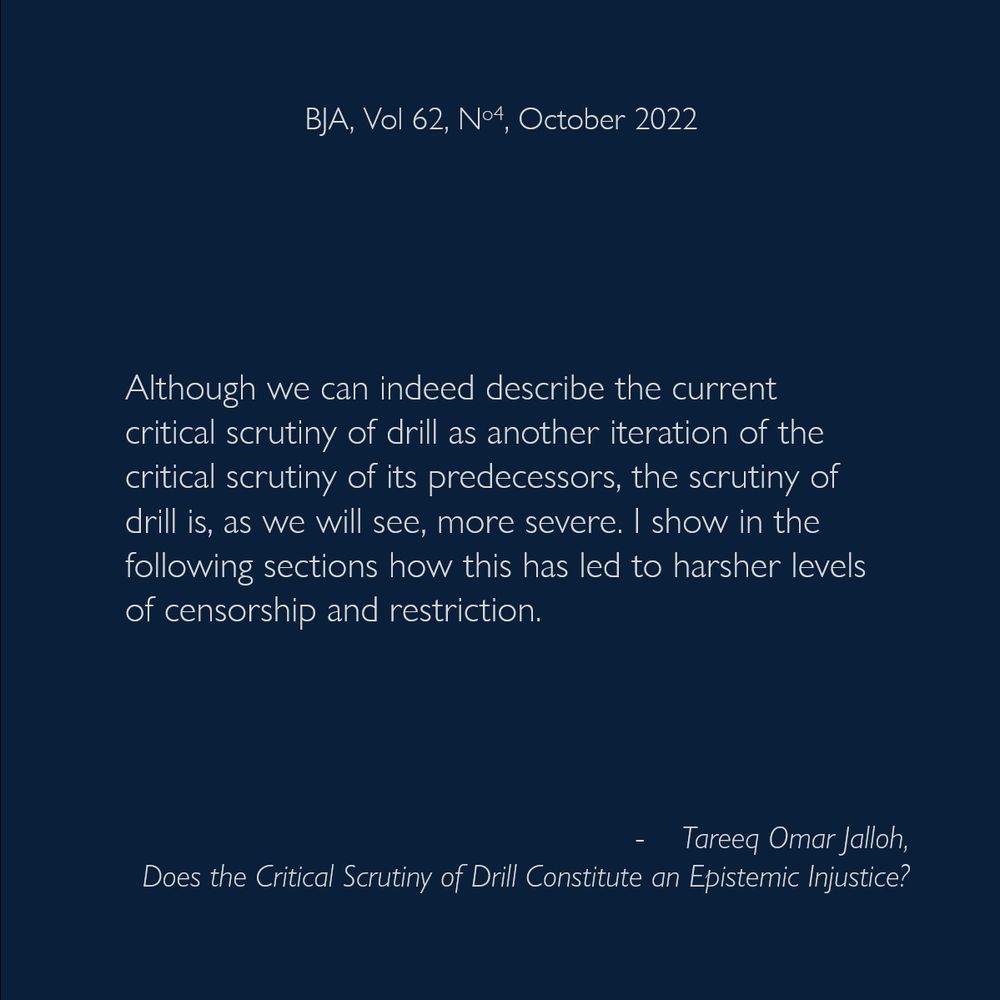
Although we can indeed describe the current critical scrutiny of drill as another iteration of the critical scrutiny of its predecessors, the scrutiny of drill is, as we will see, more severe. I show in the following sections how this has led to harsher levels of censorship and restriction.
- Tareeq Omar Jalloh, Does the Critical Scrutiny of Drill Constitute an Epistemic Injustice?
The BSA's Postdoctoral Fellowship winner for this year is Tareeq Jalloh. Read his article from our October 2022 issue on the relationship between drill music and epistemic injustice. doi.org/10.1093/aest... #philpapers
25.07.2025 08:08
👍 9
🔁 4
💬 1
📌 1
Philosophers tempted to design and play games and make art!
New call for papers: think.taylorandfranc... Philosophy through Art, Games, and Fiction. Deadline: 31 July 2026.
Submit your work! What a lovely way to honour our editorial board member Helen De Cruz who was a philosopher, a musician, an artist, and a fiction writer! #philsky
08.07.2025 16:22
👍 50
🔁 33
💬 0
📌 2

Had a wonderful time in Barcelona presenting this paper co-authored with Hans Maes. It's the first part of a larger project we're working on in which we're trying to work out what philosophers can do to help artists create art. #philsky
24.06.2025 08:53
👍 1
🔁 0
💬 0
📌 0
![[W]hen an artist confronts us with a prompt that makes a decisive contribution to an audience’s ability to achieve insight in their shared project of enquiry, they are also due a share of credit for co-producing this cognitive achievement.
- Christopher Earley, Co-Producing Art’s Cognitive Value](https://cdn.bsky.app/img/feed_thumbnail/plain/did:plc:chsp27b6x6v5fyeqzazfpspx/bafkreicvpvmklwdiongicufr7yvgt35d4hs6kgrgdk6ullj3pmhkupl6om@jpeg)
[W]hen an artist confronts us with a prompt that makes a decisive contribution to an audience’s ability to achieve insight in their shared project of enquiry, they are also due a share of credit for co-producing this cognitive achievement.
- Christopher Earley, Co-Producing Art’s Cognitive Value
In this advance article, Chris Earley defends the collaborative cognitive achievements that artworks make possible. #philsky doi.org/10.1093/aest...
23.06.2025 20:42
👍 5
🔁 5
💬 0
📌 0
Thanks Alex!
10.06.2025 07:29
👍 0
🔁 0
💬 0
📌 0
I'm very grateful for all the support I've received from the British Society of Aesthetics @britaesthetics.bsky.social and Vid Simoniti @vidsimoniti.bsky.social during my fellowship at The University of Liverpool. Excited to see what's next...
10.06.2025 07:19
👍 3
🔁 0
💬 1
📌 0
Happy to say that, as of September, I will be joining the University of Edinburgh as a Leverhulme Early Career Fellow. I will be investigating what social epistemology can tell us about art and what art can reveal about social epistemology. @leverhulme.ac.uk @schoolofppls.bsky.social #philsky
10.06.2025 07:19
👍 9
🔁 1
💬 1
📌 0


Great day of talks at the Crossroads between Arts and Politics conference at Università del Piedmonte Orientale. I presented some work on why the arts are great place to try out weird approaches to inquiry. It was weird and wild.
05.06.2025 17:35
👍 0
🔁 0
💬 0
📌 0

Christopher Earley, Co-Producing Art's Cognitive Value - PhilPapers
After viewing a painting, reading a novel, or seeing a film, audiences often feel that they improve their cognitive standing on the world beyond the canvas, page, or screen. To learn ...
Kicking off here with a few recent pieces of writing. 🧐 First, an article forthcoming in the British Journal of Aesthetics @britjaesth.bsky.social in which I argue that learning from art often takes the form of collaborative inquiry between artist and audience: philpapers.org/rec/EARCAC-7 #philsky
30.05.2025 11:17
👍 13
🔁 3
💬 1
📌 0