

Our TREE paper is now out in its final published form! Well done @yoricklambreghts.com for leading this and doing the heavy lifting! DM him for a PDF. @cellpress.bsky.social
04.03.2026 03:00
👍 15
🔁 5
💬 1
📌 0

@lizardlab
Professor of Animal Behaviour. Posts mostly about The Lizard Lab - research group investigating behaviour, ecology, evolution of lizards (mostly). https://whitinglab.com/ for research, members, photos, blog. All other links: https://linktr.ee/lizard_lab
Our TREE paper is now out in its final published form! Well done @yoricklambreghts.com for leading this and doing the heavy lifting! DM him for a PDF. @cellpress.bsky.social

How and why does cognition vary so greatly between individuals and species? In @natrevbiodiv.nature.com, we propose the "Predatory Intelligence Hypothesis" which posits that the cognitive challenges associated with predator–prey interactions drive a cognitive co-evolutionary arms race
rdcu.be/e5KIj

Top half of front-page of article titled "The prenatal foundations of kin recognition", published in Trends in Ecology and Evolution.
New paper published online in TREE, with @lizardlab.bsky.social, Tobias Uller, Camilla Whittington, and Geoff While! We discuss how prenatal development can influence the emergence of kin recognition and social evolution more broadly. Message me for PDF.
doi.org/10.1016/j.tr...

Our recent paper on lizard societies now online in a special issue of Animal Behaviour. DM if you want me to send you a PDF.

It’s a proud moment when your star exPhD student, now early career researcher, is the senior author on a Biology Letters paper in the same issue of Biology Letters as you. And to be precise, the paper above! @lizabeldm.bsky.social

A huge congrats to Dr Jai Lake! Jai just gave his exit seminar at Macquarie on why lizards are social. To be slightly more precise, his PhD was about the mechanisms underlying sociality. Papers are submitted and in prep! Watch this space. Jai was cosupervised by Geoff While at Univ. Tasmania.

A neat artivle published in Scientific American about a study published by @lizardlab.bsky.social @biodiversityguy.bsky.social
www.scientificamerican.com/article/zoo-...
Check out this NY Times piece on a recent study led by @jameststroud.bsky.social and @jblosos.bsky.social on lizards surviving limb loss. The paper offers a fresh perspective on natural selection and was published in The American Naturalist: www.journals.uchicago.edu/doi/full/10....

‘Pirate Lizards’ Can Get Around on 3 Legs www.nytimes.com/2025/10/21/s...

3-legged lizards can thrive against all odds, challenging assumptions about how evolution works in the wild
theconversation.com/3-legged-liz...

🦎THREAD: We just published something wild in @asn-amnat.bsky.social - lizards missing entire limbs not only survive, but some appear to actually thrive in the wild?!
Let me tell you about the "three-legged pirate" lizards 🏴☠️
[Paper: www.journals.uchicago.edu/doi/10.1086/... ]
(1/n)

Hot off the press! Check out our new paper on sleepy lizard aka shingleback skink fire cue discrimination led by @ecolojolly.bsky.social DM if you want a PDF.

Just out - our review of social learning in reptiles and its implications for animal culture. Part of a special issue on animal culture and conservation in a changing world. Happy to send a PDF if requested.

Our latest superb starling work in @nature.com. We observe long-term reciprocal helping relationships, and suggest reciprocity is an underappreciated mechanism promoting the stability of cooperatively breeding societies. Led by Alexis Earl and @gerrycarter.bsky.social
www.nature.com/articles/s41...

Huge congrats to Jai Lake for submitting his PhD thesis on the mechanisms underpinning social complexity. A huge amount of work - Jai learnt a whole range of new skills in the process. Jai was cosupervised by Geoff While (Uni Tasmania), with help from Dan Hoops + colleagues at Columbia University.

Check out biologists Maddi Holmes and Kathy Potter from @muche-macquarie.bsky.social talking frog science at the Sydney Comedy Festival.
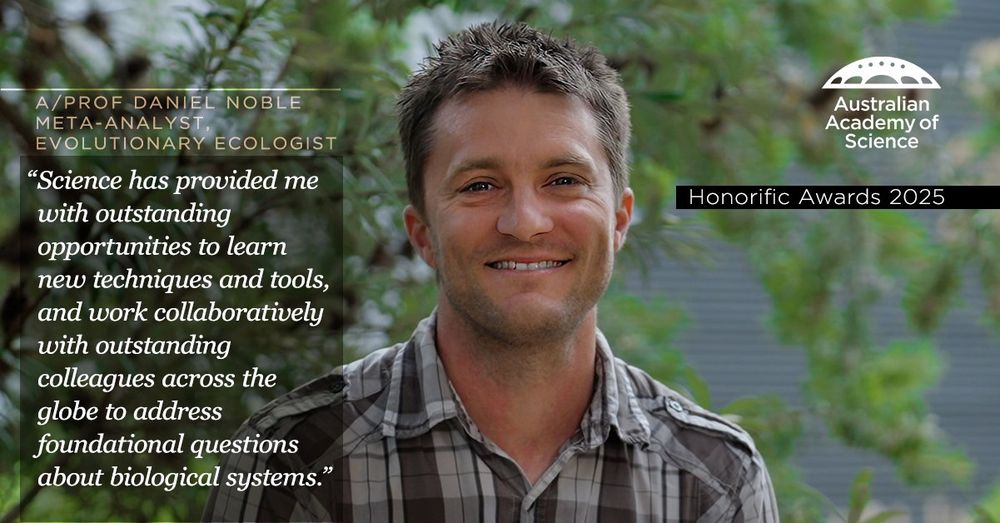
Very happy and humbled to have received this award. A huge thanks to all my wonderful colleagues @scienceanu.bsky.social and abroad who made this possible!
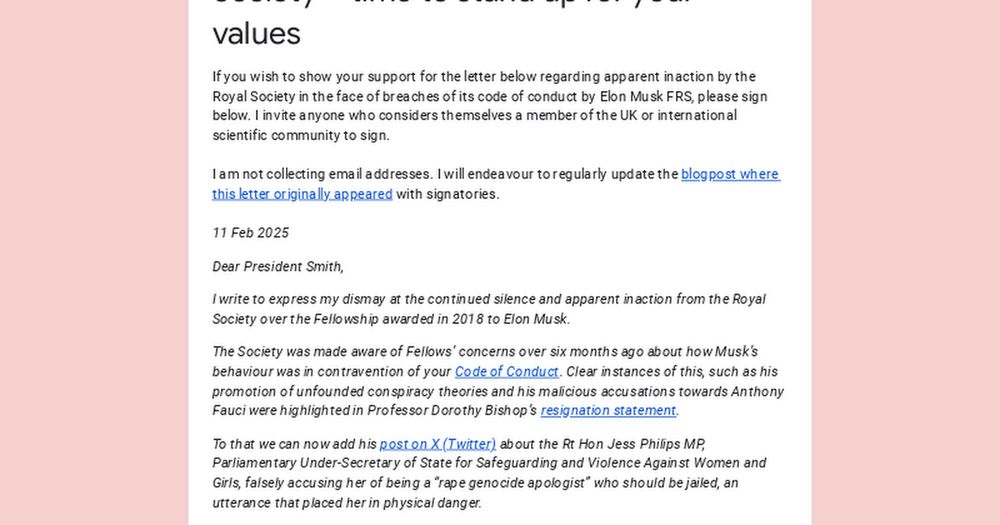
Members of the U.K. and international scientific community are invited to sign to show their support: docs.google.com/forms/d/e/1F...

Public Statement on Recent Attacks on Diversity, Equity, and Inclusion Initiatives On 10 February 2025, the ASIH Executive Committee voted in support of the following statement: 11 February 2025 The Executive Board of the American Society of Ichthyologists and Herpetologists (ASIH) is concerned about recent turmoil at the United States federal governmental agencies established to promote the advancement of science. Many of our members are supported by federal funds in their scientific pursuits, and this funding is paramount for better understanding the diversity of our natural world. Inquiries into amphibians, reptiles, and fishes have resulted in major breakthroughs in the medical industry, serve as models for our understanding of ecological and evolutionary processes, and have even been used to better prepare our armed forces for international conflicts. Federal funding has supported many of these endeavors. While we understand that funding models change over time, we adamantly condemn any model that does not incorporate cooperation between politicians and the greater scientific community. We also condemn any model that does not fairly provide funds to scientific investigators through peer review by experts in the scientific community. The suggested changes in governmental funding practices centered around diversity, equity, and inclusion (DEI) have resulted in confusion amongst members of ASIH, and the greater scientific community. The Executive Board of ASIH fully supports the idea that diversity and inclusivity of the scientific community leads to greater discoveries in ichthyological and herpetological research and ultimately strengthens us as a community of scholars. Similar to DEI initiatives at ASIH, these initiatives at the federal level are designed to foster and protect diversity in STEM education and research. We want to reaffirm our mission and commitment to all of you: ASIH condemns the recent attacks on diversity, equity, and inclusion initia…
Public Statement on Recent Attacks on Diversity, Equity, and Inclusion Initiatives
Sincerely,
the Executive Board of the ASIH (American Society of Ichthyologists and Herpetologists) #TeamFish #TeamHerps #ASIH
www.asih.org/2025-asih-ex...

Charles Darwin was born on this day in 1809. Happy birthday to the architect of natural selection and evolutionary theory - a true legend! Here he is as a youngster. We will be celebrating his birthday in our lab meeting today.
#charlesdarwin #darwin #originofspecies #naturalselection

Ever wondered why some animals are social and others solitary?
I was surprised by the link between animal behaviour and our own social structures
New #EcolClips with @lizardlab.bsky.social
m.youtube.com/watch?v=bfER...
#ecology #biology #animals #behaviour #reptiles #nature #science #australia


To read our first paper about bluey tongue colour, go here: link.springer.com/article/10.1... or message us for a PDF.
#lizard #bluetongue #bluetongueskink #bluetonguelizard #lizardcartoon #cartoon #tiliqua #coloursci
To answer that question we are delving into collaborative projects with nanoparticle engineers and experts in robotics. This phase of the study is being led by Dr. Sergio Naretto. Stay tuned for more exciting results!
They are perhaps best know for their bright blue tongues but read the cartoon — the blue colour we see is not all it appears to be.
The Lizard Lab tackled the question of why the tongue is so brightly coloured, and how that colour is produced.
Part 2
This work was edited and supported by @hudrewthis.bsky.social, an academic in MassArt's new Integrative Sciences and Biological Arts Department.
Blueys are iconic in Australia. They are a particularly large skink, found in both the wild and suburbia, where they face lots of threats.
Check out this amazing cartoon by Meghan Swan (IG: @deadpixelproductions) explaining tongue colour in the Australian blue tongue skink (blueys). It was such a pleasure collaborating on this project, which was part of a course at Massachusetts College of Art and Design.


Huge congrats to recent grads Dr. Victoria Russell and Dr. Yorick Lambreghts cosupervised by me, Geoff While and Erik Wapstra through the University of Tasmania. Both spent substantial time in the Lizard Lab at Macquarie University. Well done!