

Read the full @focaldata.bsky.social blog here:
www.focaldata.com/blog/how-to-...
04.03.2026 09:14
👍 1
🔁 0
💬 0
📌 0
Read the full @focaldata.bsky.social blog here:
www.focaldata.com/blog/how-to-...
Attention spans have collapsed.
So why are some politicians more popular than ever?

We're about to release a piece on the attention crisis gripping young people.
Some pretty shocking stats in it

Overall, inflation and economic concerns are boosting the Democrats by ~2 points, equivalent to an extra 2.5 million votes in November.


Trump approval is now sharply correlated with voters' perceived financial positions, a pattern which holds among his own voters.

In the generic House of Representatives ballot, the Democrats lead by 5 points with registered voters, and 7 with likely voters.

We just released our first US midterms polling of 2026. The main story is a familiar one, that the cost of living is again set to punish the incumbent.
Since 2024, the Democrats' vote margin has increased by double digits with those most concerned about food/gas prices.

Great to see our latest geopolitics white paper written up by the Guardian's dataviz team!
www.theguardian.com/world/ng-int...

The geopolitical centre of gravity is shifting towards China, driven primarily by Europe's increased distance from the US under the Trump II era.
We analysed decades of UN voting data to create a new US-China axis, and found the US advantage is at its lowest level this century.

Over the last month, I've been analysing the results of thousands of UN votes to create a new geopolitical axis.
I was struck by just how severe the Trump effect has been since his second term began. UK-US alignment is now at an all-time low.
Releasing a poll of 143 people, besides all the other issues involved with this particular pollster, is quite the move.
guys...

The drop coincides with immigration and asylum falling down the agenda. 35% now say it's one of the most important issues facing the country, down from 49% in early November.
As we found earlier this year, Farage-led parties typically move in lockstep with migration concern.
Our first voting intention poll of 2026 sees Reform slipping to 26%, down 3 points since late November.
🟣 RFM: 26% (-3)
🔴 LAB: 21% (+1)
🔵 CON: 20% (+2)
🟠 LDM: 14% (+1)
🟢 GRN: 10% (-2)
We (and others) try to account for the fact people say they voted when in reality they didn’t, so we have recalled turnout quotas (~74%) rather than actual (60%). Haven’t yet quantified how much of the Labour gap is explained by this alone though, but suspect it’s around 2 points
Been planning to do a write up on differences between the pollsters. Biggest difference is that FON uses actual 2024 turnout quotas (ie 40% recalled non-voters). Issue is that effectively makes the assumption that social desirability bias doesn’t exist and everyone is telling the truth abt voting

Pleased to say we've just launched a new white paper on digital sovereignty (a phrase we'll probably be hearing more of in the next 12 months).
Download it here:
www.focaldata.com/blog/britain...

GB voting intention results:
🟣 RFM: 28% (-2)
🔴 LAB: 20% (-1)*
🔵 CON: 20% (+1)
🟠 LDM: 13% (-)
🟢 GRN: 10% (+1)
*All-time low
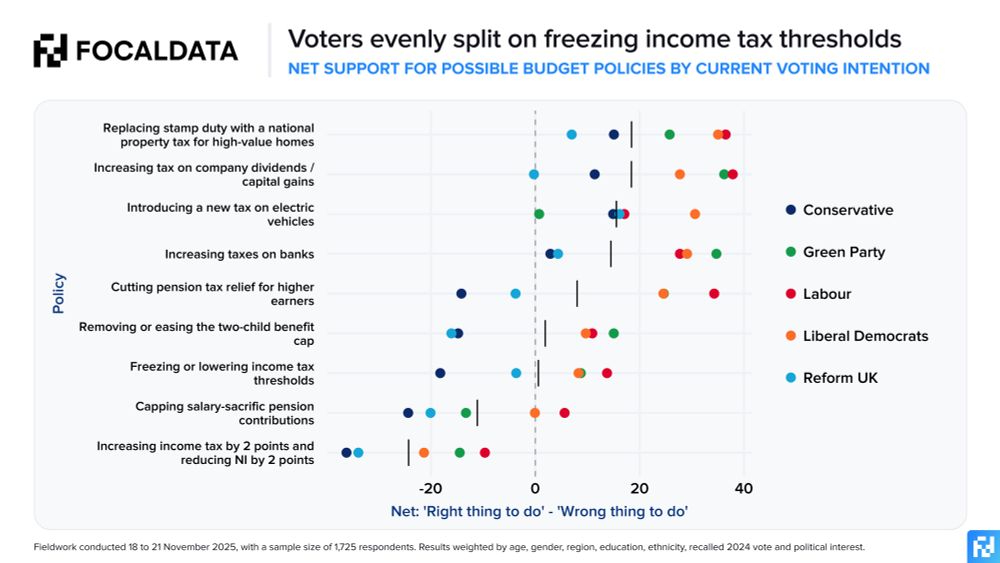
On budget measures, voters are split on whether freezing income tax thresholds and removing the two-child benefit cap are the right thing to do.
Labour, Lib Dem and Green voters narrowly back both measures, but Reform & Conservative supporters are typically opposed.

The result is this... Labour still leads on 31% with those who say they are 'living comfortably', but Reform now dominates with those facing economic hardship with 38% of the vote, with Labour narrowly in fifth place (12%).

On the eve of the Autumn Budget, our latest polling finds that *over half* of 2024 Labour voters who are 'finding it difficult' economically have now switched parties.
17% now back the Greens, and a further 17% back Reform.
🧵

Other interesting findings in the piece: www.focaldata.com/blog/how-to-...

These findings are part of a wider piece of research on climate messaging. We used our new conjoint analysis tool to estimate the effects of messengers, tone and focus on climate messages tailored for 2025.
We found that messengers mattered more than the actual messages...

With COP30 coming to a close today, which party do Brits trust most on climate and energy topics?
Greens are trusted most on core environmental issues, but fare less well on energy policy. Reflects a common issue, that voters aren't sure climate action = better economic outcomes.

Finally, we used a combination of public MRP polls, modelled with our own data and the preferences given above to estimate how the UK would vote under different electoral systems.
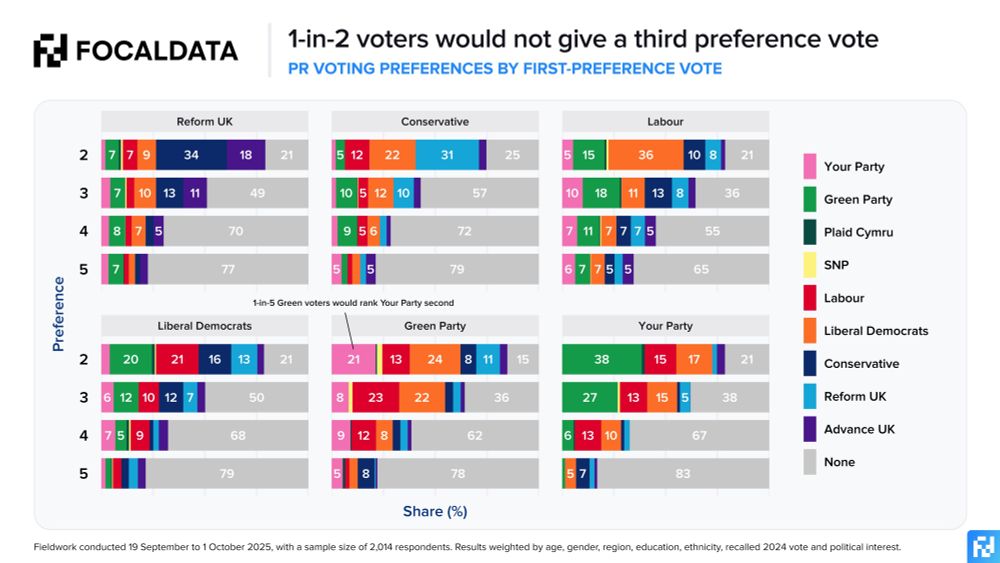
We also asked people to give their ranked ballot preferences under a PR system. Some interesting findings here (almost a quarter of Reform voters would rank Labour, the Lib Dems or Greens second).

Which parties would people be willing to go into coalition with? The public splits into pretty clear left and right blocs...

However, messages against PR are more effective at changing people's minds than those in support. The average anti-PR message reduces support by 3.8 points, whereas the average pro-PR message only increases support by 1.2 points.

In contrast to the Brexit referendum, voters on both sides of the debate more or less want the same things. Being able to vote for your preferred party rather than tactically is the characteristic most selected by supporters of each system.

