Figure 8. A map of some data from "My Green Place", a series of mapped polygons in blue overlapping each other with Green reference data behind it, covering a much larger area. Caption: Example of geometric consistency in the “My Green Place” data: mapped polygons that overlap entirely with the reference data. Background map: OpenStreetMap
New article! Anni Simola and colleagues proposed a quality assessment framework for PPGIS data and test it with three example data sets, comparing it with OpenStreetMap as reference data doi.org/10.1080/1523... #GISchat #OpenAccess
05.03.2026 16:35
👍 1
🔁 1
💬 0
📌 0
New article! Yue Chen and colleagues look at how we can apply continuous multi-scale transformation of building footprints that will be useful in dynamic zooming in web maps, like in the example below doi.org/10.1080/1523... See also their data at doi.org/10.6084/m9.f...
04.03.2026 16:31
👍 5
🔁 1
💬 0
📌 0

Figure 12 showing visualization of contour matching results for experimental area 1 across three panels labeled b, c, and d. Each panel displays overlapping contour lines from Dataset1 (blue) and Dataset2 (orange), with cyan arrows indicating matching results identified by the proposed method. Panel b shows several circular enclosed contour features in the upper left. Panel c displays relatively parallel, wavy horizontal contours with some vertical variation. Panel d shows more complex contour patterns with enclosed shapes in the lower left and converging lines in the upper right. Each panel includes a north arrow and scale bar showing 0, 50, and 100 meters.
New article! Zhekun Huang, Haizhong Qian and colleagues explore and evaluate new ways of matching contours from multiple sources of terrain data using unsupervised learning doi.org/10.1080/1523... Data doi.org/10.6084/m9.f... Code gitee.com/zhekunhuang/... #GISchat
09.02.2026 17:10
👍 2
🔁 1
💬 0
📌 0

Figure 4b) showing Example 2 of headline-with-map versus headline-with-photo posts. Both posts have the headline 'Swiss glaciers lose 10% of volume in worst two years on record' with a user profile icon and reliability rating scale from 1 (Unreliable) to 4 (Fully Reliable). The left post displays a topographic map of Switzerland with colored circles indicating glacier volume changes, with a legend showing changes from 0.00 to -0.75 meters water equivalent and circle sizes representing glacier areas of 10, 50, and 200 square kilometers. The right post shows a photograph of a striped measurement pole on a snowy glacier with mountains in the background under a blue sky.
New article! Nianhua Liu, Yu Feng and colleagues look at Trust in Climate Change Communication, including the impact of having just a map or a photo included, or just a headline #GISchat #OpenAccess doi.org/10.1080/1523... Data at figshare.com/articles/dat...
03.02.2026 15:49
👍 2
🔁 1
💬 0
📌 0

Figure 1: A horizontal diagram displaying five colorful chevron-shaped steps of a collaborative framework. Step 1 (cyan): Preparatory design of the process by decision analysis and geographic information systems experts. Step 2 (lime green): Virtual workshop with small core group to discuss Web-Delphi design. Step 3 (orange): Web-Delphi process with larger panel of experts and policymakers to ideate relevant map-based geographic information elements for policymaking in pandemic contexts. Step 4 (coral pink): Web-Delphi analyses by decision analysis and geographic information experts, including statistical analyses of results. Step 5 (purple): Virtual workshop 2 with small core group to discuss Web-Delphi results and determine which elements are relevant for policymaking in pandemic contexts.
New article! Manuel Riberio and colleagues use Web-Delphi and workshops to help develop map-based dashboards to support pandemic response policy-making #GISchat doi.org/10.1080/1523...
02.02.2026 15:42
👍 2
🔁 1
💬 0
📌 0

Flowchart diagram titled 'Thick mapping workflow: from collaborative site assessment to immersive installation.' The workflow progresses through four numbered stages shown in circular vignettes: (1) Introductory training and orientation phase showing people using collaborative data collection platforms like Field Maps, Ushahidi, or Emapic for faster insights; (2) Collaborative on-site assessment through geospatial data collection, depicting groups gathering information in outdoor and indoor settings; (3) Information processing through co-production by micro-groups, showing varied site observations being transformed into qualitative and quantitative metrics through asynchronous teamwork; (4) Co-creation of thick maps and installation for visual representation, illustrating how thread colors represent distinct categories (spatial, natural, or historical layers) in both a vertical hanging installation and a horizontal table-based display with suspended elements.
New paper! Muhammet Ali Heyik & Francisco J. Abarca-Álvarez investigate implement thick mapping in spatial design studios, providing greater understanding of complex processes and spatial understanding in complex urban environments doi.org/10.1080/1523... #GISchat
12.01.2026 16:41
👍 3
🔁 2
💬 0
📌 0

A comparison grid showing eight different map visualizations of the same geographic area featuring Silver Creek running diagonally from northwest to southeast and Interstate 65 highway running vertically to the east of the creek. The visualizations include: Label (simple map with creek and highway marked), Playground v2.5 (aerial photograph of a winding creek through green landscape), Stable diffusion 3.5 (map showing labeled creek and highway), Janus-Pro 7B (detailed street map with creek system), Map Diffusion (topographic-style map with terrain features), Flux.1-dev (minimalist map with I-65 label), GPT-4o (stylized map with creek and urban features), and MapGenerator (simplified map with creek and highway). The prompt at top describes the geographic layout with key spatial relationships highlighted in red and blue text."
The google map shows a section of a geographic area with **a creek** labeled **"Silver Creek"** running **diagonally** from the **northwest to the southeast**. To the **east** of the creek, there is a **major highway** labeled **"I-65"** running **vertically**. The background is a **light green color**, indicating land or a general area.
New article! Wenbo Zhang and colleagues employ a Parameter-Efficient Fine-Tuning (PEFT) strategy to improve automated map generating using AI: MapGenerator #GISchat doi.org/10.1080/1523...
05.01.2026 15:14
👍 2
🔁 1
💬 0
📌 0

A horizontal stacked bar chart showing the existence percentage of different harm types in GeoAI ethics cases. Five categories are displayed with icons on the left: eco (economy), phy (physical harm), pri (violation of privacy), psy (psychological harm), and equ (violation of equal rights). Each bar is divided into two segments: magenta representing 'Existence' and tan representing 'Non-existence'. The percentages are: eco shows 41.82% existence and 58.18% non-existence; phy shows 33.22% existence and 66.78% non-existence; pri shows 30.52% existence and 69.48% non-existence; psy shows 18.90% existence and 81.10% non-existence; and equ shows the lowest at 3.60% existence and 96.40% non-existence. A legend in the upper right indicates the color coding for existence (magenta) and non-existence (tan).
New article! Chaun Chen, Mengyi Wei and colleagues look at GeoAI ethics and present An infographic framework of GeoAI ethics based on news data #GISchat #OpenAccess doi.org/10.1080/1523...
19.12.2025 14:39
👍 3
🔁 1
💬 0
📌 0

Three maps labeled a, b, and c showing different visualizations of the same geographic region. Map a) georeferenced map symbols, which are aggregated into proportional rectangular
map symbols, with frequencies indicated inside these shapes. Map b) displays the same region as a dot density map with hundreds of colored dots (appearing in shades of red, orange, yellow, and other colors) distributed across the area, with the highest concentration in the center. Map c) presents a heat map or kernel density visualization with colors ranging from blue (low density) through green and yellow to red (high density), showing smooth gradients of concentration with the most intense areas appearing as red hotspots in the center and upper portions of the map. All three maps include a legend, scale bar, and attribution to OpenStreetMap contributors.
New article! Tomasz Opach and colleagues explore using a digital map to facilitate the exploration of place names from literary, using place names mentioned in Norwegian literature 1814–1905 doi.org/10.1080/1523... #GISchat
18.12.2025 13:56
👍 4
🔁 1
💬 0
📌 0

A network graph showing the evolution of seven related studies from 2020 to 2024. The timeline runs horizontally along the x-axis, with seven study names listed vertically on the left: Kang et al., CT Replication, Illinois Reproduction, Chicago Reproduction, Class Projects, VT Pharmacy Extension, and Esri Extension. Each study has a small grid showing reproducibility criteria (indicated by black and white boxes). Circles connected by lines represent different versions of each study, with solid lines indicating direct forks or pulls and dashed lines showing references. Colored symbols within or near circles indicate the type of work: green squares for reproduction, blue circles for reanalysis, red triangles for replication, and purple inverted triangles for extension. The graph shows how these studies branched, referenced, and built upon each other over time, with a note indicating that the HEGSRR template was adopted in 2022. Updates in response to reproduction efforts are noted at the top. The network demonstrates how each study reproduced, reanalyzed, replicated, or extended the original Kang et al. (2020) study (indicated by colored polygons) in sequence, improving upon different aspects of the original work (shown by black boxes in the grids).
The final paper in our upcoming special issue on #Replicability and #Reproducibility, Joseph Holler and colleagues use open science practices to develop a GIScience study on access t oCOVID-19 healthcare in Illinois, US doi.org/10.1080/1523... #OpenAccess #GISchat
15.12.2025 16:19
👍 3
🔁 1
💬 0
📌 0

A flowchart diagram showing a two-step 'template-render' framework for map symbol generation. The process begins with a user input icon on the left. Step 1 (Template Generation) is shown in a light green box: user input and a knowledge-guided prompt flow into an LLM (represented by a robot icon), which produces a symbol description or 'template' (shown as a document icon). Step 2 (Visual Rendering) is shown in a light blue box: the symbol description flows into a T2I model (represented by a 3D cube icon), which synthesizes a visual symbol from the description and outputs a point symbol or 'render' (shown as a red map pin icon on a folded map). Arrows connect each component from left to right, illustrating the sequential workflow from user input to final rendered map symbol

A diagram illustrating point symbol concept generation using 'Zoo' as an example. On the left, a pink box shows user input: 'Zoo' or 'Design a map symbol for Zoo'. An arrow labeled 'LLM' points to a green box containing the symbol description: 'Symbol of the Zoo, abstract 2D style, white background, stylized image with animal silhouettes and tree elements, rounded rectangle shape with curved top, simple lines for texture.' An arrow labeled 'T2I model' points to the final point symbol on the right: a rounded square icon with dark green background showing silhouettes of two animals (appearing to be a lion and elephant) facing each other under a tree canopy, with a white border and rounded corners.
New article! How do we go about using AI to automate point symbol generation? Shuaiqing Wang, Li Shen and colleagues have a investigate, with the process and an example shown below doi.org/10.1080/1523... Data and code at doi.org/10.6084/m9.f... #GISchat
11.12.2025 16:25
👍 2
🔁 1
💬 0
📌 0
Deepfake geography: A new paper from Valentin Meo looking at how we can detect manipulated satellite images doi.org/10.1080/1523...
Also check out our interview on the paper with Valentin and
@nickbearman.bsky.social: youtu.be/DklnevrHR1c #GISchat #FreeAccess
10.12.2025 15:17
👍 2
🔁 1
💬 0
📌 0
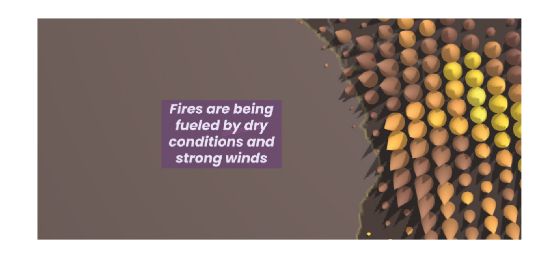
A screenshot from the app, showing a series of yellow and orange cones (each one representing fire intensity (colour) and fire frequency (width and height) along text saying "Fires are being fueled by dry conditions and strong winds".
New article! Using storytelling and guided interactions to help users understand large spatial and temporal data sets. Oana Candit et al. provide an example representing active fires of 2023 Paper: doi.org/10.1080/1523... App: www.animation.oanacanditmaps.ro/app/ #GISchat
08.12.2025 16:30
👍 3
🔁 2
💬 0
📌 0

Figure 1. Two labelings of the weather situation in Vienna at different timestamps: 23 labels appear, 26 disappear, and 11 change their position. The labelings are computed by our prototype that we describe in Section 4. Label-Icons: © GeoSphere Austria. Note that a full visual scan of the individual labels is necessary to identify all changes (Rensink et al., 1997).
New paper! Thomas Depian et al. investigate transitions in dynamic point labelling which are an issue in dynamic mapping systems. Weather data in Vienna - the labels change and it is not obvious which have changed doi.org/10.1080/1523... #GISchat #OpenAccess doi.org/10.17605/OSF...
03.12.2025 15:59
👍 4
🔁 0
💬 0
📌 0

Figure 2: A series of 6 maps, showing transition from proportional symbols (circles) for each area within the map to a choropleth map where the color shows the value. Labelled t=0 to t=1.
New article! Timofey Samsonov explores animated transitions proportional symbol and choropleth representations on thematic maps #GISchat #ICC2023 doi.org/10.1080/1523... Check out the supplementary videos of each transition at zenodo.org/records/1717... and see it in practice at observablehq.com
02.12.2025 11:57
👍 8
🔁 2
💬 0
📌 0

Three of the maps used in the evaluation, on the left a Google Maps style map (relatively plain colouring, with green for parks, blue for water and shades of grey and light brown for everywhere else), in the middle a Snazzy Maps - Hopper style map, with darker colors across the board, dark green for parks, dark blue for water, light green for gardens/ greenspace and grey for buildings, and on the right, the Place-aware Map, with much more vibrant colours.
We all know color in maps is important. Shangjing Jiang and colleagues used crowdsourced photographs to create place-aware colored maps which help create a sense of place doi.org/10.1080/1523... #GISchat Figure 1 below shows their comparisons: Google Maps, Snazzy Maps "Hopper" and place-aware maps
01.12.2025 11:51
👍 3
🔁 1
💬 0
📌 0
At a festival with events happening over a week and over a whole city? Dilara Bozkurt explores temporal navigation for festival maps on mobile devices, working out how to incorporate space and time on a small screen like a mobile phone doi.org/10.1080/1523... #GISchat #OpenAccess Check out the GIF:
27.11.2025 15:02
👍 5
🔁 2
💬 0
📌 0
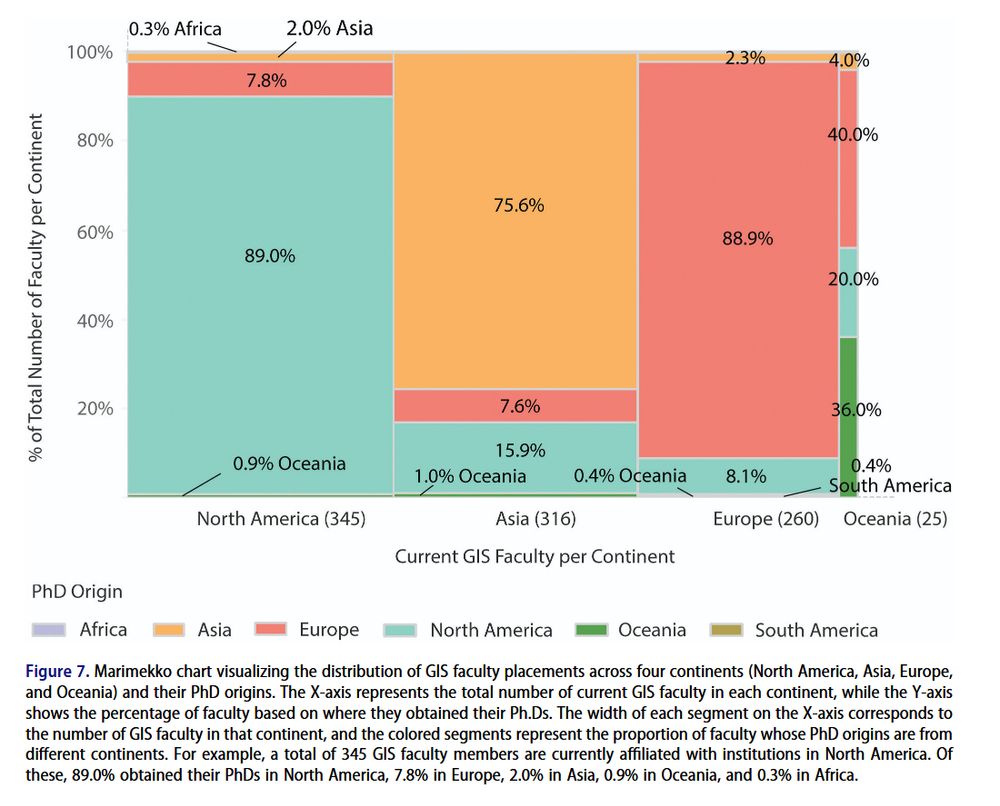
Figure 7. Marimekko chart visualizing the distribution of GIS faculty placements across four continents (North America, Asia, Europe,
and Oceania) and their PhD origins. The X-axis represents the total number of current GIS faculty in each continent, while the Y-axis
shows the percentage of faculty based on where they obtained their Ph.Ds. The width of each segment on the X-axis corresponds to
the number of GIS faculty in that continent, and the colored segments represent the proportion of faculty whose PhD origins are from
different continents. For example, a total of 345 GIS faculty members are currently affiliated with institutions in North America. Of
these, 89.0% obtained their PhDs in North America, 7.8% in Europe, 2.0% in Asia, 0.9% in Oceania, and 0.3% in Africa.
New article! Where are GIScience faculty hired from? Yanbing Chen and colleagues, using data from GISphere, analyze faculty mobility and research themes through hiring networks #GISchat doi.org/10.1080/1523... Below: where current GIS faculty are (x-axis) and where they got their PhDs (y-axis).
25.11.2025 11:55
👍 1
🔁 1
💬 0
📌 0

Figure 1, a sample of the 113 maps of Jerusalem used in this study.

Figure 19, a series of 113 rectangles plotted on top of an OpenStreetMap basemap, showing the coverage of historical maps of Jerusalem.
Fantastic article on Georeferencing historical maps using automated processes, including local feature matching and Delaunay consistency from Beatrice Vaienti, Isabella di Lenardo and Frédéric Kaplan doi.org/10.1080/1523... #GISchat #OpenAccess
24.11.2025 16:50
👍 9
🔁 4
💬 0
📌 0

A series of 6 maps with different color selections, with scores ranging from 2.10 to 4.00 (out of 5) with true value (scored by a survey) and predicted value (predicted by a color preference evaluation model)
New paper from Hong Wang, Mingda Zhang and colleagues: Evaluating color preference in thematic maps, a case study from China doi.org/10.1080/1523... #GISchat See below, figure 12: The true and predicted values of a selection of maps, with higher values for better maps.
20.11.2025 15:13
👍 1
🔁 1
💬 0
📌 0
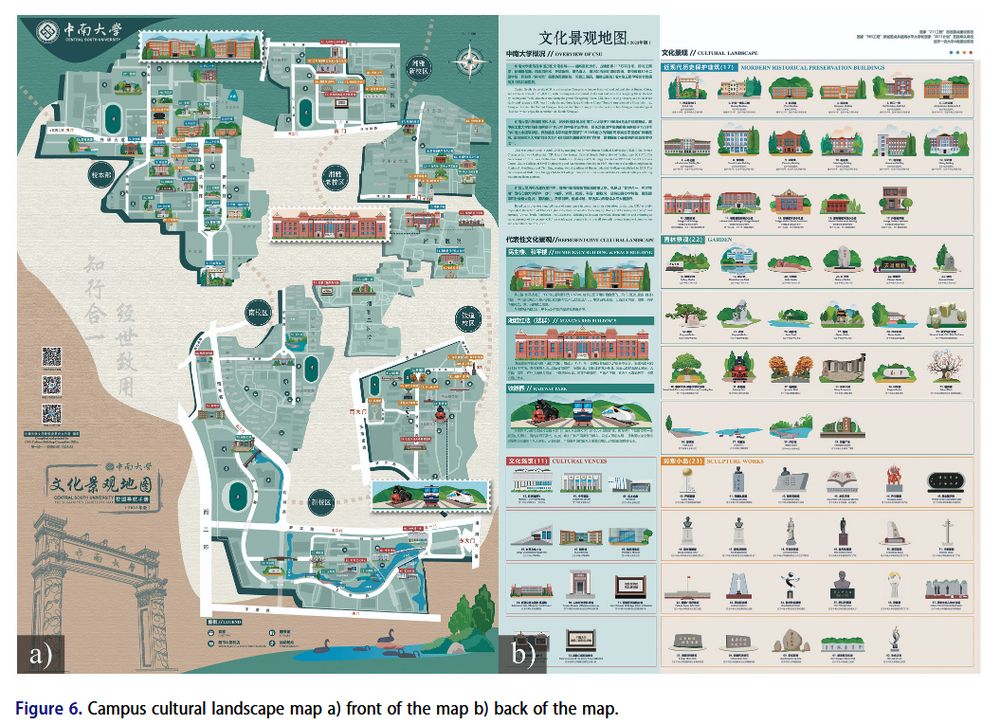
A map of a campus university in China, with interesting elements picked out.
How to design a campus cultural landscape map? Tao Zou and colleagues designed a map and then explored the user experience of the map doi.org/10.1080/1523... #GISchat Check out their map below, and the full res version at figshare.com/articles/dat...
19.11.2025 16:37
👍 6
🔁 2
💬 0
📌 0

Figure 4. Examples of deepfakes generated with PatchMatch. Real image (left, small) and the deepfake (big, right) produced by PatchMatch for urban areas. The real image includes a red house, which is removed in the fake image, replaced by green lawn.
Deepfake geography: A new paper from Valentin Meo looking at how we can detect manipulated satellite images doi.org/10.1080/1523... Also check out our interview on the paper with Valentin and @nickbearman.bsky.social: youtu.be/DklnevrHR1c #GISchat #FreeAccess
17.11.2025 14:30
👍 7
🔁 2
💬 0
📌 1

Lastly, Eric Delmelle is stepping down as Editor-in-Chief with Angela Yao stepping up to take his place - thank you Eric and Angela. And finally, thank you to our amazing 215 reviewers who help us make the journal what it is. doi.org/10.1080/1523...
12.11.2025 11:07
👍 0
🔁 0
💬 0
📌 0
bsky.app/profile/cart...
12.11.2025 11:06
👍 0
🔁 0
💬 1
📌 0
bsky.app/profile/cart...
12.11.2025 11:06
👍 0
🔁 0
💬 1
📌 0
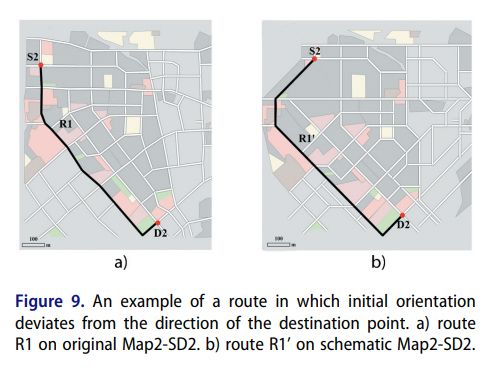
Fantastic new article looking at whether schematic maps (e.g. the London Tube map) can help with pedestrian route planning, from Ruyu Dai and colleagues, #GISchat https://doi.org/10.1080/15230406.2025.2478186
Fantastic new article looking at whether schematic maps (e.g. the London Tube map) can help with pedestrian route planning, from Ruyu Dai and colleagues, #GISchat doi.org/10.1080/1523...
12.11.2025 11:05
👍 1
🔁 0
💬 1
📌 0
bsky.app/profile/cart...
12.11.2025 11:04
👍 0
🔁 0
💬 1
📌 0

Four maps (metro map above, land cover map below, original left and enhanced right) with fixation heatmaps overlaid on top. The fixations show consistent areas being observed.
Taisheng Chen, Kun Hu et al. present a new way to automatically enhance qualitative color schemes for color vision deficiency, doi.org/10.1080/1523... #GISchat
12.11.2025 11:04
👍 0
🔁 0
💬 1
📌 0