Self-Assembly Gets Automated in Reverse of ‘Game of Life’ | Quanta Magazine
In cellular automata, simple rules create elaborate structures. Now researchers can start with the structures and reverse-engineer the rules.
The cells of your body follow simple rules and play off one another to form a complete organism. The researcher Alexander Mordvintsev has developed “neural cellular automata,” building blocks that can self-assemble into any form. @georgemusser.com reports: www.quantamagazine.org/self-assembl...
10.09.2025 14:05
👍 43
🔁 21
💬 1
📌 3
Willing to join us @pasteur.fr for a PhD for a project on how interactions between mobile genetic elements shape bacterial adaptation? Subject to be tailored to candidates with keen interest in evolution, genomics, computational biology, microbiology. Check www.pasteur.fr/en/education...
08.09.2025 08:56
👍 45
🔁 57
💬 0
📌 0

GitHub - romanzapien/enzimath
Contribute to romanzapien/enzimath development by creating an account on GitHub.
Pueden encontrar el contenido teórico (en español) en GitHub (github.com/romanzapien/...) donde abordamos reacciones químicas ✨, matemáticas 🔢, programación (Julia) 👩🏽💻 y análisis de datos 📈. El código es interactivo y puede usarse desde cualquier dispositivo, así que no duden en compartirlo 😊 🙌 (2/2)
13.08.2025 18:55
👍 0
🔁 0
💬 0
📌 0


Este Julio tuve el privilegio de organizar el club "Enzymath: Entendiendo a las Enzimas entre Genes y Ecuaciones" 🧪👨🏻🔬🧑🏼🏫 para Clubes de Ciencia México 🇲🇽. Fue una bonita experiencia de la que me llevo muchas alegrías y que espero repetir pronto. (1/2)
13.08.2025 18:55
👍 0
🔁 0
💬 1
📌 0
HFSP project — dal bello lab
📢 We're seeking a postdoc to work on a project funded by HFSP @hfspo.bsky.social at the intersection of bacterial physiology, ecology and evolution. You can find more details about the project, the position, and how to apply here www.dalbellolab.com/hfsp-project! #bacteria #ecosky #MevoSky #microSky
23.07.2025 18:41
👍 41
🔁 45
💬 1
📌 1

Behold one of the mightiest tools in mathematics: the camel principle.
I am dead serious. Deep down, this tiny rule is the cog in many methods. Ones that you use every day.
Here is what it is, how it works, and why it is essential.
03.07.2025 17:00
👍 2
🔁 2
💬 1
📌 0

A NASA Astronaut on ISS caught this sprite over Mexico and the U.S. this morning.
04.07.2025 06:50
👍 5464
🔁 819
💬 143
📌 89
Many such cases - be on guard against DoPRA (science is complex, but let's not fool ourselves that pre-pub peer review functions in these situations; need a year of post-pub to read these things)
23.06.2025 09:00
👍 21
🔁 2
💬 1
📌 0
1/n 🧵 Excited to share our new paper! We developed a framework to reveal hidden simplicity in how organisms adapt to different environments, particularly focusing on antibiotic resistance evolution. #EvolutionaryBiology #MachineLearning
15.05.2025 14:33
👍 38
🔁 22
💬 1
📌 2

In the era of AI, neural networks have become increasingly popular for modeling, inference, and prediction, largely due to their potential for universal approximation. With the proliferation of such deep learning models, a question arises: are leaner statistical methods still relevant? To shed insight on this question, we employ the mechanistic nonlinear ordinary differential equation (ODE) inverse problem as a testbed, using physics-informed neural network (PINN) as a representative of the deep learning paradigm and manifold-constrained Gaussian process inference (MAGI) as a representative of statistically principled methods. Through case studies involving the SEIR model from epidemiology and the Lorenz model from chaotic dynamics, we demonstrate that statistical methods are far from obsolete, especially when working with sparse and noisy observations. On tasks such as parameter inference and trajectory reconstruction, statistically principled methods consistently achieve lower bias and variance, while using far fewer parameters and requiring less hyperparameter tuning. Statistical methods can also decisively outperform deep learning models on out-of-sample future prediction, where the absence of relevant data often leads overparameterized models astray. Additionally, we find that statistically principled approaches are more robust to accumulation of numerical imprecision and can represent the underlying system more faithful to the true governing ODEs.
Neat looking paper: "Are Statistical Methods Obsolete in the Era of Deep Learning?" The answer seems to be "no," at least in the case where there's a mathematical structure to the model.
arxiv.org/abs/2505.21723
29.05.2025 02:04
👍 20
🔁 5
💬 6
📌 1


7 PhD positions in Translational Evolutionary Research available @uni-kiel.de
Application deadline is March 27, 2025
Please spread the word!
www.kec.uni-kiel.de/news_events/...
31.01.2025 13:58
👍 8
🔁 10
💬 0
📌 5

Partners in both life and research, the physicists Roger Guimerà and Marta Sales-Pardo recently developed a “machine scientist” algorithm that is proving to be a powerful tool for scientific discovery. (From the archive) buff.ly/0dgSvHG
22.03.2025 15:46
👍 21
🔁 7
💬 0
📌 2

UCL – University College London
UCL is consistently ranked as one of the top ten universities in the world (QS World University Rankings 2010-2022) and is No.2 in the UK for research power (Research Excellence Framework 2021).
Interested in a starting PI position at University College London to work on Genetics, Evolution or the Environment? My department has opened the call for expressions of interest for sponsorship of independent fellowship applications.
www.ucl.ac.uk/work-at-ucl/...
21.03.2025 19:43
👍 78
🔁 90
💬 1
📌 3

Let's try this again... 7 is the LEAST "random" number.
When we asked Britons to think of a number from 1-10, 33% chose 7 - this isn't the first time this phenomenon has been observed
How Brits respond...
1: 2%
2: 4%
3: 7%
4: 9%
5: 8%
6: 14%
7: 33%
8: 14%
9: 6%
10: 4%
yougov.co.uk/society/arti...
21.03.2025 11:49
👍 41
🔁 7
💬 8
📌 5

Current job offers
We offer 2 PhD Positions in Evolutionary Biology!
1️⃣ Evolutionary Developmental Biology – Craniofacial evolution. (March 31, 2025)
2️⃣ Evolution of Polygenic Traits – Genetic adaptation in Drosophila. (April 30, 2025)
More here: www.evolbio.mpg.de/1639156/Job_...
#PhD #EvoDevo #Genetics
19.03.2025 07:20
👍 7
🔁 12
💬 0
📌 1
I have been preparing a lecture on Parameter Inference for undergrad students 📊. The experience has been particularly fulfilling because I did not learned from a textbook 📖 but by doing 👨🏻💻. At the end, apart from teaching others, structuring knowledge in a lecture is a newly discovered joy for me 😄 🙌
18.03.2025 01:34
👍 2
🔁 0
💬 0
📌 0
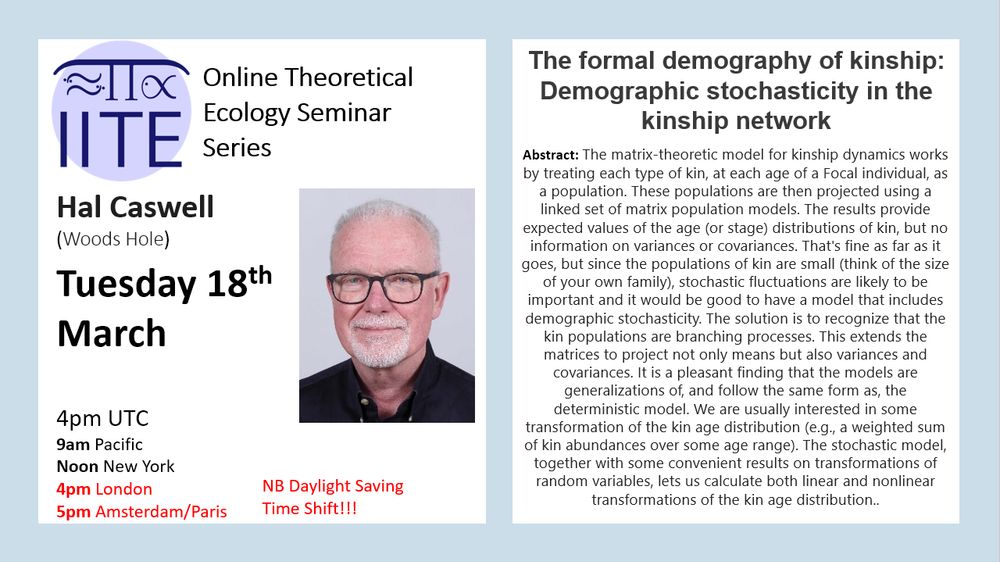
📆Join us next Tuesday for our online seminar: Hal Caswell (Woods Hole) will present on:
⭐The formal demography of kinship: Demographic stochasticity in the kinship network⭐
Free for all to join!
Zoom Link: iite.info/seminar/
Global Times: www.timeanddate.com/worldclock/f...
NB Euro time shift!
13.03.2025 10:27
👍 14
🔁 9
💬 1
📌 0
PNAS
Proceedings of the National Academy of Sciences (PNAS), a peer reviewed journal of the National Academy of Sciences (NAS) - an authoritative source of high-impact, original research that broadly spans...
I’m thrilled to share my first ever publication, now published in PNAS! www.pnas.org/doi/10.1073/...
With mentorship from the amazing @ksxue.bsky.social, I looked at how the outcomes of species introductions to microbial communities are influenced by the number of introduced microbes.
11.03.2025 13:22
👍 89
🔁 31
💬 1
📌 1

Lawful good: Bayesian models
Neutral good: Social network analysis
Chaotic good: Dynamical systems theory
Lawful neutral: Drift diffusion
True neutral: Information theory
Chaotic neutral: Agent-based models
Lawful evil: Symbolic logic
Neutral evil: Neural networks
Chaotic evil: Quantum mechanics
I have a bunch of things I have to get done, so naturally I decided to procrastinate by making an alignment chart of mathematical models
19.12.2023 01:03
👍 228
🔁 76
💬 17
📌 9
It's our birthday! 🎂 The Royal Institution was founded on this day in 1799 for "the teaching by courses of Philosophical Lectures and Experiments, the application of Science to the Common Purposes of Life".
In this 1985 video, George Porter shows us Faraday's lab, which you can still visit today
07.03.2025 13:48
👍 56
🔁 22
💬 3
📌 2
Understanding and predicting microbial evolutionary dynamics - 2025 meeting
I'm delighted to announce that the 2025 @microbiologysociety.org meeting on "Understanding and predicting microbial evolutionary dynamics" will be held in Liverpool 26-27 November 2025! Abstract submission will open soon... #microsky 🧪🧫🦠 microbiologysociety.org/event/societ...
18.02.2025 09:50
👍 162
🔁 92
💬 3
📌 3