Mike O'Donnell's Avatar

Mike O'Donnell

@mike-od

Worms, bacteria and the brain. Asst Prof @MCDB Yale. odonnelllab.yale.edu

495
Followers
725
Following
6
Posts
26.04.2024
Joined
Posts Following

Latest posts by Mike O'Donnell @mike-od

Evolution of monoamine reception and its role in cellular contractility.

Evolution of monoamine reception and its role in cellular contractility.

How do #sponges coordinate their bodies despite lacking neurons and true muscles?

We show that sponges use monoamines to control water flow in their canals β€” reminiscent of how adrenaline regulates blood vessels.

My PhD story, now on BioRxiv:
www.biorxiv.org/content/10.6...
#Evolution

18.02.2026 13:34 πŸ‘ 62 πŸ” 21 πŸ’¬ 3 πŸ“Œ 4

Another one with our next door colleagues! @marianneroca.bsky.social in @jameslightfoot.bsky.social's group found the IL2 neurons detecting prey (this study) are also sensing octopamine, which we recently found plays an important role in predatory aggression! www.nature.com/articles/s41...

29.01.2026 13:41 πŸ‘ 21 πŸ” 4 πŸ’¬ 0 πŸ“Œ 0
Preview
A microscopy-based CRISPR screening platform enables organellar functional genomics and illuminates ciliary biology Sun et al. develop a microscopy-based CRISPR screening platform that combines ease of implementation with flexible analysis of live-cell or antibody-based markers. Screens in human cells using a serie...

Ever wanted to do a genome-scale CRISPR screen for a microscopy phenotype? Pooled CRISPR screens are amazing, but hard to combine with imaging... Excited to share our latest work in Dev Cell on a technology platform for imaging screens and applications to primary cilia: www.cell.com/developmenta...

20.11.2025 17:06 πŸ‘ 24 πŸ” 4 πŸ’¬ 1 πŸ“Œ 1
Preview
Sensory processing reformats odor coding around valence and dynamics Extracting relevant features of a complex sensory signal typically involves sequential processing through multiple brain regions. However, identifying the logic and mechanisms of these transformations...

Excited to share my most recent postdoctoral work in the Jeanne lab @yaleneuro.bsky.social !

β€œSensory processing reformats odor coding around valence and dynamics”
www.biorxiv.org/content/10.1...

We ask: how is a sensory code transformed across multiple stages of processing to inform behavior?

09.11.2025 12:58 πŸ‘ 40 πŸ” 18 πŸ’¬ 2 πŸ“Œ 1
Preview
A CRISPR activation screen reveals a cilia disassembly pathway mutated in focal cortical dysplasia A gain-of-function screen uncovers a cilia disassembly pathway linked to genes somatically mutated in neurodevelopmental disease.

Excited to share our latest work on a new cilia disassembly pathway and a link between this pathway and the neurological disorder focal cortical dysplasia: www.science.org/doi/10.1126/...
Brief summary: we used a genome-wide CRISPRa GOF screen to identify negative regulators of ciliary signaling...

30.10.2025 15:14 πŸ‘ 39 πŸ” 10 πŸ’¬ 3 πŸ“Œ 1

We'd love to hear your thoughts! (6/6)

24.10.2025 16:30 πŸ‘ 1 πŸ” 0 πŸ’¬ 0 πŸ“Œ 1

For the worm-types, the ultimate destination of the glucose-octopamine complex is CAN - whose function is essential but not well understood. CAN appears to have the capacity to release octopamine but not to make it itself, implying that it functions like a neuron under certain circumstances. (5/6)

24.10.2025 16:29 πŸ‘ 0 πŸ” 0 πŸ’¬ 1 πŸ“Œ 0

Similar types of conjugates of neurotransmitters are present in many animals, and we think this might represent a way to inactivate and store these types of chemicals so that they can be re-used only under certain conditions or after specific experiences. (4/6)

24.10.2025 16:29 πŸ‘ 0 πŸ” 0 πŸ’¬ 1 πŸ“Œ 0

With Frank Schroeder's lab, we found that octopamine is imported into the intestine, where it's linked to glucose, and then linked to fatty acids that depend on a specific diet. This allows octopamine to move to other neurons where it can be re-released and change olfactory behavior. (3/6)

24.10.2025 16:29 πŸ‘ 0 πŸ” 0 πŸ’¬ 1 πŸ“Œ 0

Many diet and stress-related behaviors are controlled by a neurotransmitter called octopamine (think norepinephrine, but in invertebrates). In worms, there are only 2 neurons that make this chemical. How can a single neuron type in the head coordinate octopamine signaling in space and time? (2/6)

24.10.2025 16:29 πŸ‘ 2 πŸ” 0 πŸ’¬ 1 πŸ“Œ 0
Preview
Nuclear receptor-neurotransmitter coupling links behavior to metabolic state Animals must flexibly respond to environmental stimuli to survive, and optimal responses critically depend on the organism's current needs. Many organisms have evolved both cell-intrinsic and intertis...

I'm thrilled to share our new preprint, in which we've found that neurotransmitters can be chemically "marked" as a way to incorporate metabolic history - such as diet or life stage. www.biorxiv.org/content/10.1... Led by Porhathai "Un" Malaiwong, Allen Schroeder and Tia Brown. (1/6) 🧡

24.10.2025 16:28 πŸ‘ 15 πŸ” 5 πŸ’¬ 1 πŸ“Œ 1
Post image

Despite the mess, we are grateful to be funded, have exciting science happening, and have an opening for a postdoc!

If you are interested in sensory biology and esp in cilia, thermosensation, or interoception, and would like to join an interactive & supportive group - please email.

Please RT πŸ™

16.10.2025 17:29 πŸ‘ 47 πŸ” 45 πŸ’¬ 0 πŸ“Œ 3

C. elegans is a real animal and we set out to understand how it comes to have its distinctive biogeography. Its ancestral center of diversity is in the higher elevation forests of Hawaii. Its closest relatives are spread across east Asia. Did they travel from Asia? [Preprint 🧡]

24.09.2025 20:33 πŸ‘ 168 πŸ” 79 πŸ’¬ 5 πŸ“Œ 8
Preview
N6-methyladenosine promotes temozolomide resistance through non-canonical regulation of mRNA stability in glioblastoma cells N6-methyladenosine (m6A) is a critical regulator of mRNA processing and function, impacting nearly every step of the mRNA lifecycle. Changes in m6A status have been implicated in many different types ...

Thrilled to share a new preprint from the lab! We investigated how m6A regulates the transcriptome in chemoresistant glioblastoma through unexpected mechanisms, and the potential therapeutic applications of this discovery.
Check out the preprint here ⬇️
www.biorxiv.org/content/10.1...

15.09.2025 20:41 πŸ‘ 17 πŸ” 7 πŸ’¬ 1 πŸ“Œ 0

Well, none of us may ever get funded again but in the meantime, here's some new science!

Led by recent PhD Anjali Pandey w/ex-UG Maya Katz. Here we identify an asymmetric molecular mechanism that underlies symmetric context-dependent sensory plasticity in the AWC olfactory neuron pair in C. elegans

30.07.2025 00:51 πŸ‘ 47 πŸ” 16 πŸ’¬ 2 πŸ“Œ 1
Video thumbnail

🚨Very happy that my PhD work is now out in @nature.com!

We discovered that evolution, by acting in the midbrain, shifted the threshold to escape in Peromyscus mice, to fine-tune defensive strategies in different environments

www.nature.com/articles/s41...

This was a truly collaborative effort! πŸ§΅β¬‡οΈ

23.07.2025 15:05 πŸ‘ 473 πŸ” 103 πŸ’¬ 26 πŸ“Œ 5
Preview
Lineage-resolved analysis of embryonic gene expression evolution in C. elegans and C. briggsae The constraints that govern the evolution of gene expression patterns across development remain unclear. Single-cell RNA sequencing can detail these constraints by systematically profiling homologous ...

Despite all that is going on, we are still all working on our science. Our 2nd collaboration with @jisaacmurray.bsky.social‬ and Bob Waterston (UW) is out:

Lineage-resolved analysis of embryonic gene expression evolution in C. elegans and C. briggsae | Science www.science.org/doi/10.1126/...

20.06.2025 14:46 πŸ‘ 52 πŸ” 12 πŸ’¬ 0 πŸ“Œ 1
UW Human Resources University of Washington Human Resources

Our posting for a research technologist is now live! This job is ideally suited for a recent college grad interested in lab experience. Please spread the word!

uwhires.admin.washington.edu/ENG/Candidat...

28.05.2025 00:53 πŸ‘ 1 πŸ” 1 πŸ’¬ 0 πŸ“Œ 0
A screenshot of the termination notice showing "Outstanding Investigator Grants"
A screenshot of the termination notice showing "Outstanding Investigator Grants"

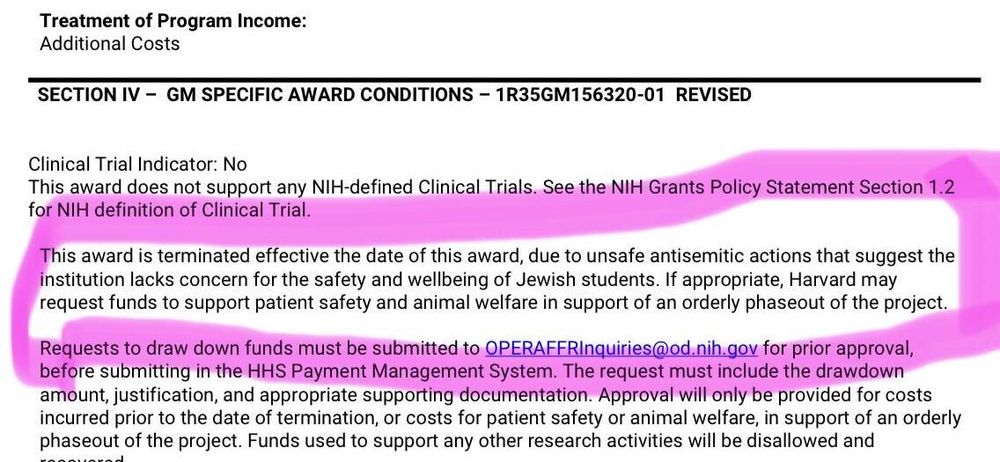
A screenshot of the termination notice with "This award is terminated effective the date of this award, due to unsafe antisemitic actions that suggest the institution lacks concern for the safety and wellbeing of Jewish students." highlighted

A screenshot of the termination notice with "This award is terminated effective the date of this award, due to unsafe antisemitic actions that suggest the institution lacks concern for the safety and wellbeing of Jewish students." highlighted

Yesterday, the NIH R35 β€œOutstanding Investigator” grant to fund scientists in my lab studying antibiotic resistance was terminated for reasons not related to the content of the science, or any actions taken by me or members of my lab

13.05.2025 23:37 πŸ‘ 879 πŸ” 579 πŸ’¬ 144 πŸ“Œ 73

OK If we are moving to Bluesky I am rescuing my favourite ever twitter thread (Jan 2019).

The renamed:

Bluesky-sized history of neuroscience (biased by my interests)

01.12.2024 20:29 πŸ‘ 625 πŸ” 203 πŸ’¬ 14 πŸ“Œ 14
Preview
Conserved autism-associated genes tune social feeding behavior in C. elegans - Nature Communications C. elegans aggregate in large clumps during feeding. Here, the authors find conserved autism-associated genes mediate distinct molecular and circuit signaling components that tune C. elegans feed...

New paper ALERT!! Mara Cowen, PhD discovered and defined how conserved autism-associated genes modify a 'social' behavior in C. elegans!! So proud of her work in the lab!
www.nature.com/articles/s41...

11.11.2024 19:49 πŸ‘ 43 πŸ” 12 πŸ’¬ 4 πŸ“Œ 1
Preview
Cilia structure and intraflagellar transport differentially regulate sensory response dynamics within and between C. elegans chemosensory neurons The relative contributions of intraflagellar transport (IFT) and cilia structure to sensory neuron responses remains unclear. This study reveals unexpected complexity in the contribution of IFT and ci...

πŸ§ͺ Lab's latest!! Work by PD (and now PI) Alison Philbrook.
C. elegans sensory neurons have gorgeous #cilia. We’ve always thought that a) no cilia = no sensory responses, & b) no IFT = no cilia. Punchline is we thought wrong. Read paper for more!
#neuroscience
journals.plos.org/plosbiology/...

26.11.2024 23:38 πŸ‘ 184 πŸ” 62 πŸ’¬ 10 πŸ“Œ 6