
AIs can’t stop recommending nuclear strikes in war game simulations
Leading AIs from OpenAI, Anthropic and Google opted to use nuclear weapons in simulated war games in 95 per cent of cases
AIs can’t stop recommending nuclear strikes in war game simulations
Leading AIs from OpenAI, Anthropic and Google opted to use nuclear weapons in simulated war games in 95 per cent of cases
www.newscientist.com/article/2516...
25.02.2026 12:27
👍 3052
🔁 1298
💬 395
📌 1481

‘A feedback loop with no brake’: how an AI doomsday report shook US markets
Shares in Uber, Mastercard and American Express fall on back of apocalypse scenario posted on Substack
It's hard to see it going any other way at this point. I expect there will be a moment soon like in March 2020 when even the Tories realised that we would need to intervene drastically in the economy (with furlough) or there would be complete meltdown.
www.theguardian.com/technology/2...
25.02.2026 10:25
👍 0
🔁 1
💬 0
📌 0

Student loans: Phillipson says freeze will cost average graduate £8 a month
Some graduates in England say
Education Secretary defends freezing the repayment threshold for student loans in England.
Ridiculous plan to align repayment threshold with minimum wage.
Graduates pay tax+repayment at marginal rate of 37%, higher than capital gains tax rate for the super rich.
Abolish uni fees. Write-off debt.
25.02.2026 07:21
👍 380
🔁 156
💬 19
📌 6
@martinlewis.moneysavingexpert.com
@georgeeaton.bsky.social
@peterstefanovic.bsky.social
@vicderbyshire.bsky.social
24.02.2026 21:45
👍 0
🔁 0
💬 0
📌 0
Student loans need to be completely reformed, not just tinkered with. And arguably the solution that causes the least headaches is wiping them completely and funding out of general taxation.
24.02.2026 21:35
👍 2
🔁 0
💬 1
📌 0

4-panel line chart titled "The Student Loan Trap: Whether or not interest is capped at inflation, or thresholds are indexed to inflation, middle earners are squeezed the hardest."
The charts map total lifetime repayment (Y-axis, £0 to £120k) against starting graduate salary (X-axis, £25k to £150k) for a £50k Plan 2 loan over 30 years.
Top Left: "Current policy: Frozen threshold, Sliding interest up to RPI+3%." Total repayments peak steeply at nearly £120k for salaries around £70k before dropping for higher earners. Lower and middle earners pay significantly more than the original loan. Top Right: "Indexed threshold." The peak shifts right to £80k salaries, maxing near £90k. Bottom Left: "Frozen threshold, Flat interest (RPI only)." Peak drops to £80k for £55k earners. Bottom Right: "Indexed threshold, Flat interest." The flattest curve, peaking near £70k for £70k earners.
All panels show a large orange area representing unpaid debt written off after 30 years, and a green area indicating fully repaid loans for higher earners. Middle-income earners consistently hit the highest peak of total lifetime repayments in all four scenarios.
Whether or not interest is capped at RPI, or thresholds are unfrozen, middle earning graduates will continue to be squeezed the most while the richest pay less.
24.02.2026 21:31
👍 2
🔁 0
💬 1
📌 0

Step 1: Insert bacteria ("Wolbachia") into mosquitoes.
Step 2: Release mosquitoes.
Step 3: Watch Dengue rates plummet.
Phenomenal results from Singapore.
Link: tinyurl.com/59c9t67u, by Lim et al.
11.02.2026 23:21
👍 77
🔁 23
💬 2
📌 2

AI poses unprecedented threats. Congress must act now | Bernie Sanders
Despite the speed at which it is progressing, AI is getting far too little discussion in Congress, the media and within the general population. That has got to change
It’s a mistake to dismiss AI as just slop, or a bubble that will pop and fade away - it will likely be revolutionary, but we're on a dark path leaving its future entirely in the hands of private corporations with zero regulation. AI needs to be regulated and the benefits democratised ASAP.
02.12.2025 14:53
👍 1
🔁 0
💬 0
📌 0
I'm taking part in this webinar on Friday to discuss my experience in #SciComm as an ECR during the Covid-19 pandemic - should be a really interesting conversation! Sign up below:
07.07.2025 10:37
👍 2
🔁 0
💬 0
📌 0

‘Nobody wants a robot to read them a story!’ The creatives and academics rejecting AI – at work and at home
Is artificial intelligence coming for everyone’s jobs? Not if this lot have anything to do with it
For better or worse (and there's lots of arguments for both) the genie is out of the bottle - it's here to stay, and that means we should be trying to maximise it's usefulness to society, and at the same time, trying to minimise harms. This is just wishing it away.
03.06.2025 14:18
👍 1
🔁 0
💬 0
📌 0

The Covid Inquiry Podcast - 49. ‘I wasn’t the decision maker’ - BBC Sounds
The Inquiry hears from the lead of the test and trace unit
While the Inquiry's focus on improving quarantine adherence is important (summary: www.bbc.co.uk/sounds/play/...), it's a shame it overlooks DCT - one of the few pandemic policies validated through modelling + RCTs and then rolled out to reduce societal impacts while controlling transmission.
02.06.2025 10:52
👍 1
🔁 0
💬 0
📌 0


Great to see @christophraser.bsky.social discuss daily contact testing as a way of reducing quarantine burden at the UK Covid Inquiry. However, it is disappointing this is the only mention of this policy in the entire 12 days of the Test, Trace, and Isolate Module.
02.06.2025 10:52
👍 3
🔁 0
💬 1
📌 0

Now to make the most mid latte art of all time 🤩
05.05.2025 14:32
👍 3
🔁 0
💬 0
📌 0
Just a few days left to apply for a PhD integrating behavioural data in infectious disease modelling using AI at Charité Berlin with me and Prof Stefan Flasche.
Deadline 6th April!
02.04.2025 12:52
👍 3
🔁 1
💬 0
📌 0
In Britain, we pride ourselves on authenticity, tradition, and cultural heritage.
*sips pint of Madri*
28.03.2025 11:28
👍 0
🔁 0
💬 0
📌 0
I'm mainly talking about when it's already at the point where it's pandemic, so high R and high N, lots of cases, widely distributed.
I think for containment at source it's a different question, I think there's more reason to throw the book at it there to stop it becoming a pandemic.
24.03.2025 12:57
👍 1
🔁 0
💬 0
📌 0
I think the West could have done all those things and had a better experience (I think a comprehensive rapid testing approach could allow us to avoid lockdowns) but I don't think global eradication was or is feasible for something like Covid.
24.03.2025 12:48
👍 0
🔁 0
💬 1
📌 0
But to test efficacy/effectiveness of vaccines, you need to have cases somewhere. So the success of countries like Australia/NZ owes a lot to other countries like the having big epidemics which allowed for vaccine trials. A very tricky issue (potentially solvable with human challenge studies - TBD)
24.03.2025 11:59
👍 1
🔁 0
💬 1
📌 0

Like I think the below is rather simplistic, as the success of NPIs in large part is determined by timely development and rollout of PIs. Hard lockdown early isn't going to be effective if you haven't rolled out good vaccines by the time you loosen it - look at experience of Australia/NZ vs China.
24.03.2025 11:54
👍 0
🔁 0
💬 1
📌 0
My two pence on lockdowns/NPIs is that for high R resp. pathogens we should really talk about effectiveness in terms of capacity to delay, rather than prevent. So the question is then: what reduces R but also carries lowest societal costs so it can be maintained until we get vaccines/antivirals out?
24.03.2025 11:39
👍 7
🔁 0
💬 1
📌 0
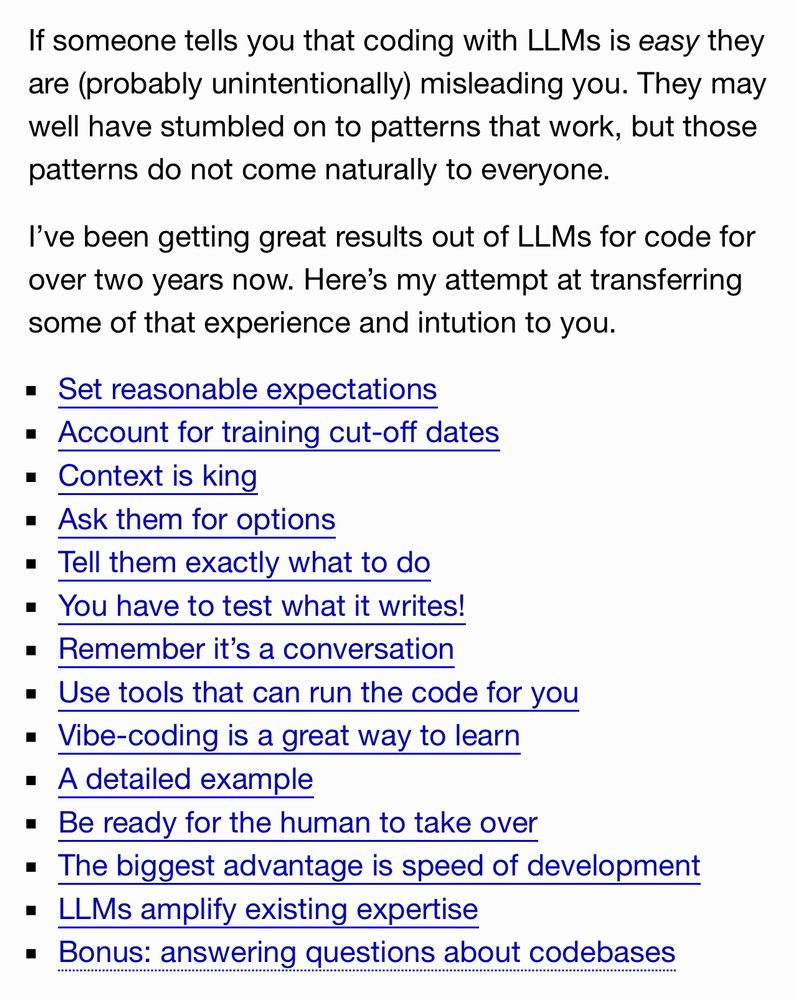
If someone tells you that coding with LLMs is easy they are (probably unintentionally) misleading you. They may well have stumbled on to patterns that work, but those patterns do not come naturally to everyone.
I’ve been getting great results out of LLMs for code for over two years now. Here’s my attempt at transferring some of that experience and intution to you.
Set reasonable expectations
Account for training cut-off dates
Context is king
Ask them for options
Tell them exactly what to do
You have to test what it writes!
Remember it’s a conversation
Use tools that can run the code for you
Vibe-coding is a great way to learn
A detailed example
Be ready for the human to take over
The biggest advantage is speed of development
LLMs amplify existing expertise
Bonus: answering questions about codebases
Here's the table of contents for my lengthy new piece on how I use LLMs to help me write code simonwillison.net/2025/Mar/11/...
11.03.2025 14:11
👍 336
🔁 67
💬 14
📌 15

Of course its already a thing: knowyourmeme.com/memes/accide...
Article: www.theguardian.com/business/202...
12.03.2025 15:23
👍 1
🔁 0
💬 0
📌 0

This photo in @theguardian.com looks like a screenshot from an isometric strategy video game:
12.03.2025 15:21
👍 2
🔁 1
💬 1
📌 0
Interested in pursing a PhD in infectious disease dynamics, artificial intelligence, and behavioural science?
Come and join myself and Professor Stefan Flasche at the Charité Center for Global Health in Berlin:
karriere.charite.de/en/job-vacan...
07.03.2025 09:41
👍 74
🔁 32
💬 1
📌 1

When an epidemic hits, how long does it take to get going with common epidemic analysis tasks?
A couple of weeks ago, we asked representatives from over a dozen UK organisations and universities who work actively on epidemic analysis and modelling how long the below tasks would take them....
1/
25.02.2025 22:04
👍 38
🔁 16
💬 2
📌 1
Though interesting that Neukölln - which was in the West - has gone to Die Linke, for the first time ever
24.02.2025 07:38
👍 1
🔁 0
💬 0
📌 0

What wall?
24.02.2025 07:13
👍 2
🔁 0
💬 1
📌 0
Can't vote but #FUKAFD and #FUKNZS! #BTW2025
23.02.2025 10:30
👍 1
🔁 0
💬 0
📌 0


