@peerresearch.bsky.social is all about generating actionable research. This very topic will be a central debate during the upcoming #highered rulemaking, which kicks off *next week.* Check it out to stay ahead of the curve!
03.12.2025 15:56
👍 1
🔁 0
💬 0
📌 0

And for more on how the graduate and professional limits will affect student borrowing (and how parent borrowers will be affected by those new limits), here's another piece with more data from @peerresearch.bsky.social! www.american.edu/spa/peer/upl... 4/4
06.11.2025 19:46
👍 0
🔁 0
💬 0
📌 0
Negotiators have also raised concern about the exclusion of other fields, like physical therapy, occupational therapy, audiology, and physician assistant programs. For more on current graduate borrowing, check out this report: www.american.edu/spa/peer/upl... 3/
06.11.2025 19:46
👍 0
🔁 0
💬 1
📌 0

@peerresearch.bsky.social's @jdmatsudaira.bsky.social has looked at the current borrowing levels across fields of study. Check out the attached (green dots for fields that fall in the new definition) for more on the average annual borrowing of the largest professional fields today. 2/
06.11.2025 19:46
👍 0
🔁 1
💬 1
📌 0

At this week's #highered negotiations, @usdeptofed.bsky.social proposed a new definition of professional programs that includes this list of 10, plus clinical psychology/psych Ph.Ds, and related programs (i.e., in the same 4-digit CIP code as any of those fields). 1/
06.11.2025 19:46
👍 2
🔁 0
💬 1
📌 0
How to prorate loans for part-time students -- and how to implement the change for current borrowers -- is one topic on the agenda for a @usdeptofed.bsky.social live rulemaking next week.
31.10.2025 15:32
👍 1
🔁 0
💬 0
📌 0
A really informative new report from my @peerresearch.bsky.social colleagues!
23.10.2025 19:06
👍 1
🔁 0
💬 0
📌 0
Our best estimates of the impact of the One Big Beautiful Bill Act's accountability provision:
➡️For each credential level
➡️For each field of study
➡️For every state
➡️Across for-profits, non-profits, publics
➡️Across HBCUs, TCUs, HSIs, MSIs
➡️For every program at every college in the country
07.10.2025 16:49
👍 1
🔁 0
💬 0
📌 0

As @usedgov.bsky.social implements a new #highered accountability law, @PEERResearch.bsky.social urged officials to:
➡️ Provide radically improved transparency
➡️ Maintain an earnings test for certificates, a debt-based test
➡️ Release already-collected data
More: www.american.edu/spa/peer/rec...
02.09.2025 15:45
👍 0
🔁 1
💬 0
📌 0


As new grad. loan limits take effect, @PEERResearch.bsky.social dug into the data:
➡️ Health degrees account for nearly half of grad borrowing
➡️ High-debt fields typically have high median earnings
➡️ Typical borrowing varies, across schools and within programs
www.american.edu/spa/peer/upl...
18.08.2025 17:41
👍 2
🔁 2
💬 0
📌 0
Excited to be at the @sheeoed.bsky.social conference on behalf of @peerresearch.bsky.social, catching up with old friends and learning more about all the #highered work happening in states across the country! Find me around the conference if you want to chat about PEER and our work!
12.08.2025 19:24
👍 3
🔁 1
💬 0
📌 0

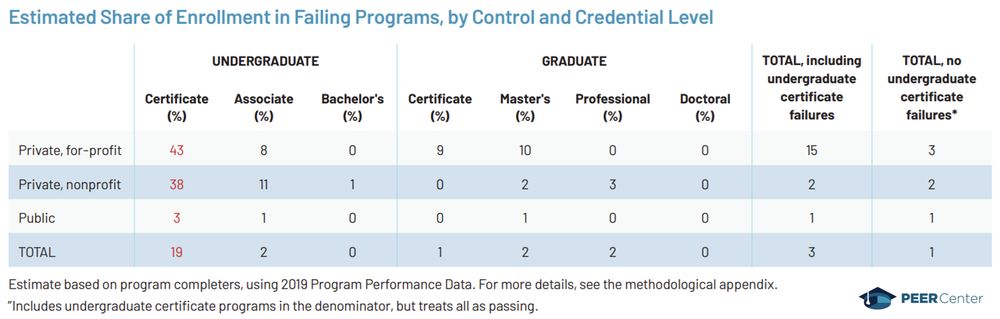
@usedgov.bsky.social is planning a rulemaking on #highered accountability. Check out @peerresearch.bsky.social analysis of which programs fall short of the new reconciliation law's standards: www.american.edu/spa/peer/upl.... For researchers looking to get involved in the process, reach out to PEER!
29.07.2025 16:51
👍 1
🔁 2
💬 0
📌 0

Staff reductions @usedgov.bsky.social will likely facilitate an uptick in institutional misconduct, as colleges are able to get away with not following the rules, a senior FSA official acknowledged to @insidehighered.com @jessicablake.bsky.social www.insidehighered.com/news/governm...
21.07.2025 13:26
👍 1
🔁 0
💬 0
📌 0
Congress just passed a reconciliation package that codifies a new standard for #highered programs -- check out our latest from @claremccann.bsky.social @tiacaldwell.bsky.social @jdmatsudaira.bsky.social to see which programs fall short and what the policy leaves out. www.american.edu/spa/peer/upl...
11.07.2025 13:32
👍 0
🔁 1
💬 0
📌 0
@jdmatsudaira.bsky.social and @clibassi.bsky.social explain what new graduate loan limits will mean, not only for borrowers in medical school but across the graduate education landscape. Check out this thread/follow @peerresearch.bsky.social for more!
02.07.2025 17:26
👍 3
🔁 1
💬 0
📌 0
The Senate just passed a new #highered accountability framework -- @jdmatsudaira.bsky.social, @tiacaldwell.bsky.social, and I analyzed what it will mean for colleges, who's off the hook, and how Congress can improve it going forward. www.american.edu/spa/peer/acc...
01.07.2025 20:59
👍 2
🔁 1
💬 0
📌 0

A Closer Look at the House Risk-Sharing Proposal
A deep dive into the House bill uncovers drawbacks that would likely undermine these principles and the accountability sought by the proposal.
RECONCILIATION WATCH: @jdmatsudaira.bsky.social, @tiacaldwell.bsky.social, @claremccann.bsky.social weigh in on the House’s risk-sharing framework. Read more about the impact of risk-sharing -- and another approach to IDing unaffordable programs without the pitfalls: www.american.edu/spa/peer/hou...
23.06.2025 14:57
👍 1
🔁 2
💬 0
📌 0

Check out some of @peerresearch.bsky.social's latest work by @jdmatsudaira.bsky.social @srcellini.bsky.social @tiacaldwell.bsky.social @claremccann.bsky.social at peer-center.org -- and follow us on LinkedIn for more updates! www.linkedin.com/company/post...
18.06.2025 13:16
👍 4
🔁 2
💬 0
📌 0
A great, informative new piece from my colleague @srcellini.bsky.social about an under-noticed piece slipped into the House #highered reconciliation package, and what the evidence base tells us about why it could be a dangerous idea.
29.05.2025 15:00
👍 2
🔁 0
💬 0
📌 0
(we read the House #highered reconciliation bill so you don't have to) 💅
20.05.2025 14:24
👍 0
🔁 0
💬 1
📌 0

This morning, @claremccann.bsky.social of @peerresearch.bsky.social urged @usedgov.bsky.social to maintain the financial value transparency rules for #highered, ensuring students & policymakers have access to high-quality info about how much students pay for college and the payoff of their programs.
29.04.2025 13:58
👍 1
🔁 1
💬 0
📌 0

Out today from @peerresearch.bsky.social: 22 states froze college tuition (or capped growth in tuition) at least once between 1990 to 2019. Here’s what happened. www.american.edu/spa/peer/upl... 1/
08.04.2025 13:21
👍 6
🔁 3
💬 1
📌 1
Again, full report here! www.american.edu/spa/peer/upl... END/
02.04.2025 18:35
👍 0
🔁 0
💬 0
📌 0
What does this mean? Clearly, there are programs where graduates are left with too much debt. But uniform loan limits (like those Congress is debating) would have very different impacts on different fields -- a point worthy of deeper consideration as we think about the right limits to set. 7/
02.04.2025 18:35
👍 1
🔁 0
💬 1
📌 0

There are also big differences in debt within fields, too. Some schools leave graduates with way more debt than others -- but not necessarily with similarly higher earnings. Take law schools, for instance: Of 197 law programs in the data, 17 had median debt levels at least $50k above the median. 6/
02.04.2025 18:35
👍 0
🔁 0
💬 1
📌 0
Every year, about 60,000 grad school completers leave with $100,000+ in graduate debt. That includes about 90% of those in medicine, dentistry, osteo; the typical law school grad; and even some with social work, MBA degrees. Not all those fields lead to high earnings. 5/
02.04.2025 18:35
👍 0
🔁 0
💬 1
📌 0

...But those aren't necessarily the highest-debt programs. MBAs account for as much annual graduate loan volume as dentistry programs (because there are five times as many MBA borrowers), but one-fifth the annual debt load ($18k for MBAs, $80-100k for dentistry). 4/
02.04.2025 18:35
👍 0
🔁 0
💬 1
📌 0
The 25 largest fields of study enroll about 47 percent of all graduate loan borrowers -- and those students account for 60 percent of all annual graduate borrowing. Biggies are health, law, business, education, social work, and psychology... 3/
02.04.2025 18:35
👍 0
🔁 0
💬 1
📌 0
This figure blows my mind a little bit: Almost HALF of annual graduate borrowing is for health-related programs.
In fact, *more than half* of the $3.8 billion increase in grad volume from 2016-2023 is in professional/doctoral medicine programs alone. 2/
02.04.2025 18:35
👍 0
🔁 0
💬 1
📌 0

