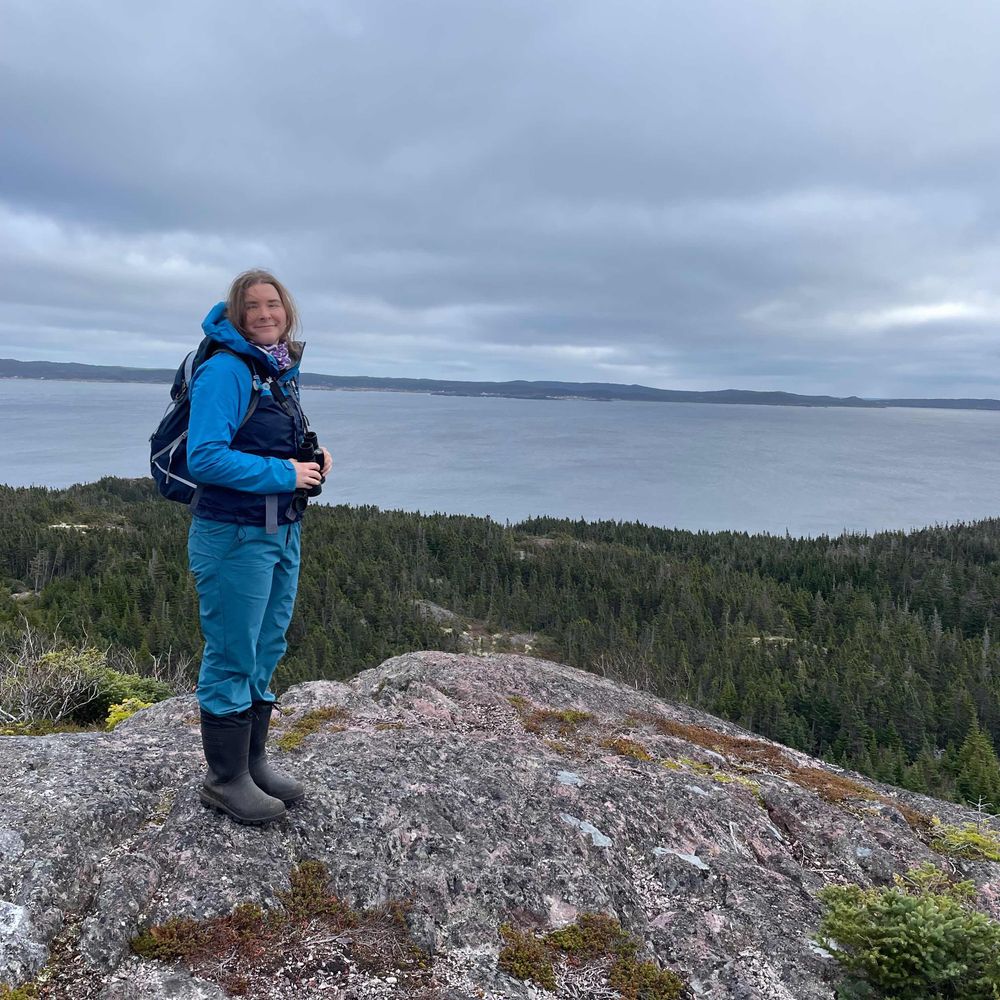
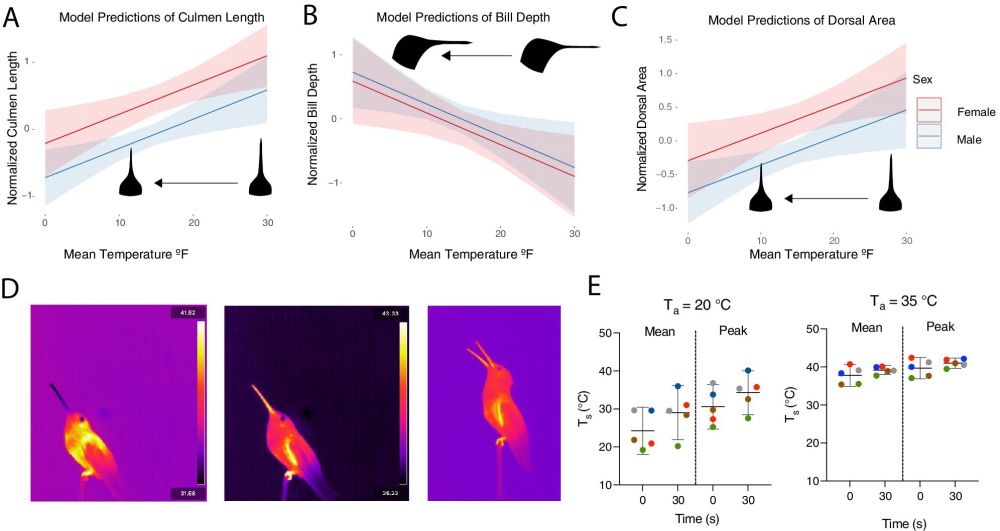
How and why does cognition vary so greatly between individuals and species? In @natrevbiodiv.nature.com, we propose the "Predatory Intelligence Hypothesis" which posits that the cognitive challenges associated with predator–prey interactions drive a cognitive co-evolutionary arms race
rdcu.be/e5KIj
26.02.2026 02:22
👍 47
🔁 23
💬 1
📌 1

Partnership with journals - MetaROR
About Our Partner Journals About Our Partner Journals Leveraging reviews for streamlined journal submissions Leveraging reviews for streamlined journal submissions
After peer review and editori...
🤝 MetaROR is happy to announce Replication Research as its new partner journal!
@r2journal.bsky.social is an interdisciplinary journal for replication research focusing on reproductions, close replications and conceptual replications.
👇 See our full list of partners on our website
19.02.2026 09:49
👍 3
🔁 5
💬 0
📌 0

Same species, different stories: The facts about caribou and reindeer - WWF.CA
Are reindeer and caribou really that different? And what challenges are these deer-like animals facing across the Arctic?
Nice, accessible overview from WWF on caribou and reindeer and why they matter in a rapidly changing Arctic. It's been great to collaborate with Jan Adamczewski and WWF on caribou research across northern Canada.
wwf.ca/stories/fact...
#Caribou #Arctic #Conservation
21.12.2025 02:26
👍 3
🔁 2
💬 0
📌 0

Criteria for zoogeochemical niche construction.
Zoogeochemical niche construction: how animal-mediated biogeochemistry affects evolution
http://dlvr.it/TPswWZ
@kristymferraro.bsky.social & colleagues
@cp-trendsecolevo.bsky.social
#AGU25
17.12.2025 17:33
👍 4
🔁 3
💬 0
📌 0
While our evidence supports early warming triggered these observations in 2024 and 2025, I want to record that for a hot minute we thought it was caused by the 2024 total solar eclipse, as NL was in the path of totality. And that might have been the peak of my scientific career 🌞 (6/6).
09.12.2025 16:10
👍 1
🔁 0
💬 0
📌 0

A group of caribou in their white winter coat look at the camera
We will continue to monitor the Fogo Island caribou population to see if this trend persists, and look for impacts on reproductive fitness that may occur from simultaneous antler growth and pregnancy, of particular importance in this at risk species. (5/6)
09.12.2025 16:10
👍 2
🔁 0
💬 1
📌 0

A caribou growing velvety antlers, 3-4 inches long, her belly indicates she is pregnant (we confirmed later that year).
After days, that felt like weeks, we finally photographed a pregnant caribou sporting velvety antlers 📸. But our side quest had only just begun. We observed no individuals with mature antlers that spring, when usually ~20% have mature antlers. Why had the caribou lost their antlers early? 🕵️♀️(3/6)
09.12.2025 16:10
👍 1
🔁 0
💬 1
📌 0
Thus began a sidequest, get photographic evidence that the caribou were growing their antlers at the ‘wrong’ time of the year. Caribou are the only species where females grow antlers, shedding them after calving in late spring. We had never seen antlers growing in spring. (2/6)
09.12.2025 16:10
👍 1
🔁 0
💬 1
📌 0

A partially obscured caribou with 3 inch long velvety antler nubs.
The curious incident of the antlers in the springtime 🦌
During 2024 spring fieldwork, I spotted a female caribou, for a split second through binoculars, growing fuzzy antlers when she should have had mature antlers. She ran away before anyone else saw. 🧪(1/6)
#caribou #nature #naturalhistory
09.12.2025 16:10
👍 4
🔁 2
💬 1
📌 1
While our evidence supports early warming triggered these observations in 2024 and 2025, I want to record that for a hot minute we thought it was caused by the 2024 total solar eclipse, NL was in the path of totality. And that might have been the peak of my scientific career 🌞 (6/6).
09.12.2025 15:49
👍 0
🔁 0
💬 0
📌 0
We will continue to monitor the Fogo Island caribou population to see if this trend persists, and look for impacts on reproductive fitness that may occur from simultaneous antler growth and pregnancy, of particular importance in this at risk species. (5/6)
09.12.2025 15:49
👍 0
🔁 0
💬 1
📌 0
We explore multiple hypotheses in our recent work, but ultimately found support for one.
🔎 Earlier warming and reductions in snow cover seem to have triggered early antler shedding, and regrowth. This alternate timing coincides with pregnancy and lactation. (4/6)
09.12.2025 15:49
👍 0
🔁 0
💬 1
📌 0
After days, that felt like weeks, we finally photographed a pregnant caribou sporting velvety antlers. But our side quest had only just begun. We observed no individuals with mature antlers that spring, despite 20% normally having antlers. Why had the caribou lost their antlers early? 🕵️♀️ (3/6)
09.12.2025 15:49
👍 0
🔁 0
💬 1
📌 0
Thus began a sidequest, get photographic evidence that the caribou were growing their antlers at the ‘wrong’ time of the year. 📸
Caribou are the only species where females grow antlers, shedding them after calving in late spring. We had never seen antlers growing in spring. (2/6)
09.12.2025 15:49
👍 0
🔁 0
💬 1
📌 0

Chance Encounter Prompts U of G Discovery About Reindeer
Part of a research team measuring the health of a woodland caribou herd on Fogo Island in Newfoundland, the University of Guelph PhD student…
#UofG researchers alter course in their study of caribou on Fogo Island, Newfoundland, finding climate change could be having significant impacts on the Arctic mammal.
@uofgcbs.bsky.social
09.12.2025 14:02
👍 5
🔁 4
💬 0
📌 1
Check out our special feature!! We're excited to highlight some of the recent trends in the movement ecology field!
09.12.2025 14:53
👍 7
🔁 3
💬 0
📌 0

Equilibrium - is it a thing? Jury's still out according to the sticker poll on my poster at #CSEE2025! Stay tuned for the paper!
11.07.2025 14:57
👍 11
🔁 2
💬 0
📌 1
I had a great time at @csee-sceemtgs.bsky.social in Sherbrooke, thank you so much to the organizers and volunteers.
And thanks everyone who indulged me for a few minutes to be caribou game show contestants! I had a blast talking about the landscape of disgust with everyone.
11.07.2025 01:07
👍 4
🔁 0
💬 0
📌 0
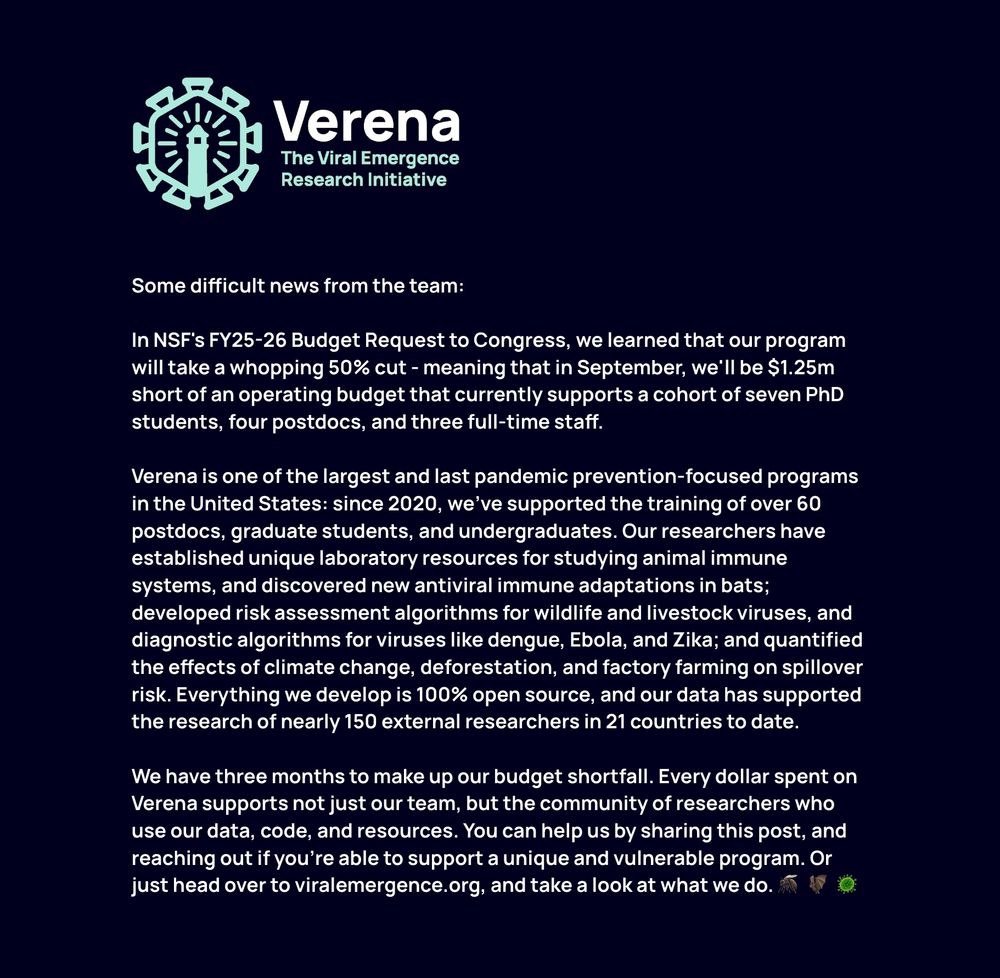
Some difficult news from the team:
In NSF's FY25-26 Budget Request to Congress, we learned that our program will take a whopping 50% cut - meaning that in September, we'll be $1.25m short of an operating budget that currently supports a cohort of seven PhD students, four postdocs, and three full-time staff.
Verena is one of the largest and last pandemic prevention-focused programs in the United States: since 2020, we've supported the training of over 60 postdocs, graduate students, and undergraduates. Our researchers have established unique laboratory resources for studying animal immune systems, and discovered new antiviral immune adaptations in bats; developed risk assessment algorithms for wildlife and livestock viruses, and diagnostic algorithms for viruses like dengue, Ebola, and Zika; and quantified the effects of climate change, deforestation, and factory farming on spillover risk. Everything we develop is 100% open source, and our data has supported the research of nearly 150 external researchers in 21 countries to date.
We have three months to make up our budget shortfall. Every dollar spent on Verena supports not just our team, but the community of researchers who use our data, code, and resources. You can help us by sharing this post, and reaching out if you're able to support a unique and vulnerable program. Or just head over to viralemergence.org, and take a look at what we do. 🦟 🦇 🦠
An update from the team on the uncertain future of our program and the impact of NSF budget cuts. Please share and reach out 🦠
02.06.2025 12:08
👍 139
🔁 104
💬 1
📌 14

Proposed Bill 5 threatens Ontario wildlife and ecosystems
Proposed Bill 5 threatens Ontario wildlife and ecosystems.
The government of Ontario is proposing to change the endangered species act. My advisor @qwebber.bsky.social and @ryannorrissci.bsky.social wrote an op-ed about the proposed changes and planned new bill (and a link to proposal). Public consultation closes May 17th, have you submitted a comment yet?
12.05.2025 12:58
👍 1
🔁 0
💬 0
📌 0
When the Romans conquered Carthage they famously salted the fields so nothing new would grow. By killing NSF, MAGA is salting the scientific fields where new economic innovations would have grown
10.05.2025 01:07
👍 21
🔁 5
💬 0
📌 0

Alannah Grant and Jonathan Chu, PhD in Integrative Biology students

Natalie Wilkinson, Biological Science student

Audrey Peñafiel, Wildlife Biology & Conservation student
Congratulations to the CBS winners of the Student Experience Awards!
🏆Natalie Wilkinson, Biological Science
🏆Audrey Peñafiel, Wildlife Biology & Conservation
🏆Alannah Grant and Jonathan Chu, PhD in Integrative Biology students
🗞️ news.uoguelph.ca/2025/05/cele...
@integrativebiology.bsky.social
09.05.2025 16:11
👍 4
🔁 2
💬 0
📌 0