
A conservative one-point estimate implies ~3.3% of grades enhanced, with a rough overall rate ~5–10% when accounting for pass/fail stakes and >1-point adjustments.
02.01.2026 11:51
👍 0
🔁 0
💬 0
📌 0
A conservative one-point estimate implies ~3.3% of grades enhanced, with a rough overall rate ~5–10% when accounting for pass/fail stakes and >1-point adjustments.
Frequencies just below cut points are systematically lower than just above, and the “above–below” gap is especially pronounced at grade thresholds. We found no robust teacher-gender effect; a small student-gender interaction favors females near thresholds.

In the points distribution, scores cluster immediately above the key thresholds, consistent with borderline “rounding up.” To separate generic round-number preferences from grade-improving discretion, we compared adjacent non-round values straddling thresholds (e.g., 74 vs 76; 89 vs 91).
We analyzed 10+ years of administrative records (winter 2008/09 to summer 2020/21), starting from 2,006,928 evaluations. Institutional cutoffs enable a clear detection strategy (A: 90–100; B: 75–89; C: 60–74; below 60 results in failure; 50–59 triggers a “retake” outcome).
Are teachers objective and impartial when grading (business school) students? Our new (with @bahniks.bsky.social and Simon Senčar) mixed-methods paper examines “grade enhancement”: the practice of raising grades without corresponding improvements in performance. authors.elsevier.com/a/1mNHq38nsw...


In a new short conceptual/review paper with @petrhoudek.bsky.social, we describe how groups or organizations can become corrupt due to selection and sorting effects, socialisation, institutional capture, and norm entrenchment: authors.elsevier.com/c/1ltb3,rU~O...

Only a one week left left to register to the Brno Replication Games on Sept 7th. Virtual participation is possible and coauthorship to a meta paper is granted.
Register here: www.surveymonkey.ca/r/Replicatio...

Our new paper on self-selection effects in dishonesty with @petrhoudek.bsky.social, @marekhudik.bsky.social, and Nicolas Say is out now: authors.elsevier.com/a/1lMN67tbfH...
Last week to apply for a postdoctoral position to work with me, @lubomircingl.bsky.social, and @petrhoudek.bsky.social: bsky.app/profile/bahn...
Salary is competitive, position potentially for up to 3 years, projects are interesting, Prague is great to live in, and application process is easy.

We are hiring up to 3 postdoctoral researchers in economics, psychology, or organizational studies to join our interdisciplinary group at the Prague University of Economics and Business: im.vse.cz/cevyz/englis...
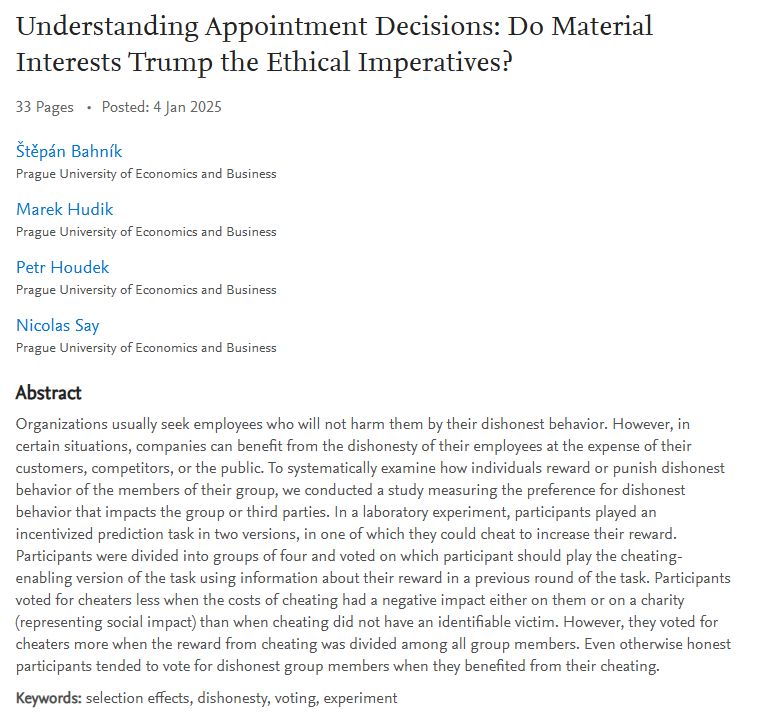
Check out our latest working paper, "Understanding Appointment Decisions: Do Material Interests Trump the Ethical Imperatives?" with @bahniks.bsky.social @petrhoudek.bsky.social and Nicolas Say. 1/5
Hi, Ryan, I would love to be added; thanks.
Hi, Seraphin, I would love to be added; thanks.

if you are interested in real vs. hypothetical choices and/or Taking Games (a version of Dictator Game), we have a super brief paper showing that hypothetical decisions are not always more prosocial / ethical than the real ones authors.elsevier.com/a/1k0dEc5GSa... / t.co/cfuUTxJeAl
Hi Lionel, would love to be added; thanks.
Hi Ben, would love to be added; thanks.
Hi Dan, would love to be added; thanks.
Hi Stephanie, would love to be added; thank you.

6/ 🎓 Read the full study on how random external factors impact leader evaluations and decision-making here: sciencedirect.com/science/arti... We have replicated an earlier study by Weber, Camerer, Rottenstreich, and Knez (2001).
5/ 🚨 Key takeaway: Misattributing success or failure to leadership rather than situational factors can lead to poor decision-making and organizational dysfunction. #DecisionMaking #Leadership
4/ 🧠 Overconfidence trap! Leaders who succeeded in easier tasks were more willing to take risks in harder challenges, despite their initial success being due to external factors. 🎯#RiskTaking #CognitiveBias
3/ 👥 Gender differences emerged: Female leaders were more lenient in evaluating their teams in tough situations compared to male leaders. 💡 #GenderStudies #Leadership
2/ 🔬 In an experiment, we found that team members wrongly credited or blamed leaders based on randomly assigned task difficulty. Success was tied to easy tasks, while hard tasks led to negative evaluations. Leaders were judged on outcomes beyond their control. ⚖️

1/n New research alert! 🚨Our study (led by Nikola Frollová; me and Marcel Tkáčik helping) explores a common organizational error: attributing too much influence to leaders on teams' task outcomes. Spoiler alert: luck plays a bigger role than we think! 🍀

Forces such as business education, management gurus, and expectations from stakeholders create the ideal identity of a manager. Their real identity cannot fully achieve the ideal. The inability to acknowledge some differences leads to managerial taboos, which cause several negative consequences

Our new conceptual paper identifies managerial taboos as key stressors affecting managers' mental health and productivity. We link idealized managerial and leadership identity to adverse personal and organizational outcomes. sciencedirect.com/science/arti...

My recent study on why nudging—subtle behavioral interventions—often fails to make a lasting impact in corporate settings is here doi.org/10.1016/j.jb...
Deep-rooted factors like biology, history & language impact cross-cultural differences & HR practices. My new paper introduces frameworks for integrating these factors into HR management education doi.org/10.1016/j.ij.... Inspired by research by @lamarpierce.bsky.social and others.