The power of data: ethics, politics, and public interest | LSE Event
YouTube video by LSE
First was an engaging session on the role of data science in understanding and shaping the public interest at the LSE with @abpowell.bsky.social, @chrishwiggins.bsky.social, and Erin Young www.youtube.com/live/tLIV4xg... (2/5)
09.05.2025 04:49
👍 2
🔁 1
💬 1
📌 0
The power of data: ethics, politics, and public interest | LSE Event
YouTube video by LSE
Last week, DSI and the Department of Media and Communications (@lsemedia.bsky.social) hosted a talk on data science's role in public interest – from access to info to democracy.
Speakers included Chris Wiggins, @abpowell.bsky.social and Erin Young.
Watch here▶️ www.youtube.com/watch?v=tLIV...
15.05.2025 08:44
👍 4
🔁 3
💬 0
📌 0

The power of data: ethics, politics, and public interest
6.30pm Thurs 8 May | Alison Powell, Chris Wiggins, Erin Young | Free public event at LSE
🤖 The power of #data: #ethics #politics & #publicinterest @lsedatascience.bsky.social
📅 Thurs 8 May 2025 6.30-8pm
@abpowell.bsky.social & experts discuss important questions around the role of data science in understanding & shaping the public interest
Find out more: www.lse.ac.uk/Events/2025/...
26.03.2025 15:34
👍 3
🔁 2
💬 0
📌 0
This is exciting. This is (something like? Some part of?) what I was hoping to see, hoping to create. If you'd like me to come and talk about deceptive stories of technology, or do tech policy tarot, get in touch. We could collab on sensible things too :-)
01.04.2025 10:07
👍 2
🔁 0
💬 0
📌 0

Where can we find other stories for tech policy? My "Repairing Systems and Stories" at U Helsinki gets beyond critique by playing around with narrative structure - involving live Tarot readings for policy projects. Enjoy! www.helsinki.fi/fi/unitube/v...
04.02.2025 15:00
👍 10
🔁 2
💬 0
📌 0
glad you liked it!
15.01.2025 10:04
👍 5
🔁 0
💬 0
📌 0
And if you're still reading - I think this article really shows how joyful creativity can counter the debilitating deluge of AI-schlock in academia and elsewhere. Come for the AI policy; stay for the Shakespeare jokes.
08.01.2025 10:01
👍 3
🔁 0
💬 0
📌 0
I've got the most fun, hilarious, enlightening article with Fenwick McKelvey in this special issue. It's all about the **drama*** of AI policy-making publicera.kb.se/jdsr/article...
07.01.2025 20:52
👍 12
🔁 2
💬 11
📌 0

Are you working on automation of care? The private/public spaces of genomic databases? Epistemic justice? Submit to 4S open panel hosted by @philippseuferling.bsky.social and me - focusing on deceptive narratives and health and care systems. www.xcdsystem.com/4sonline/mem... we are Open Panel 47.
18.12.2024 13:48
👍 10
🔁 1
💬 0
📌 0

Technocolonialism: when technology for good is harmful
6.30pm Thurs 5 Dec | Mirca Madianou | Free public event at LSE
TOMORROW! London friends, come to this LSE talk / book launch for #Technocolonialism: when technology for good is harmful, chaired by @abpowell.bsky.social @lsemedia.bsky.social For those further afield you can join remotely, details below ⬇️ Book details here: www.politybooks.com/bookdetail?b...
04.12.2024 12:19
👍 17
🔁 6
💬 0
📌 0
View of Re-wilding the Night: Understanding How Darkness Is Valued Through the Nighttime Light Ecology of Bonn Botanical Gardens
I've written a few pieces about the idea of the 'more-than-human, looking at 'otherness' 'risk' and 'danger', and how more-than-human ecologies don't only repair the artificial fracture between society and nature, they also allow for deep reflection on humanity itself. ugp.rug.nl/potcj/articl...
25.11.2024 11:39
👍 7
🔁 0
💬 0
📌 0
I need to make a confession. I don't know how to "do" social media any more. I'm a different person than I used to be. The previous person was into Networking. This person is mostly interested in Doing The Work. I like the memes though, thanks.
23.11.2024 15:58
👍 7
🔁 0
💬 0
📌 0
This line really got me: "even though women academic experts posted as frequently as male experts on Twitter and followed and engaged with similar numbers of people, they, amassed, on average, only half as many followers as their male colleagues. Male experts also got nearly double as many likes"
18.11.2024 17:27
👍 7
🔁 4
💬 0
📌 0
I'm so happy to see this. I've been thinking recently about "digital innovation harm reduction" - that is, rebalancing how innovation is thought about, who benefits from it and how it is done. Rachel's done so much of the heavy lifting to start and connect work in this area - hope to join in
16.11.2024 15:02
👍 4
🔁 1
💬 9
📌 1
Wonderful! Already shared to my students.
15.11.2024 10:46
👍 3
🔁 0
💬 0
📌 0
I have mixed feelings about a focus on AI metaphors. If one knows that an LLM is an elaborate autocorrect, one might read 'intelligent machine' as a metaphor to critique. But much of public press is shaped towards the idea that the robots are smart, and there's nothing we can do about it.
15.11.2024 09:13
👍 2
🔁 0
💬 0
📌 0
News from Aotearoa, where the treaty governing the country has *two versions* - only one that Māori signatories agreed to. Soon to be published is a PhD by my student Henry Lyons investigating the epistemic, ontological and land-based issues that have resulted, in the here and now
14.11.2024 16:38
👍 0
🔁 0
💬 0
📌 0
I have a periodically pinched nerve in the neck which makes a migraine-like effect.... stress triggered obviously. But no stress here! Totally relaxing time! Nothing awry at all! (etc)
14.11.2024 16:32
👍 1
🔁 0
💬 1
📌 0
I've discovered I might have nerve headaches for four years. That'll bring the twitch
14.11.2024 13:25
👍 1
🔁 0
💬 1
📌 0

How Lidl accidentally took on the big guns of cloud computing
A unit of Europe’s largest retailer is offering IT services to companies wary of big providers such as Amazon and Google
Thinking about how to avoid US owned compute...? "How Lidl accidentally took on the big guns of cloud computing: A unit of Europe’s largest retailer is offering IT services to companies wary of big providers such as Amazon and Google" www.irishtimes.com/business/202...
14.11.2024 10:47
👍 35
🔁 13
💬 1
📌 3

Pedestrians spend more, new report reveals
Living Streets launches its updated Pedestrian Pound report, showing the correlation between walkable places and thriving business.
“One of the many fascinating facts in the report is that businesses based in the town centre earn 20% more profit when there’s a bank and post office on the high street. It’s clear that public realm improvements can provide multi-dimensional benefits.”
www.livingstreets.org.uk/press-media/...
14.11.2024 13:06
👍 8
🔁 6
💬 0
📌 0

AI is Expensive
LSE’s Alison Powell explains the real costs of AI, and how these might be mitigated. AI is everywhere; AI is here. The story around AI implies that it is here because it’s making things effic…
Hello to everyone. These days most of my energies are going to teaching that the current arrangements of power/discourse/technology are not inevitable - but I did write this short thing recently on how AI is expensive blogs.lse.ac.uk/medialse/202...
13.11.2024 09:07
👍 6
🔁 2
💬 0
📌 0

begin | Carceral AI
New - and ever more crucial report - on carceral AI, a growing class of algorithmic and data-driven practices designed to police, incarcerate, surveil, and control people.
Recommendations, report, and beautiful artwork too!
www.carceral-ai.com Spearheaded by @dashapruss.bsky.social
11.11.2024 21:31
👍 39
🔁 25
💬 1
📌 2
Oh geez. Penny just dropped.
08.11.2024 11:01
👍 0
🔁 0
💬 0
📌 0
Critical Data Studies researcher here. 100% agree. Do not under any circumstances submit your medical scans to Grok.
29.10.2024 17:46
👍 3
🔁 2
💬 0
📌 0
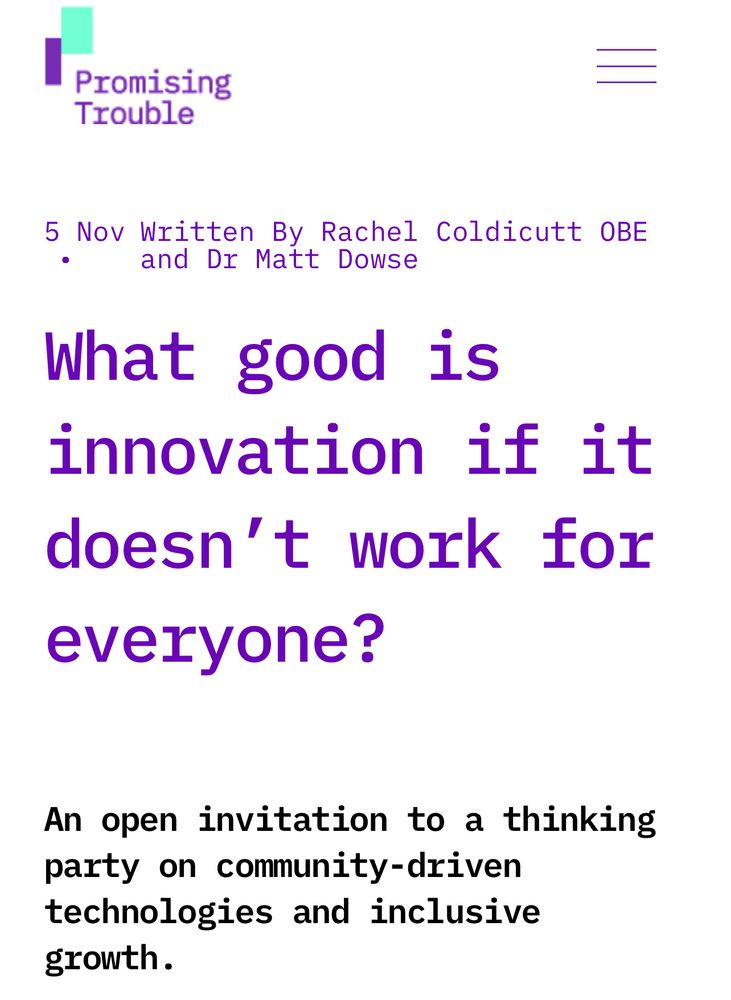
Promising
Trouble
5 Nov Written By Rachel Coldicutt OBE
and Dr Matt Dowse
What good is innovation if it doesn't work for
everyone?
An open invitation to a thinking party on community-driven technologies and inclusive growth.
![Rather than accruing benefits only to a small, socially elite group of innovators, a truly modern innovation economy must seek to create more plural, more equitable opportunities that are accessible beyond major research institutions and massive tech corporations, that prioritise regeneration over extraction, and that uplift and empower people and communities in their diversity.
"Small" in this case does not mean a lack of ambition; it denotes a lack of concentration - a tendency towards pluralism, and an embrace of many possible, parallel realities and futures that are imagined within limits.
The resource intensive nature of modern technologies at scale make these steps urgent, and it seems likely that a shift to smaller-scale and more distributed approaches to computing will become an imperative over the coming decade. [4]](https://cdn.bsky.app/img/feed_thumbnail/plain/did:plc:dvvvi2lfda3eq46zikkozitb/bafkreidz7dr4l3rcyapdfywjyqbhraez44seqq7gv7kp6nnzzrwoxuepo4@jpeg)
Rather than accruing benefits only to a small, socially elite group of innovators, a truly modern innovation economy must seek to create more plural, more equitable opportunities that are accessible beyond major research institutions and massive tech corporations, that prioritise regeneration over extraction, and that uplift and empower people and communities in their diversity.
"Small" in this case does not mean a lack of ambition; it denotes a lack of concentration - a tendency towards pluralism, and an embrace of many possible, parallel realities and futures that are imagined within limits.
The resource intensive nature of modern technologies at scale make these steps urgent, and it seems likely that a shift to smaller-scale and more distributed approaches to computing will become an imperative over the coming decade. [4]

1. Funding: What needs to shift to make viable technology investment that prioritises long-term social returns rather than short-term profit and status?
2. Measurement: What are the metrics and measurement approaches that will make this attractive to policy makers?
3. Infrastructure: What infrastructures are needed to foster long-term, vision-led investments in technology capabilities that prioritise equitable, regenerative, health societies?
![4. Intelligences: What interventions are needed to enable technologies to be created and altered to enable a
"repertoire of intelligences" [5] rather than support returns to a small number of Silicon Valley companies and investors?
5. Organising: What methods of organising are needed? What does organising in this new normal look like? How can communities organise for a new innovation economy?](https://cdn.bsky.app/img/feed_thumbnail/plain/did:plc:dvvvi2lfda3eq46zikkozitb/bafkreihcxxrzn3m3zisjzd4clr3xnx675nitda4xt2wsypy2rmtjijxpjm@jpeg)
4. Intelligences: What interventions are needed to enable technologies to be created and altered to enable a
"repertoire of intelligences" [5] rather than support returns to a small number of Silicon Valley companies and investors?
5. Organising: What methods of organising are needed? What does organising in this new normal look like? How can communities organise for a new innovation economy?
Don't pace around nervously! Read this new essay by me and Matt Dowse from the Centre for Sociodigital Futures.
What if innovation were rethought as if people, rather than firms, are the things that matter most?
www.promisingtrouble.net/blog/innovat...
@carefultrouble.bsky.social
05.11.2024 08:02
👍 46
🔁 18
💬 3
📌 7

Spectacular cream and green fungus growing within and around a gnarled log
So we are here, now. Hello. I've been thinking about 'digital innovation," and how narratives of efficiency, objectivity and accuracy obscure potential damage to knowledge and care. Been writing about Babylon Health, teaching students about AI governance. Gardening and looking at mushrooms. You?
08.11.2024 09:51
👍 3
🔁 0
💬 0
📌 0