📣 Please share: We invite submissions to the 29th International Conference on Artificial Intelligence and Statistics (#AISTATS 2026) and welcome paper submissions at the intersection of AI, machine learning, statistics, and related areas. [1/3]
12.08.2025 11:46
👍 36
🔁 21
💬 2
📌 2

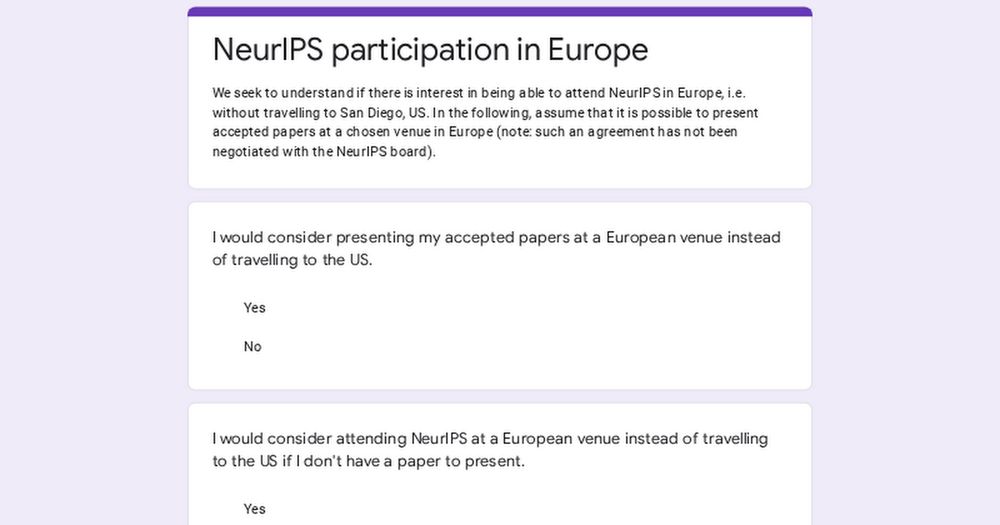
EurIPS is coming! 📣 Mark your calendar for Dec. 2-7, 2025 in Copenhagen 📅
EurIPS is a community-organized conference where you can present accepted NeurIPS 2025 papers, endorsed by @neuripsconf.bsky.social and @nordicair.bsky.social and is co-developed by @ellis.eu
eurips.cc
16.07.2025 22:00
👍 143
🔁 70
💬 2
📌 19
📣 Excited to present our ICLR spotlight paper at #ICLR2025!
"Bayesian Optimization via Continual Variational Last Layer Training"
📍 Poster #368 (Hall 3 + Hall 2B)
⏰ Friday during Poster Session 3
If you're in Singapore and interested in BO or Bayesian methods, definitely stop by!
More infos👇
22.04.2025 22:48
👍 1
🔁 1
💬 1
📌 0
If you would like to read the paper, download the models or catch us at AISTATS, here are the details:
📑: arxiv.org/abs/2503.13296.
📍: Poster Session 1 - Poster 109.
Code+Models: github.com/jonasvj/OnLo... (7/7)
22.04.2025 11:48
👍 0
🔁 0
💬 0
📌 0
Finally, we open-source all of our trained BNNs for further analysis - we do this due to the computational efforts required to train these models, and to allow further analysis of empirical results that we find highly unintuitive and surprising. (6/7)
22.04.2025 11:48
👍 0
🔁 0
💬 1
📌 0
We also conduct a number of sensitivity and ablation studies to explain the different predictive performance between BNN and DE-BNNs. (5/7)
22.04.2025 11:48
👍 0
🔁 0
💬 1
📌 0
We show that increased out-of-distribution performance in DE-BNNs often comes at an in-distribution performance cost and that DEs generally outperform DE-BNNs on in-distribution metrics for large ensemble sizes. (4/7)
22.04.2025 11:48
👍 0
🔁 0
💬 1
📌 0
Surprisingly, we find that across a number of dataset, architectures, approximate inference methods and tasks, that this is not the case when the ensembles grow large enough (but not in the asymptotic regime). A few key points from the paper: (3/7)
22.04.2025 11:48
👍 0
🔁 0
💬 1
📌 0
In this work we investigated the commonly held belief that trivially equipping Deep Ensembles (DEs) with local posterior structure (obtaining what we call DE-BNNs) should improve predictive uncertainty and model calibration. (2/7)
22.04.2025 11:48
👍 0
🔁 0
💬 1
📌 0
I will soon be travelling to Thailand to present our recently accepted paper "On Local Posterior Structure in Deep Ensembles" at AISTATS! The paper was written with my joint first co-author Jonas Vestergaard Jensen, Mikkel Schmidt and Michael Riis Andersen. (1/7)
22.04.2025 11:48
👍 5
🔁 1
💬 1
📌 1
Our paper got accepted to ICLR 2025! 🎉 Looking forward to meeting everyone in Singapur!
25.01.2025 08:34
👍 1
🔁 1
💬 0
📌 0

BO with Variational Last Layers as Surrogate
📚 New Paper with collaborators from DTU, Vector, & Google DeepMind
A neural net-based approach to BO that performs well in both classic, small-scale problems, and can efficiently scale far beyond GP surrogate models.
Visit our poster @ NeurIPS Bayesian decision-making workshop today!
More info👇
14.12.2024 20:59
👍 6
🔁 3
💬 1
📌 2