More or Less - The Stats of the Nation - Older People, Education, Prisons and the Weather - BBC Sounds
Tim Harford explores the stats on pensioners, exams, justice and climate change.
I had a great time chatting about older people with
@timharford.ft.com on BBC4 More or Less. The starting question was – are one in four pensioners really millionaires? Quick thread below: www.bbc.co.uk/sounds/play/...
08.01.2026 11:17
👍 10
🔁 6
💬 2
📌 0

Only consolidating pots worth <£1k would still mean many people would reach retirement with savings scattered across several pots.
No timeline was announced for the consolidation of larger deferred pots. But the Minister for Pensions did indicate this could happen in the future
24.04.2025 15:12
👍 0
🔁 0
💬 1
📌 0

The DWP report contains lots of detail on how this will be implemented in practice. They plan to create a Small Pots Data Platform to carry out the consolidation.
Good to see that they will consider how this platform could build on the work done for Pensions Dashboard.
24.04.2025 15:12
👍 0
🔁 0
💬 1
📌 0
The government has announced plans to automatically consolidate deferred pots worth up to £1k into one of a number of consolidator schemes.
Overall, this will be a large improvement on the status quo, reducing costs for pension providers and complexity for individual savers.
24.04.2025 15:12
👍 0
🔁 0
💬 1
📌 0

Earlier this year, we showed that lower earners, younger employees and women are particularly likely to accumulate these small pots.
24.04.2025 15:12
👍 0
🔁 0
💬 1
📌 0
The proliferation of these small pots matters.
First, it is costly for pension providers, leading to higher charges for savers.
Second, it makes it easier for people to lose track of their savings, and much harder to make good decisions on using wealth in retirement.
24.04.2025 15:12
👍 0
🔁 0
💬 1
📌 0
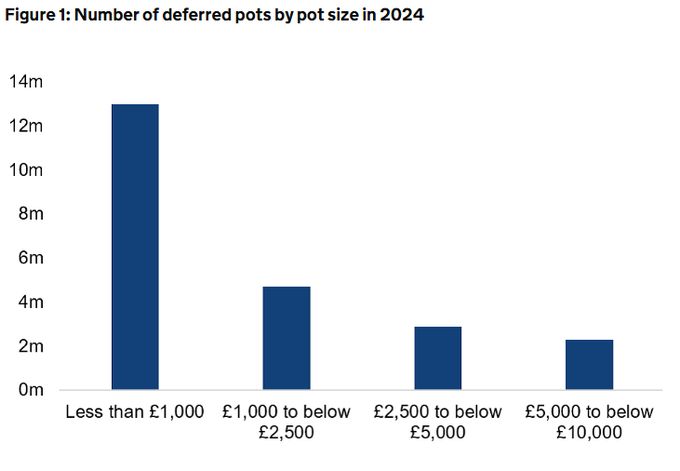
In 2024 there were over 13 million pension pots in the UK worth <£1k that are no longer being contributed to ("deferred"). This is up from around 12 million in 2023.
Plus another 10 million pots worth between £1k and £10k.
24.04.2025 15:12
👍 0
🔁 0
💬 1
📌 0
Today the government announced more detail on how they plan to tackle the large number of small pots in the UK pension system.
The reforms are due to be announced in the upcoming Pension Schemes bill this spring.
A few thoughts on why this matters and what was announced. 👇
24.04.2025 15:12
👍 3
🔁 5
💬 1
📌 0
We've built a new IFS tool which can be used to explore what the government spends money on, and where in the UK benefits from that spending. Here it is: ifs.org.uk/calculators/.... Short thread on what you can do with the tool:
10.04.2025 08:42
👍 13
🔁 8
💬 1
📌 1
State pension age starts rising again in April 2026. Most people in their early 60s know their state pension age, but a significant minority are incorrect or unaware.
This is worrying as people may base retirement and saving decisions on incorrect information. Short thread👇
07.04.2025 09:31
👍 6
🔁 6
💬 0
📌 0

New report out today with colleagues @theifs.bsky.social and funded by @jrf-uk.bsky.social and @healthfoundation.bsky.social.
We look at what we know about the role of changing health and reported disability in the 38% rise in people claiming disability benefits since the pandemic. A 🧵 [1/10]
12.03.2025 15:56
👍 11
🔁 5
💬 1
📌 1

Guest comment: Ending the small pots epidemic
IFS research economist and report author, Laurence O’Brien, takes a closer look at recent research on the small pots epidemic, arguing that it is
NEW: Ending the small pots epidemic
@laurenceobrien.bsky.social writes about why the proliferation of small deferred pension pots is burdensome, and the policy options, for Pensions Age:
19.02.2025 09:32
👍 1
🔁 1
💬 0
📌 0

Chart shows median of real hourly earnings for public sector employees in Scotland and the UK. Title states: "Median public sector pay is now higher in Scotland than in the UK overall."
NEW: Median public sector pay is up by 5% in Scotland since 2019, in contrast to no UK-wide increase.
Jonathan Cribb, Magdalena Domínguez and @laurenceobrien.bsky.social's new Scottish Budget report analyses Scottish public sector employment and pay, and the policy implications:
[THREAD: 1/7]
18.02.2025 07:27
👍 0
🔁 2
💬 2
📌 0
There are over 12 million DC pension pots worth <£1k. This creates complexity for savers and increases costs for providers.
The government should help savers out by ensuring that their deferred small pension pots are consolidated together automatically. See 👇 for more details
12.02.2025 17:36
👍 3
🔁 1
💬 0
📌 0
A proper piece of work, this. Some great analysis of how households responded to the energy price shock and how effective government policy was at shielding them.
The implications for HM Treasury are pretty clear: build a better database! It could save you billions!
ifs.org.uk/publications...
31.01.2025 08:46
👍 9
🔁 9
💬 0
📌 0
Or check out @david-sturrock.bsky.social's summary thread here: bsky.app/profile/davi...
23.01.2025 15:27
👍 0
🔁 0
💬 0
📌 0
New @theifs.bsky.social research out today! We show that Pakistani and Bangladeshi employees are almost twice as likely to opt out of their workplace pension as other employees.
This can have big implications for retirement incomes and evidence points to Islamic religious beliefs as a key driver.
23.01.2025 15:27
👍 4
🔁 1
💬 1
📌 0

Ethnicity gaps in pension participation | Institute for Fiscal Studies
IFS researchers will present new findings exploring ethnic gaps in pension participation rates following the rollout of automatic enrollment.
EVENT: Ethnicity gaps in pension participation
Thurs 23 Jan 2025 | 2pm – 3pm | Online
We present new findings on ethnic gaps in pension participation rates, with Taha Choukhmane, Athina Vlachantoni, @laurenceobrien.bsky.social and Carl Emmerson.
Sign up here: ifs.org.uk/events/ethni...
17.01.2025 12:06
👍 1
🔁 3
💬 0
📌 0
Understanding these drivers is key for predicting the effects of future ERA changes, both in the UK and abroad.
e.g. Future UK retirees will likely have larger DC pots, which they can flexibly access before ERA. This could mean more can afford to retire before ERA, reducing its employment effect.
10.01.2025 16:23
👍 0
🔁 0
💬 0
📌 0

We also find no evidence of employers being more likely to dismiss workers once they reach the ERA in the UK. While this is common in e.g. the Netherlands & the US, strong age discrimination laws prevent this in the UK.
10.01.2025 16:23
👍 0
🔁 0
💬 1
📌 0
On the other hand, other mechanisms seem less important in our context.
Women with larger changes in wealth due to the reform had similar changes in employment to women with smaller changes in wealth. "Wealth effects" - i.e. retiring later due to lower wealth - are therefore not a main driver.
10.01.2025 16:23
👍 0
🔁 0
💬 1
📌 0
We find women who had low levels of financial wealth before reaching the ERA were twice as likely to retire later due to the reform as wealthier women.
This suggests that "credit constraints", i.e. not being able to afford to retire before the ERA, is a key driver of the employment rise.
10.01.2025 16:23
👍 0
🔁 0
💬 1
📌 0

This led to an increase in employment rates for women in their early 60s of just over 9 percentage points.
The magnitude of the increase is consistent with studies from other countries.
We compare the employment responses for different groups of women to shed light on the key drivers.
10.01.2025 16:23
👍 0
🔁 0
💬 1
📌 0

To do this, we look at the increase in the ERA for women in the UK (often referred to as the state pension age).
The female ERA increased from 60 to 66 between 2010 and 2020.
10.01.2025 16:23
👍 0
🔁 0
💬 1
📌 0
New working paper out!
Governments in many countries have raised early retirement ages (ERAs) in response to public finance pressures from ageing populations.
These policies have consistently been found to lead to increased employment rates among older workers.
This paper asks: why? 🤔
10.01.2025 16:23
👍 2
🔁 4
💬 2
📌 0