

New year, new forthcoming book announcement! Very excited to post more about it soon! Link: www.cambridge.org/us/universit...
02.01.2026 14:54
👍 17
🔁 5
💬 0
📌 0
New year, new forthcoming book announcement! Very excited to post more about it soon! Link: www.cambridge.org/us/universit...
1. Downgraded from Claude Max to Pro. My mental health has significantly improved. Less feeling like I'm being chased all the time (was whipping myself for higher productivity)
2. Claude>>Codex for me so far
3. Still haven't figured out how best to raise the next academic generation in this era

🚨 Interested in survey experiments? I'll be giving a virtual talk on (false) null results in experiments--and how to protect against them--at SWERP on 3/13 (3/12 8pm EST). Hope to see you there, and thanks to @sysilviakim.bsky.social for inviting me!
Link to join: swerp.netlify.app
I’m having a mini panic attack every day

It must be very hard to publish null results Publication practices in the social sciences act as a filter that favors statistically significant results over null findings. While the problem of selection on significance (SoS) is well-known in theory, it has been difficult to measure its scope empirically, and it has been challenging to determine how selection varies across contexts. In this article, we use large language models to extract granular and validated data on about 100,000 articles published in over 150 political science journals from 2010 to 2024. We show that fewer than 2% of articles that rely on statistical methods report null-only findings in their abstracts, while over 90% of papers highlight significant results. To put these findings in perspective, we develop and calibrate a simple model of publication bias. Across a range of plausible assumptions, we find that statistically significant results are estimated to be one to two orders of magnitude more likely to enter the published record than null results. Leveraging metadata extracted from individual articles, we show that the pattern of strong SoS holds across subfields, journals, methods, and time periods. However, a few factors such as pre-registration and randomized experiments correlate with greater acceptance of null results. We conclude by discussing implications for the field and the potential of our new dataset for investigating other questions about political science.
I have a new paper. We look at ~all stats articles in political science post-2010 & show that 94% have abstracts that claim to reject a null. Only 2% present only null results. This is hard to explain unless the research process has a filter that only lets rejections through.
So happy that my Cambridge Element with @yesolakweon.bsky.social has been published! Free access for the next two weeks!
It’s now official. I’ll be publishing my first book, Respectability Politics, w/ @uchicagopress.bsky.social!
Proud to join a press w/ a strong lineage in Black studies & Black politics, including Cohen’s Boundaries of Blackness, which has deeply inspired my work.
Now to get these revisions done.

p.s. This took ~9 hours of back-and-forth with Claude Code. What an era.
For student or faculty struggling to juggle projects: I've definitely benefited from this approach. I'm not saying this is a magic productivity bullet, but if you need some motivation, create your own for 2026.
PRs/feedback welcome (it's still probably buggy in places)

It supports standard flowcharts (great for academic diagrams) and Gantt-style timelines.
I heavily rely on timeline viz to see where my projects are and where I am. Used this format for 6+ years with my writing group. See attachment for my 2026 timeline and goals.

Just built ✨FlowCraft✨, a free, open-source diagramming app (thanks Claude Code!)
Browser-based, no server, no signup, no tracking, no subscription, no dependencies, and no Internet required. Just open a single HTML file and start diagramming. AGPL.
github.com/sysilviakim/...

Look at the intensity gap in this NYT graph of how voters describe their current feelings toward Trump www.nytimes.com/interactive/...

Just published at PNAS (@pnas.org): “Electing amateur politicians reduces cross-party collaboration”
We show that districts electing first-time members of the U.S. House experience substantial declines in bipartisan representation in the subsequent Congress.
🧵1/4

"President Donald Trump and his top aides are using the word 'insurrection' more frequently to describe anti-ICE protests in places like Portland," writes Zachary B. Wolf. https://cnn.it/4pWYmzr
Public/private info on whether you will be doing admissions as usual will also be hugely appreciated!! Thank you
U.S. political scientists, are any of your depts *not* admitting new PhD students this year (esp. for international applicants)?
I'm gathering info to help students know where to reconsider applying. Applications are not cheap and they're despairing. Appreciate any details.
The latest issue of PA is out now. We have a great collection of papers by @yamilrvelez.bsky.social, @sysilviakim.bsky.social, @mattblackwell.bsky.social, @sophieehill.bsky.social, @dwlee.bsky.social, @melissazrogers.bsky.social, @kaipingchen.bsky.social, @samuelbaltz.bsky.social (1/2)
서울대학교 정치외교학부에서 전임교원을 채용합니다. 미국정치 1명 및 미국 외교정책 1명입니다. 다음 링크를 참고 부탁드립니다. 감사합니다.
social.snu.ac.kr/%EA%B3%B5%EC...

SWERP is back for fall 2025! Under what international contexts are citizens more likely to support peace with a foreign adversary? Jungmin Han will present about how third-party interactions shape public opinion on rapprochement.
Sep 26, 2025, 10am KST (= Sep 25 9pm ET)

I'm not at APSA, but my master's student/coauthor, Sangmyung, is presenting! Come see how ideological "incongruence" in the U.S. has changed in the last decade.
Sat, Sep 13, 2-3:30pm local time.
This was a really fun paper to write (but a pain to collect data!) It took me embarrasingly long to wrap up and submit, so I'm thrilled it's now in the books.
Thank you for the post Hans!!


Ideologically extreme candidates don't solicit more small dollar donations. New at @respol.bsky.social from @sysilviakim.bsky.social
journals.sagepub.com/doi/10.1177/...

Currently in FirstView: In “Addressing Measurement Errors in Ranking Questions for the Social Sciences,” Yuki Atsusaka and @sysilviakim.bsky.social examine the statistical consequences of measurement error and introduce a framework for improving ranking data analysis.
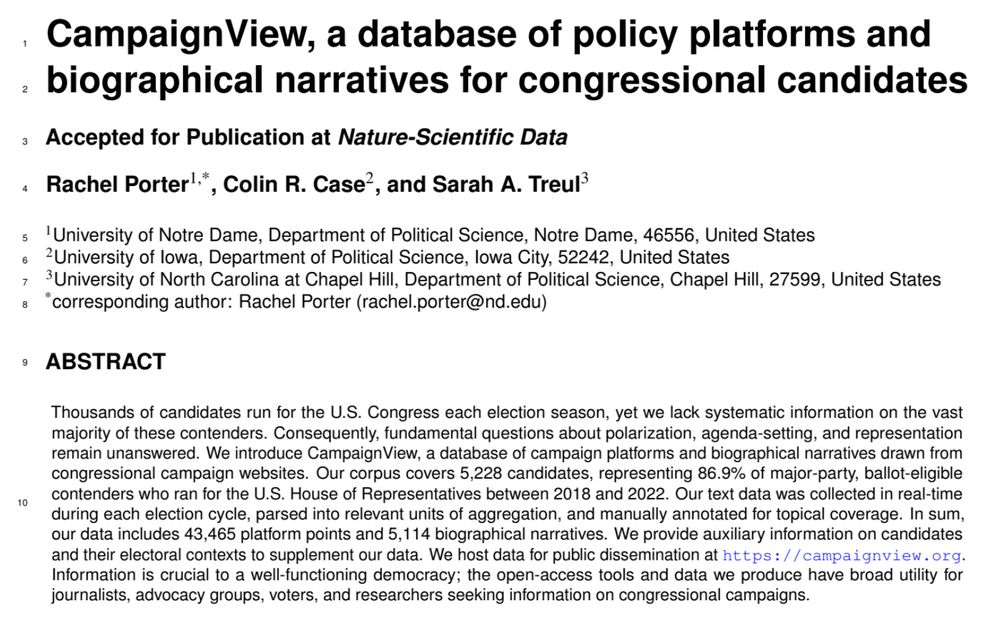
📢 Thrilled to share our new article introducing CampaignView—a comprehensive open-source dataset of congressional candidate campaign bios and policy platforms (2018–2022). Paper + data here: campaignview.org & doi.org/10.7910/DVN/... 🧵1/4

SWERP returns with 2025's third presentation. Dr. Kyosuke Kikuta asks: what is the effect of solar eclipses on violence? Find out how armed groups rationally can use darkness for their tactical purposes.
5/2 10am KST = 5/1 Thu 9pm EST. See you soon!
swerp.weebly.com
Wasn't there a paper recently about how partisans are willing to tolerate cost to themselves and copartisans as long as outpartisans were going to suffer more? Anybody remember which paper this was?

Targeting people for their political views is not going to stop with immigrants.
Gift link: wapo.st/43Ssl2Q
🚨 New paper (with Kasey Rhee & Nico Studen). We use a new within-precinct design to isolate how ideology affects vote choice holding turnout fixed, analyzing 3.4M precinct observations across state & fed elections (2016-2022).
tldr: Ideological moderation affects vote shares, but not by much. 🧵⬇️

Thanks Michael! @jsievert.bsky.social Here's the link: doi.org/10.1086/735435. Happy to chat if you have any questions.