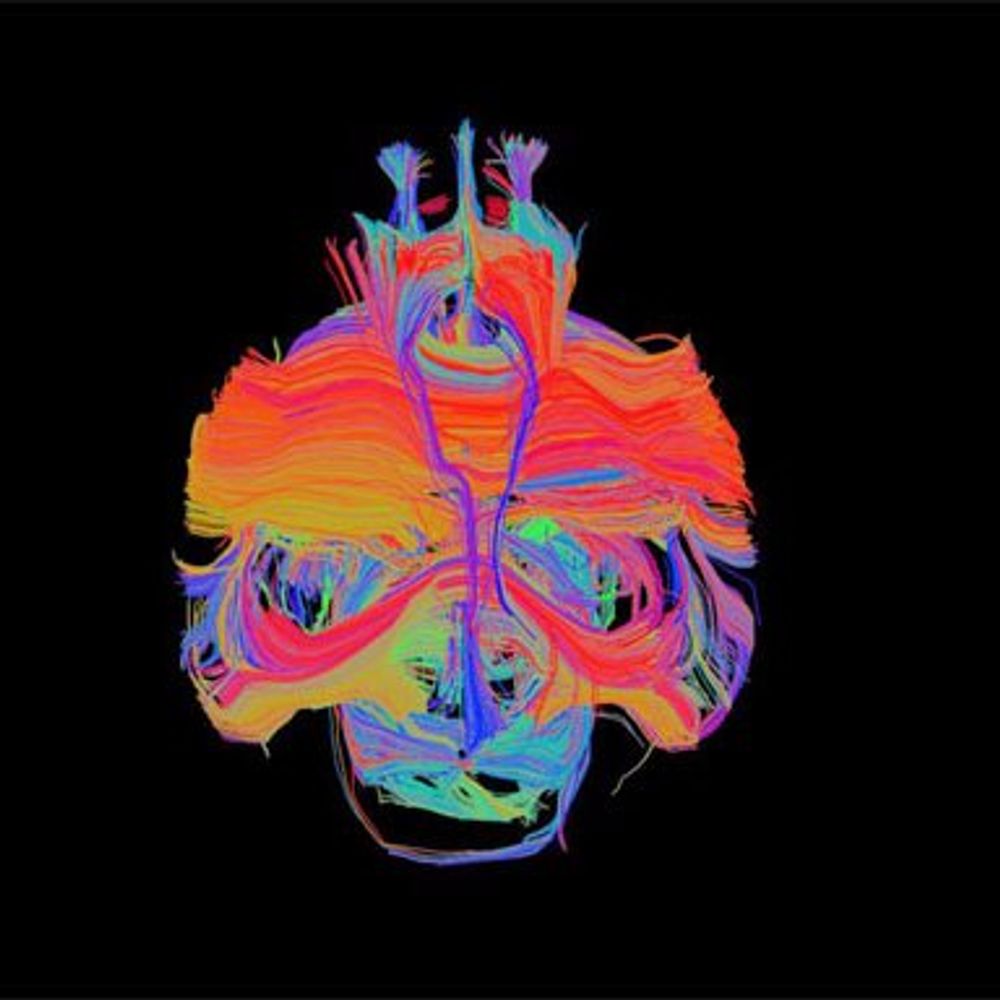
Very grateful to Diego Stefano for involving us in this study (and for the multiple and patient “explain it to me like I’m five” sessions we had 😅). And many thanks also to @erc.europa.eu and @iitalk.bsky.social for funding this work
10/10
05.03.2026 13:39
👍 2
🔁 1
💬 0
📌 0
Take-home message: high-amplitude cofluctuation patterns (CAPs/QPP-like events) can *emerge* from cortico-cortical attractor dynamics alone - especially when anatomical connectivity is *directed*. So neuromodulatory input is not (theoretically) necessary to the emergence of this phenomenon
9/10
05.03.2026 13:39
👍 2
🔁 0
💬 1
📌 0

Bonus 2: we also see transient *non-homotopic* states despite a highly symmetric connectome -i.e., spontaneous symmetry breaking (physicists, you know 😆...). Similar signatures show up in the real fMRI data too.
8/10
05.03.2026 13:39
👍 0
🔁 0
💬 1
📌 0

Bonus 1. The model also predicts the classic anti-correlations in “fMRI connectivity” that appears after global signal regression, linking this phenomenon to antagonistic transient states (as opposed to an extra ad-hoc mechanism).
7/10
05.03.2026 13:39
👍 0
🔁 0
💬 1
📌 0

These results suggest that empirical CAPs may be manifestations of whole-cortex attractor dynamics of the kind we describe in our model!
⚠️Importantly, this rich dynamics emerges only when using a *directed* axonal connectome, and collapses after connectome symmetrization (think of DTI...)⚠️ 6/10
05.03.2026 13:39
👍 2
🔁 0
💬 1
📌 0

We thus analyzed the dynamics of our model numerically and expressed model attractors as patterns of fMRI activity.
Notably, most stationary attractors we found had symmetric anatomy and emerged in spatially-opposed pairs, recapitulating topography of real-world mouse fMRI CAPs!
5/10
05.03.2026 13:39
👍 0
🔁 0
💬 1
📌 0

Recurrent non-linear networks exhibit attractor dynamics (i.e., they transition into a preferred activity patterns). We thus hypothesized that similar dynamics may exist in real-world fMRI timeseries, and that the emergence & spatial features of CAPs may be related to these attractor states 4/10
05.03.2026 13:39
👍 1
🔁 0
💬 1
📌 0

To begin with, this model reproduces well (ρ = 0.55) the topography of static fMRI connectivity in the mouse, with strong inter-hemispheric symmetry + recognizable systems (Default mode network, latero-cortical, etc..) 3/10
05.03.2026 13:39
👍 0
🔁 0
💬 1
📌 0

This work was led and conceived by star collaborators #stefano_panzeri and #diego_fasoli They built a whole-cortex mouse network model, combining a *directed* axonal connectome (Allen) plus non-linear E/I firing-rate dynamics (spoiler: directed connectivity matters here...) 2/10
05.03.2026 13:39
👍 0
🔁 0
💬 1
📌 0

fMRI connectivity is dominated by recurring high-amplitude BOLD events (CAPs, QPPs)
But what originates these events? Many think neuromodulation is the culprit. Our new work offers a simpler take: cortico-cortical dynamics alone can generate CAP-like events! doi.org/10.1371/journal.pcbi.1013995
🧵1/n
05.03.2026 13:39
👍 37
🔁 17
💬 1
📌 0

fUSI-BIDS extension proposal v0.0.12
BIDS Extension Proposal 40 (BEP040): fUSI-BIDS version 0.0.12.dev Available under the CC-BY 4.0 International license. Extension moderators/leads: Jean-Charles Mariani <jean-charles.mariani@cri-paris...
Next #fUSI - #BIDS meeting is coming up! 🧠
📅 March 19, 5PM CET
🎯 Solving remaining spec remarks & moving toward official maintenance.
Newcomers welcome! 🚀 Planning to BIDSify your data? Join us, we’re here to answer your questions.
Details on the GDoc: docs.google.com/document/d/1...
26.02.2026 13:16
👍 4
🔁 2
💬 0
📌 0

We think of white matter as the highways of the brain. But when we followed development along those highways, we were surprised. The journey is more complex than we thought. My final PhD paper, “Two Axes of White Matter Development”, is now out in @natcomms.nature.com! 🛣️🧠✨
🔗 bit.ly/wm2axes
02.03.2026 01:09
👍 100
🔁 47
💬 2
📌 4

🚨 New Paper: Controlling the Human Connectome with Spatially Diffuse Input Signals
Now in press at Communications Biology!
www.nature.com/articles/s42...
28.02.2026 23:54
👍 38
🔁 13
💬 0
📌 1

🚨A busy start of the year for the lab, with another preprint just out in PsyArXiv, with @lenapl.bsky.social's group. Fernando Gonzales Aste goes deep into the potential for neurophys brain imaging with MEG in severe mental illness research & transformation of care.
osf.io/preprints/ps...
01.03.2026 15:40
👍 8
🔁 2
💬 0
📌 0
A recent paper in @natureportfolio.nature.com raised concerns about the lesion network mapping method. Our team of 16 coauthors analyzed >1000 lesions and 34 symptoms and found that "The methodological foundations of lesion network mapping remain sound" www.biorxiv.org/content/10.6...
26.02.2026 20:40
👍 45
🔁 21
💬 2
📌 3

a man wearing headphones is sitting in front of a microphone .
ALT: a man wearing headphones is sitting in front of a microphone .
New preprint 📣
Do you use the @alleninstitute.org mouse brain connectome?
In work led by Vikram Nathan we found issues with existing connectome representations, fixed them, showed the impact on connectome measures.
Do you wonder what they are?
Do you wonder what they do?
tinyurl.com/5y9mft4e
24.02.2026 09:22
👍 13
🔁 5
💬 1
📌 1

Ten simple rules for building a collaborative coding culture
This was such a fun collaboration with @analog-ashley.bsky.social and team, including some of our own @sciencebanshee.bsky.social and @shen4brains.bsky.social And h/t to Alana McPherson for the infographic!
dx.plos.org/10.1371/jour...
23.02.2026 21:01
👍 16
🔁 8
💬 0
📌 2
thanks Thomas!!!! I knew you'd like our work ;-)
19.02.2026 22:13
👍 0
🔁 0
💬 0
📌 0

NeuroStats2026
Save the date 👆🧵 Neuroimaging Statistics Workshop, 12-13 June, @ohbmofficial.bsky.social 2026 satellite meeting, w/ @ohbmossig.bsky.social's BrainHack. Keith Worsley lecture by Sir. John Aston, + great work at Neuro/Stats/ML/AI interface. Registration opens soon! sites.google.com/view/nsw2026
19.02.2026 17:02
👍 17
🔁 6
💬 1
📌 0
Very cool!
17.02.2026 16:55
👍 5
🔁 1
💬 0
📌 0
Finally, huge credit to soon-to-be-PhD @chiarapepe.bsky.social who led this work with exceptional rigor and vision, and to @jcmariani.bsky.social who co-led and shaped the project throughout. And grateful to @erc.europa.eu and @iitalk.bsky.social for supporting this research! 14/14
17.02.2026 12:25
👍 2
🔁 2
💬 0
📌 0
Take-home message: you can map the mouse functional connectome easily and conveniently with transcranial fUSI. As a long-time fMRI user, I’m genuinely struck by how much lower the technical and infrastructural barrier is compared with MRI!
12/n
17.02.2026 12:25
👍 1
🔁 1
💬 2
📌 0

Best part: the state transitions aren’t random! They form a structured grammar that converges onto three stable attractor-like co-activation modes, matching hallmark fMRI dynamics.
12/n
17.02.2026 12:25
👍 1
🔁 1
💬 1
📌 0

But static maps are only half the story. Resting brain activity moves through states. fUSI captures this too: activity falls into recurring co-activation patterns, organized into paired opposites (CAP/anti-CAPs).
11/n
17.02.2026 12:25
👍 1
🔁 1
💬 1
📌 0

But we didn’t stop at one correlation number. We found that structure–function coupling is best understood as four major axes, i.e., 4 dominant “wiring-to-function motifs” shaping the whole connectome
10/n
17.02.2026 12:25
👍 1
🔁 1
💬 1
📌 0

Next question (the fun one): are these fUSI networks actually grounded in anatomical wiring? Yes: functional connectivity aligns with the structural connectome, strongly and systematically
9/n
17.02.2026 12:25
👍 1
🔁 1
💬 1
📌 0

But fUSI isn’t just “fMRI-lite”. It has its own signature: connectivity patterns are way stronger and reproducible in cortical regions than fMRI, but are more focal and less robust subcortically (so depth sensitivity matters!)
8/n
17.02.2026 12:25
👍 1
🔁 1
💬 1
📌 0