Redirecting
Finally, experience shapes future markets. Positive long-term SHS experience increases willingness to pay for certified, high-quality products. Early failures erode trust in quality signals and risk a “low-quality trap”.
doi.org/10.1016/j.en...
21.01.2026 20:14
👍 0
🔁 0
💬 0
📌 0
Environmental patterns: when systems fail early, their life-cycle efficiency worsens.
Limited lifetimes and battery issues mean many systems struggle to reach meaningful energy payback over their lifetime, despite zero operational emissions.
21.01.2026 20:14
👍 0
🔁 0
💬 1
📌 0
Socioeconomic patterns: outcomes like appliance uptake and children’s evening study time are much stronger where systems keep working.
Short-lived systems deliver far less of the potential “development” effect than installation numbers suggest.
21.01.2026 20:14
👍 0
🔁 0
💬 1
📌 0
Method-wise, we combine three perspectives in one study:
– a propensity-weighted observational comparison
– a life-cycle assessment
– a discrete choice experiment
This lets us connect durability to development outcomes, life-cycle performance, and future demand.
21.01.2026 20:14
👍 0
🔁 0
💬 1
📌 0

About one-third of beneficiary households still have a functioning SHS in use ~10 years after dissemination.
Most non-users report technical failure (often the battery) pointing to repair and replacement as key bottlenecks.
21.01.2026 20:14
👍 0
🔁 0
💬 1
📌 0
The benefits of electrification are often treated as automatic once systems are distributed.
We argue they’re conditional on durability: social outcomes, environmental efficiency, and market trust depend on how long systems provide functional years of service.
21.01.2026 20:14
👍 0
🔁 0
💬 1
📌 0

New paper out in Energy Policy on solar home systems (SHS) in rural Pakistan.
With Marco Nilgen and @jlinde.bsky.social we follow a large SHS programme in rural Sindh ~10 years after rollout and ask:
When does early “access” become sustained i.e., a system that still works and is used years later?
21.01.2026 20:14
👍 1
🔁 1
💬 1
📌 0

Who needs formal evaluations when your students hand you a bottle of beer after the final lecture?
24.07.2025 17:23
👍 2
🔁 0
💬 0
📌 0
War USAID nicht hauptsächlich für Gesundheitsthemen zuständig? Gerade in dem Bereich wo es positiven Impact gibt (Malaria, HIV, etc.)...? Scheint daher mehr ein Angriff auf den politischen Gegner zu sein als evidenzbasiertes handeln
16.02.2025 09:23
👍 1
🔁 0
💬 0
📌 0
Das heimtrikot
13.12.2024 14:22
👍 0
🔁 0
💬 0
📌 0
Relational values are hard—maybe impossible—to monetize. But that doesn’t mean they should be overlooked. Nor should they dominate adaptation planning entirely, as this could risk sidelining practical and instrumental considerations.
28.11.2024 08:18
👍 1
🔁 0
💬 1
📌 0

The Results:
1️⃣ WTP alone doesn’t capture the depth of relational values. People value cultural connections but struggle to express this in monetary terms.
2️⃣ Budget preferences reflected relational concerns more effectively, especially in Bangladesh
28.11.2024 08:18
👍 1
🔁 0
💬 1
📌 0
We examined whether relational values in the Solomon Islands and Bangladesh could be quantified using monetary tools like:
- Willingness to Pay (WTP)
- Preferences for government budget allocation
👉 Can relational values be monetized?
👉 If so, do these metrics capture their full significance?
28.11.2024 08:18
👍 1
🔁 0
💬 1
📌 0
Climate adaptation often relies on cost-benefit analyses to decide:
- Which projects to fund
- Where to invest resources
- Who gets protected
But what about the cultural, emotional, and ethical connections between people and nature—like seeing an atoll as part of your identity?
28.11.2024 08:18
👍 1
🔁 0
💬 1
📌 0
#ClimateAdaptation is about the people and their connections to the places they call home. But what happens when the value of these connections is left out of the equation? Our new study @steimani.bsky.social @maxburger.bsky.social explores whether relational values can fit into monetary frameworks
28.11.2024 08:18
👍 5
🔁 2
💬 2
📌 1
Local leaders with high solidarity are also trusted more by villagers, especially during crises. Those with high solidarity were named as key helpers after Typhoon Haiyan, reinforcing the importance of pro-social leadership during disasters.
12.11.2024 09:17
👍 1
🔁 0
💬 0
📌 0
We controlled for factors like income to isolate the unique election effect—showing that pro-sociality persists regardless of these influences. While councilors earn a small income, the collective work they engage in and their network positions enhance community solidarity.
12.11.2024 09:17
👍 1
🔁 0
💬 1
📌 0
Results show that leaders make more pro-social decisions 2 and 6 years after election. Our study suggests that leaders might internalize villagers’ expectations. A follow-up experiment found that villagers expect elected leaders to be more generous.
12.11.2024 09:17
👍 1
🔁 0
💬 1
📌 0
Democratic societies need leaders with strong intrinsic motivations to serve the public. Using a regression discontinuity design, we studied close elections to determine if being elected impacts leaders' pro-social choices.
12.11.2024 09:17
👍 1
🔁 0
💬 1
📌 0
It seems the Special Issue on "Social Norms: Enforcement, Breakdown & Polarization" in EER is completed. Our paper "The Pro-Sociality of Local Democratic Leaders: Impact of Being Elected" explores how elections impact leaders' pro-social behavior www.sciencedirect.com/science/arti....
12.11.2024 09:17
👍 2
🔁 1
💬 1
📌 0
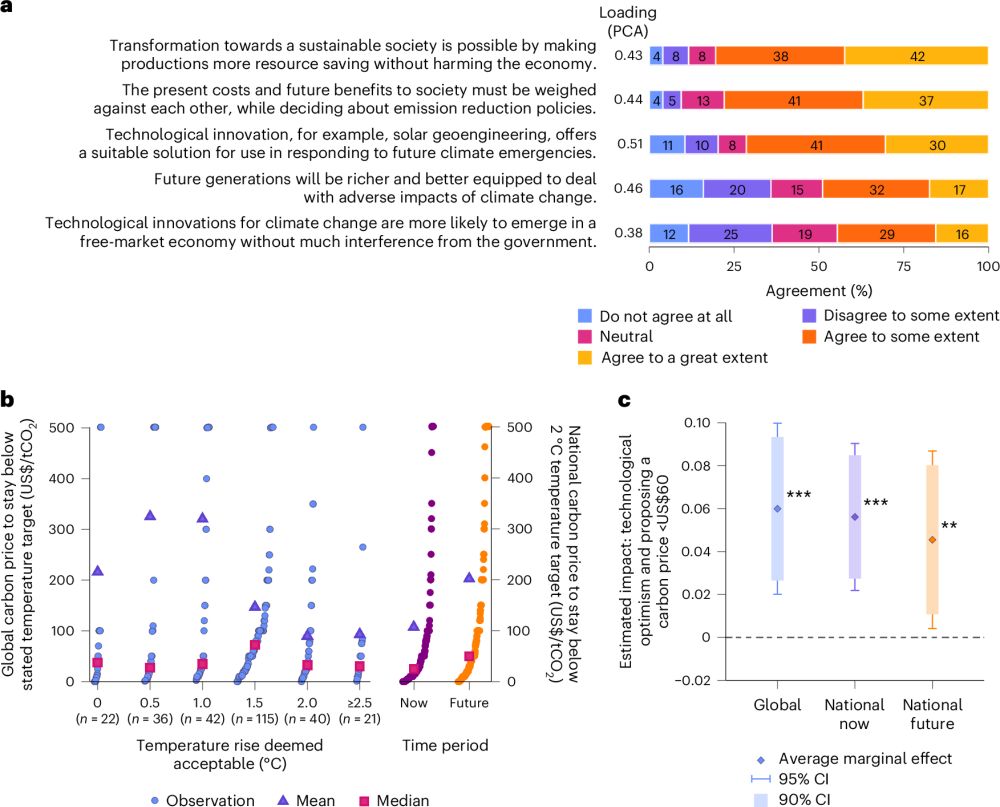
While most delegates agree that a temperature rise above 1.5°C is unacceptable, techno-optimists were more willing to accept increases beyond 2°C. This disconnect between belief in tech and necessary emissions reductions poses risks for effective climate action.
21.09.2024 08:25
👍 1
🔁 1
💬 0
📌 1
Paradoxically, those who believe most strongly in the power of tech innovation recommend lower carbon prices. But innovation should thrive under higher CO₂ prices, which incentivize technological breakthroughs. Without this push, innovation may not deliver fast enough.
21.09.2024 08:25
👍 1
🔁 0
💬 1
📌 0
Delegates with higher techno-optimism were more likely to recommend books advocating for incremental changes over transformative solutions, such as Andrew McAfee's More from Less vs. Doughnut Economics by @kateraworth.bsky.social
21.09.2024 08:25
👍 2
🔁 0
💬 1
📌 0
How was this mindset measured? Delegates were surveyed on their agreement with five statements about technological innovation (e.g., “Tech innovations like geoengineering offer suitable solutions to climate emergencies”). Responses formed the basis of their techno-optimism score.
21.09.2024 08:24
👍 1
🔁 0
💬 1
📌 0

New paper with Donia Mahabadi and Max Burger in Nature Sustainability: Technological optimism among COP24 delegates is linked to support for less stringent climate policies. What does this mean for global #ClimateAction?
21.09.2024 08:19
👍 11
🔁 5
💬 2
📌 1