Much analysis of forgery has focussed on text, leaving the materiality of the documents, and the evidence of parchment and form, relatively neglected. Yet there is much evidence there for how forgers worked, and for how they understood the nature of their work.
25.02.2026 20:19
👍 0
🔁 0
💬 0
📌 0
At Westminster, access to forged seal matrices was clearly a concern, and they often seem to have been associated with particular forging scribes, not common property. Sometimes forgers had to reuse authentic seal impressions, where other scribes had access to forged matrices.
25.02.2026 20:16
👍 0
🔁 0
💬 1
📌 0
Forgers often omitted wrapping ties from writs because they knew their documents would never be delivered to county courts, and sometimes attached seals in irregular ways. Some of the Westminster forgeries have seals attached upside down, for reasons now unclear.
25.02.2026 20:13
👍 1
🔁 0
💬 1
📌 0
Forging was not merely a work of imitation, but also of adaptation. Scribes had to make up parchments in such a way to help them write unfamiliar scripts, so that forgeries were more often ruled and lined than authentic documents.
25.02.2026 20:11
👍 3
🔁 1
💬 1
📌 0
The Production of Forgery at Westminster Abbey, 1050–c. 1154 | Early Medieval England and its Neighbours | Cambridge Core
The Production of Forgery at Westminster Abbey, 1050–c. 1154 - Volume 52
When scribes forged in the middle ages, they knew that their forged documents would be used differently from authentic ones, and this changed their habits of work. How this worked in practice is set out in my new article, doi.org/10.1017/ean....
25.02.2026 20:10
👍 10
🔁 2
💬 2
📌 0

Cover image of the 2025 edition of Anglo-Norman Studies.

Contents list of 2025 edition of Anglo-Norman Studies

First page of my article in the 2025 Anglo-Norman Studies
Pleased to receive a copy of Anglo-Norman Studies for 2025, based on the 2024 conference at Durham.
23.09.2025 19:58
👍 3
🔁 0
💬 0
📌 0

Also, a substantial part of the Eastgate in the town walls survives, which I’d not realised before.
05.08.2025 15:01
👍 0
🔁 0
💬 0
📌 0


I’d not much liked Bath Abbey, because it’s so late, with heavyhanded restoration. A while ago I read Davenport’s book on Bath, which showed there were some Romanesque survivals, and it seems to be true, as here in the south aisle chapel. Having an hour to kill waiting for a train can show so much.
05.08.2025 14:58
👍 0
🔁 0
💬 1
📌 0
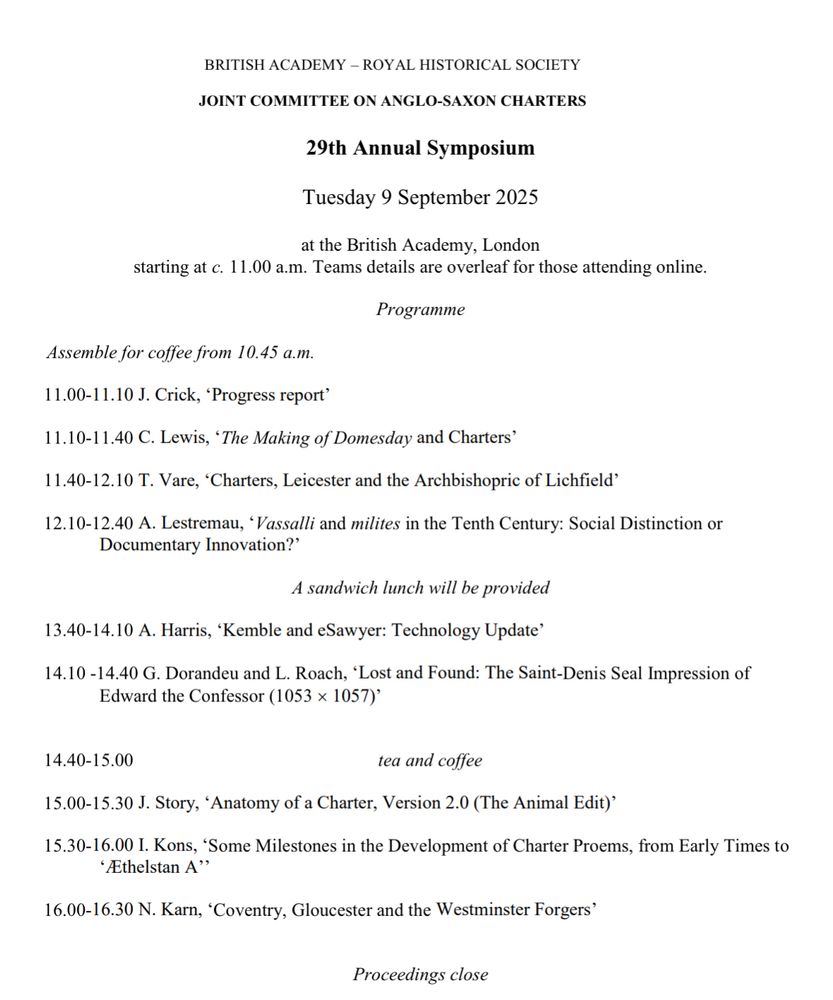
An exciting day of papers for those interested in early medieval charters (on 9 September). If you’d like to attend, do send me a message!
05.08.2025 11:45
👍 26
🔁 12
💬 1
📌 0

The Antiquary 2024\/5 - Full Supplement | PDF to Flipbook
Created with the Heyzine flipbook maker
Pleased to see a brief publication just appeared as part of a wide-ranging compilation on the historic practice of forgery: heyzine.com/flip-book/d9...
20.07.2025 19:55
👍 0
🔁 0
💬 0
📌 0


Complicated, but probably an enhancement to the site.
15.07.2025 22:03
👍 0
🔁 0
💬 0
📌 0

In York on a rainy day for a viva and saw the recent work at Clifford’s Tower.
15.07.2025 22:01
👍 0
🔁 0
💬 1
📌 0


The 12th-c remains are spectacular.
04.07.2025 19:36
👍 2
🔁 0
💬 0
📌 0

At Santiago de Compostela today, to see the pilgrimage church itself.
04.07.2025 19:34
👍 4
🔁 0
💬 1
📌 0

At the enormous Escorial complex yesterday, just outside Madrid.
02.07.2025 05:26
👍 1
🔁 0
💬 0
📌 0


And here’s the enormous new cathedral, alongside the old one
01.07.2025 06:08
👍 2
🔁 0
💬 0
📌 0

A notice about the frequency of the Mozarabic rite, in one of the cloister chapels.
01.07.2025 06:06
👍 1
🔁 0
💬 1
📌 0

Yesterday I was in Salamanca, with the remarkable double cathedral, one 13th c and the other 16th c. Here’s the older one.
01.07.2025 06:03
👍 4
🔁 0
💬 1
📌 0
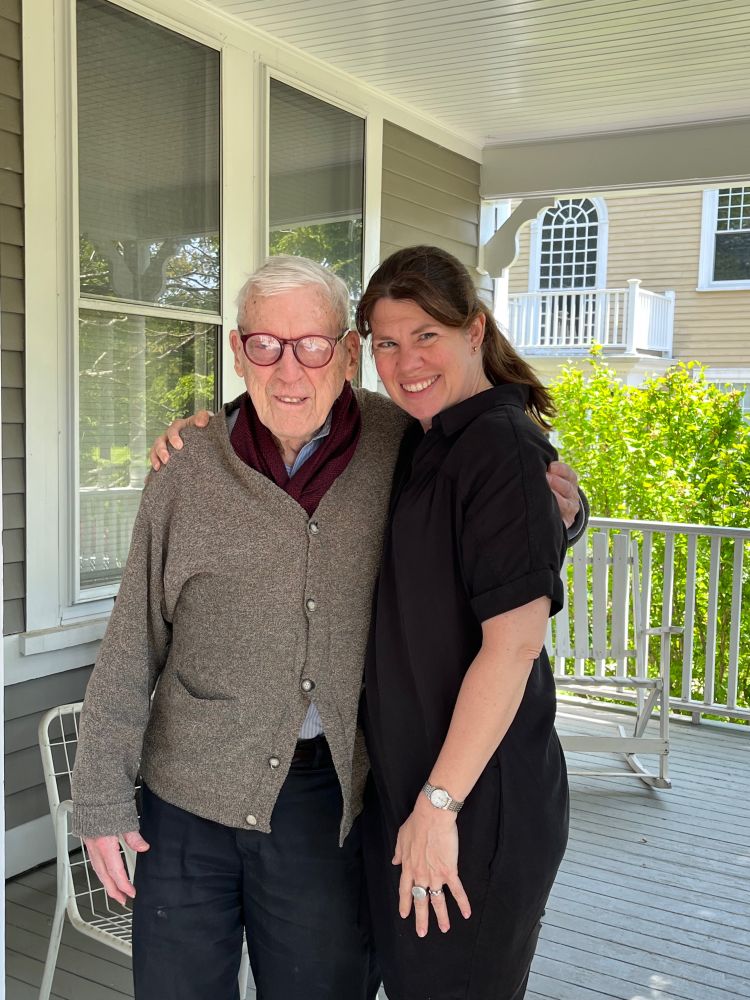
An elderly white man with glasses and a middle aged white woman on a porch in summer
I am very sorry to say that my PhD advisor Thomas N. Bisson has died. He was a great scholar, a kind man, and a central figure in my life. I will miss him.
30.06.2025 20:28
👍 78
🔁 5
💬 12
📌 5


This is a tenth-century mosque, later the church of Christo de la Luz
29.06.2025 07:03
👍 5
🔁 0
💬 0
📌 0

This is a twelfth-century synagogue, later the church of Santa Maria la Blanca. Truly extraordinary.
29.06.2025 06:59
👍 5
🔁 0
💬 1
📌 0

Yesterday I was in Toledo, which has the most amazing medieval surviving buildings in it. The town and its setting are both spectacular.
29.06.2025 06:57
👍 6
🔁 0
💬 1
📌 0

Bayesian inference for partial orders from random linear extensions: Power relations from 12th century royal acta
In the eleventh and twelfth centuries in England, Wales and Normandy, royal acta were legal documents in which witnesses were listed in order of social status. Any bishops present were listed as a group. For our purposes each witness-list is an ordered permutation of bishop names with a known date or date-range. Changes over time in the order bishops are listed may reflect changes in their authority. Historians would like to detect and quantify these changes. There is no reason to assume that the underlying social order, which constrains bishop-order, within lists is a complete order. We therefore model the evolving social order as an evolving partial ordered set or poset. We construct a hidden Markov model for these data. The hidden state is an evolving poset (the evolving social hierarchy) and the emitted data are random total orders (dated lists) respecting the poset present at the time the order was observed. This generalises existing models for rank-order data such as Mallows and Plackett–Luce. We account for noise via a random “queue-jumping” process. Our latent-variable prior for the random process of posets is marginally consistent. A parameter controls poset depth, and actor-covariates inform the position of actors in the hierarchy. We fit the model, estimate posets and find evidence for changes in status over time. We interpret our results in terms of court politics. Simpler models, based on bucket orders and vertex-series-parallel orders, are rejected. We compare our results with a time-series extension of the Plackett–Luce model. Our software is publicly available.
What do witness lists actually mean? They're a familiar part of sources which have wide currency, and there seems to be an assumption that they reflect favour or power, but it's not been tested rigorously. Here's an attempt to fix that: projecteuclid.org/journals/ann...
20.06.2025 20:11
👍 9
🔁 3
💬 2
📌 2
Thank you. The new edition is based on a different manuscript, not used by the last editor of the text, and is hopefully more faithful to the original text. In any case, it looks rather different from the old Mellows edition.
20.06.2025 20:03
👍 1
🔁 0
💬 1
📌 0

Image of printed pages on a desktop; the title page of the essay is defaced by the word 'PROOF' written in large capitals across it.
Pleased today to get proofs for my essay in the forthcoming volume on the cult of St Oswald. The edition to which this relates is now complete, and so this acts as precursor to that.
20.06.2025 19:54
👍 5
🔁 0
💬 1
📌 0

In Westminster looking for forgeries today
20.03.2025 13:51
👍 4
🔁 1
💬 0
📌 0
It's a good book. I learnt from reading it.
20.02.2025 19:47
👍 0
🔁 0
💬 0
📌 0