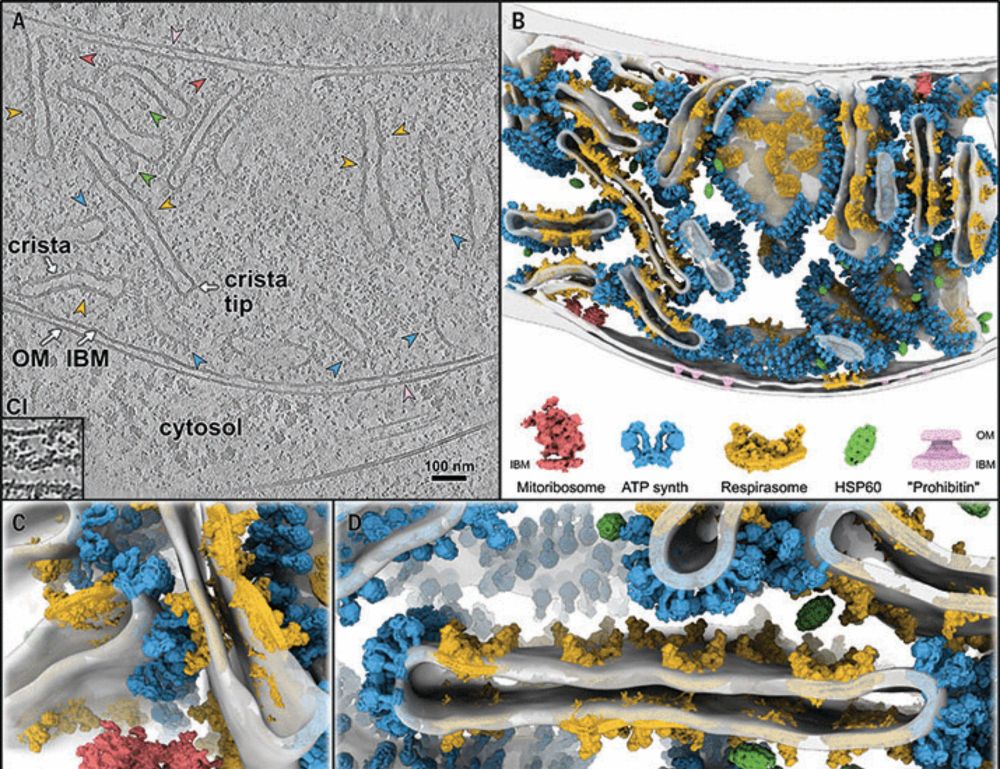
How a discovery in Yellowstone National Park led to the development of PCR - Richmond Scientific
A discovery in Yellowstone National Park led to the development of PCR, the gold-standard COVID-19 tests used to fight the global pandemic.
Reminder: Nobel-prize winning PCR (1983), used in basically all genetic tech today, was only possible because of extremophile bacterium discovered in 1964 in Yellowstone funded by a small ~$80k NSF grant with no obvious application at the time. #science 🧪
www.richmondscientific.com/how-a-discov...
08.06.2025 21:09
👍 1232
🔁 519
💬 22
📌 28
NIH's work saves lives—& Trump is gutting it.
Straight from D.C. I headed to Seattle Children's to hear from researchers & patients alike about the importance of NIH funding—it's not just about lines in a budget, it's about lifesaving discoveries.
We ALL need to speak up to save it.
02.05.2025 21:04
👍 735
🔁 191
💬 29
📌 14
We haven’t done anisotropic, which is a good idea since labeling the arrestins isn’t much of an issue. We do observe differences between different receptors in terms of their recruitment of different orientations of oligomers.
10.04.2025 18:18
👍 1
🔁 0
💬 0
📌 0
Thanks!
10.04.2025 18:16
👍 0
🔁 0
💬 0
📌 0
We are doing some experiments now where we induce dimerization of beta arrestins before receptor activation. Depending on the orientation of the dimers, it can inhibit its function. But it looks like certain orientations function just as well as WT arrestins.
09.04.2025 16:50
👍 1
🔁 0
💬 1
📌 0
We think this finding may explain how beta-arrestins interact with a wide range of proteins and how they may organize signaling at the receptor. This is just the start! We are currently performing additional experiments and MD simulations to model these potential interactions.
09.04.2025 00:46
👍 2
🔁 0
💬 0
📌 0

Consistent with this, we found that a constitutionally active ADGRE1 (ADGRE1-b – lacking most of the extracellular domain but maintain the tethered agonist sequence) promoted condensates, unlike the apo receptor (ADGRE1 FL) or a receptor without tethered agonist (ADGRE-1 bT).
09.04.2025 00:46
👍 3
🔁 0
💬 2
📌 0

While the beta-arrestins in this 2:2 complex were not directly interacting, they were in a conformation that could promote an N-N interaction that was identified through metadynamics. This suggested that receptor activation could promote beta-arrestin oligomerization.
09.04.2025 00:46
👍 2
🔁 0
💬 1
📌 0

Serendipitously, Peng Xiao and Jinpeng Sun solved the structure of an adhesion receptor that forms tight complexes with beta-arrestins. Surprisingly, this structure displayed a 2:2 complex with the beta-arrestin at a unique angle compared to other GPCR:beta-arrestin structures.
09.04.2025 00:46
👍 2
🔁 0
💬 1
📌 0

Previous work from the Marullo, Benovic, and Gurevich labs identified specific sites in beta-arrestins that bind inositol hexaphosphate (IP6) to regulate beta-arrestin oligomerization. We found those mutations impacted beta-arrestin-dependent internalization and GPCR signaling.
09.04.2025 00:46
👍 2
🔁 0
💬 1
📌 0

We then used an optogenetic approach to test if these were consistent with condensates. When Cry2 undergoes light-induced oligomerization, the presence of specific sequences (such as IDRs) leads to condensate formation (see FUSN). Beta-arrestin 1 had a similar effect!
09.04.2025 00:46
👍 2
🔁 0
💬 1
📌 0

We performed FRAP that demonstrated that proteins in these puncta exchanged with solution, although with slightly slower kinetics than beta-arrestin 2 in the cytosol.
09.04.2025 00:46
👍 2
🔁 0
💬 1
📌 0

It has been known for decades that beta-arrestins oligomerize, but the relevance of this in a cellular context is unknown. Labeling beta-arrestin 2 with GFP results in a cytoplasmic pattern, while labeling with components of split GFP results in punctae, consistent with oligomers.
09.04.2025 00:46
👍 2
🔁 0
💬 1
📌 0

Killing Cancer Patients (Once the Payments Clear)
'Speeds things up, you know. Move fast and break things, amIright?
Problem is, in biomedicine some of the things you break are human beings.'
@dereklowe.bsky.social
www.science.org/content/blog...
02.02.2025 11:11
👍 37
🔁 17
💬 0
📌 2

Merck stopped the Phase 3 Hyperion trial of its pulmonary arterial hypertension (PAH) treatment Winrevair early due to strong efficacy data & fiercepharma.com/pharma/effic... all study participants will be offered access to the drug. #biosky 1/n
30.01.2025 22:51
👍 5
🔁 3
💬 1
📌 1
American science and medicine has been thrown into chaos and uncertainty over the past week. Here are some stories to get up to speed. 1/12
28.01.2025 03:58
👍 1823
🔁 1137
💬 57
📌 189
Started off this morning emailing my Senators and Congressman about the NIH and the potential damage being done by unnecessary disruptions.
They need to hear from us loud and clear. Constituents matter to them as one of the primary purposes of a politician is to get re-elected (and its their job).
23.01.2025 11:26
👍 313
🔁 130
💬 11
📌 11

a cartoon says hey everybody an old man 's talking while bart simpson looks on
ALT: a cartoon says hey everybody an old man 's talking while bart simpson looks on
Bluetorial: When the leadership of Science magazine does not seem to care about getting the facts right in a news story...
A very troubling incident occurred some years ago and I think the concerns and lessons are important.
My apologies for the length, but it is a complicated story.
17.01.2025 15:13
👍 115
🔁 41
💬 9
📌 17
This is usually the premise behind a horror movie…
04.01.2025 23:45
👍 0
🔁 0
💬 1
📌 0
Similar finding with resolution of chest pain after stress test or cath…
27.11.2024 19:55
👍 2
🔁 1
💬 1
📌 0
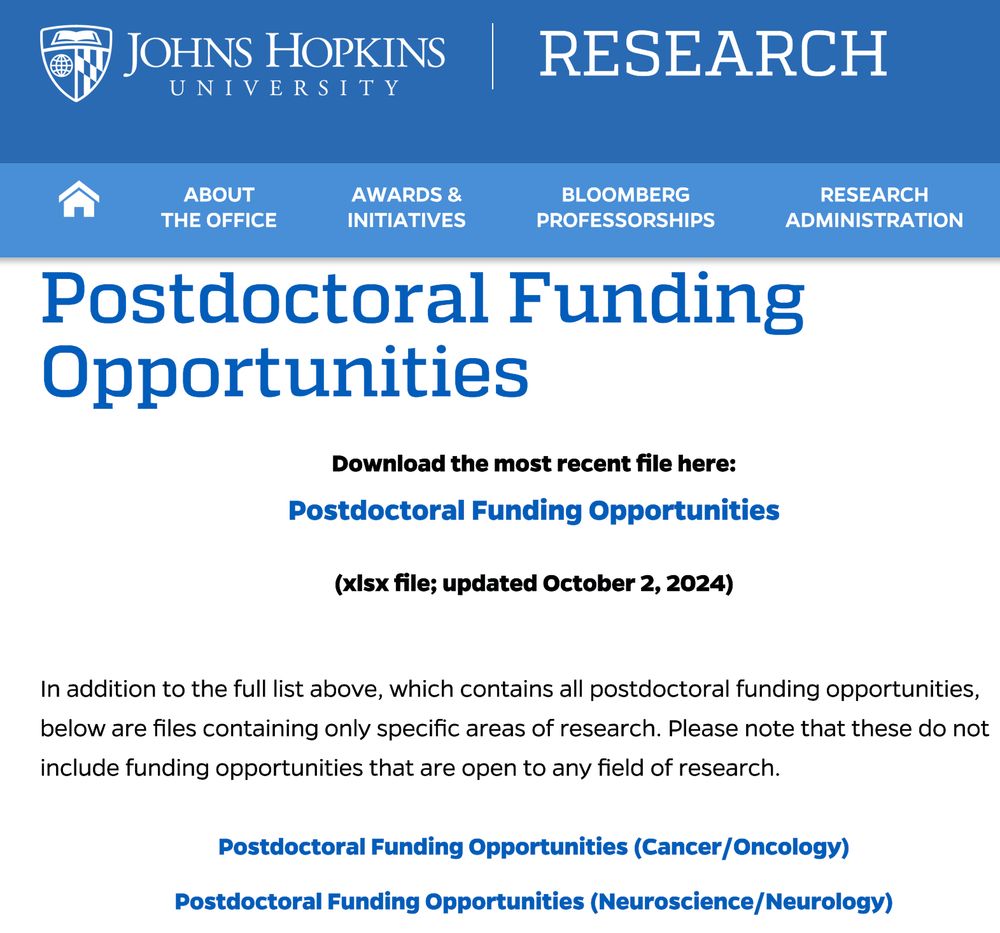
We have updated and expanded our database of fellowships for POSTDOCS in neuroscience/neurology/cog science.
For each fellowship, we provide a description, $ amount, deadline, link, and eligibility criteria.
Download our database freely here: research.jhu.edu/rdt/funding-... pic.x.com/eEhXhlOzEj
24.11.2024 22:35
👍 80
🔁 48
💬 2
📌 0