Thrilled to be involved in this fantastic project!
#WomensScreenWork #Digital #Humanities #DigitalHumanities #DHLab #IWD #InternationalWomensDay #Film #TV #WomenFilmmakers #Archives #FilmArchives
09.03.2026 11:25
👍 2
🔁 2
💬 0
📌 0

Plan of Exeter, decorated in shades of red, yellow, green, brown and blue. The map was engraved by John Roper and dates to 1810. A reference key on the right lists the places of worship in each ward. At the bottom of the plan is an illustration of Exeter Cathedral.
This colourful plan of Exeter, dating back to 1810, was engraved by John Roper. It includes a lovely illustration of Exeter Cathedral.
Which landmarks can you identify that still exist today? And what has changed?
📷 Townsend Maps T17
#MapMonday #MappingOurExeter #Maps #Exeter
09.03.2026 09:40
👍 24
🔁 5
💬 3
📌 0
Therefore, digital preservation is an ongoing process of adaptation. To archive the web is to try to preserve something that never stops evolving. This makes the work both equally difficult and vital!
#Digital #Preservation #Archives #InternetArchive #DH #DHLab #DigitalHumanities #HASS #Humanities
24.02.2026 16:00
👍 1
🔁 0
💬 0
📌 0
Despite these challenges, there are major initiatives that work to archive digital history. For example, Internet Archive is dedicated to capturing snapshots of websites over time, and communities are developing new tools and ethical frameworks that respond to constantly shifting digital landscapes
24.02.2026 16:00
👍 1
🔁 0
💬 1
📌 0

Digital preservation is cultural memory work. Websites disappear. Platforms shutdown. Links rot. Online creativity can vanish!
For digital humanities, archiving the web means safeguarding historical records of the cultural moment, but preserving something so dynamic & vast is technically complex!
24.02.2026 16:00
👍 7
🔁 3
💬 1
📌 0

Green book cover of 'Umbrellas and their History' by William Sangster.

Opened book showing the title page of 'Umbrellas and their History', and the frontispiece, which includes an illustration of Jonas Hanway, 'The First Englishman Who Ever Carried An Umbrella'.
Today is National Umbrella Day - very apt for this continuously wet weather! ☔
Our book collections include 'Umbrellas and their History' (1871) by William Sangster, which seems like an ideal read for today!
📷 Reserve 391.44 SAN
#NationalUmbrellaDay #RareBooks
10.02.2026 11:22
👍 16
🔁 3
💬 0
📌 0

Colour image of an early 17th century map of Exeter. This bird’s-eye view from the southwest shows Exeter surrounded by a city wall with gates. Exeter is dominated by the Gothic cathedral of St Peter. At the top left is the castle of Rougemont. People are walking towards and through the city.
Today is International Map Day!
One of our favourite maps in the collections is this map of Exeter, engraved by Frans Hogenberg in c 1618.
Can you identify any landmarks that still exist today?
📷 Constable Maps 27; digitised by @dhlabexeter.bsky.social
#InternationalMapDay #MappingOurExeter
03.02.2026 09:53
👍 31
🔁 9
💬 1
📌 0
We did have quite a few startled reactions to the spirit suddenly looming overhead! 🩻👻
27.01.2026 12:04
👍 2
🔁 0
💬 0
📌 1


We were very excited to welcome students from the EAS3502 Shakespeare and Crisis module to experience Hamlet in VR!
After donning the MetaQuest Headset, students got to step into Shakespeare and meet the ghost of Hamlet's father!
#VR #VirtualReality #Digital #Humanities #DigitalHumanities #Hamlet
27.01.2026 11:57
👍 6
🔁 0
💬 0
📌 1

A map showing the route from Barnstaple to Ilfracombe in six vertical strips. Decorated in red, blue, green and yellow inks.
This strip map by John Ogilby shows 'The Road From Exeter to Barnstable & Thence to Ilfracomb', and dates back to c 1675.
Can you spot Exeter on the map? 🔍
📷 Townsend Maps T4; digitised by @dhlabexeter.bsky.social
#MapMonday #MondayMaps #Maps #MappingOurExeter #Exeter #Devon
26.01.2026 10:02
👍 21
🔁 4
💬 0
📌 1

📷EUL UA/P/1
Check out this link to @exeterunispeccoll.bsky.social's record of the @exeter.ac.uk Photograph Archive:
lib-archives.ex.ac.uk/Record.aspx?...
#Digital #Humanities #DigitalHumanities #DH #DHLab #Digitisation #HASS #Exeter #Devon #Negatives #GlassNegatives #Photography #PhotoNegatives
22.01.2026 11:50
👍 3
🔁 0
💬 0
📌 0
'I have enjoyed seeing how the labs are adapted for a wide variety of materials with additional specialist equipment or simple everyday items. Positioning the negatives and choosing the appropriate camera settings took some practice, but the end result was really rewarding!' - Holly, DH Intern
22.01.2026 11:50
👍 2
🔁 0
💬 1
📌 0
'It is interesting to see the University's development unfolding with each photograph - from the construction of the Physics tower to cars from across decades. It was great to learn how to handle this material and how to detect forms of decay like Vinegar Syndrome' - Molly, Assistant Technician
22.01.2026 11:50
👍 1
🔁 0
💬 1
📌 0

The process involves our 150MP cultural heritage camera, A0 Guardian Copystand, and a lightbox that we modify with black card to block out the light around an image.
#Digital #Humanites #DH #DHLab #DigitalPreservation #Digitisation #Photography #PhotographyNegatives #Interns #Internships #Exeter
22.01.2026 11:50
👍 3
🔁 0
💬 1
📌 0

We have been working on lots of exciting projects in the DH Lab so far this term! Recently, our DH Interns and GBP Assistant Technician have been working with images from the @exeter.ac.uk archive to learn how to digitise glass negatives
#Digital #Humanities #DigitalHumanities #Digitisation #DHLab
22.01.2026 11:50
👍 6
🔁 1
💬 1
📌 0

Archives strong room showing roller racking.
Today is World Logic Day!
Chess is often described as a game of logic. Did you know the writer William Golding and the literary critic Anthony Curtis played postal chess? Our collections include cards and letters through which they exchanged moves!
#WorldLogicDay #Archives
14.01.2026 14:34
👍 10
🔁 3
💬 1
📌 0

Black and white photograph showing the Chancellor of the University of Exeter (centre) - Mary Cavendish, the Duchess of Devonshire - with two honorary graduates on either side of her. A small boy also stands to her left. The honorary graduates - Agatha Christie (far left), Theodor Heuss, William Hodge and Bernard Leach - are wearing velvet bonnets.

Information box containing a cropped image of a letter signed by Agatha Christie on the right hand side, and on the left hand side, the following text: "This collection is from the offices of Hughes Massie and Co. Ltd. relating to Agatha Christie's literary estate. Throughout her career her agent was Edmund Cork, and these files were created by him to reflect his dealings with publishers, film-makers and other professional persons with an interest in the Christie estate, including Agatha Christie herself, and her husband, Sir Max Mallowan. Each file of correspondence relates to a particular year, and may include correspondence between Agatha Christie and Edmund Cork, correspondence between Cork and American literary agent, Harold Ober, and other interested parties. There are between 5,000-6,000 letters in the collection. Further information is available on the archive catalogue."
Agatha Christie died on 12 January 1976 - 50 years ago today.
Did you know our Agatha Christie business papers comprise thousands of letters, incl. from the novelist herself?
📷 EUL UA/P/5i: Christie receiving an honorary degree from @exeter.ac.uk in 1961
#AgathaChristie #OnThisDay #OTD #Archives
12.01.2026 10:13
👍 32
🔁 13
💬 1
📌 2

#HappyNewYear! We are excited to welcome back to all the students for this new term!
Whether you are a student or a member of staff, feel free to get in touch to see how we can support your HASS teaching and/or research - we’re always happy to support creative challenges!
#DHLab #DH #Digital #HASS
12.01.2026 13:42
👍 5
🔁 1
💬 0
📌 0

Green background with snowflakes. In the centre is a cropped image from a newspaper featuring a black and white photograph of the view towards the Washington Singer Building, with the grounds and trees covered in snow. The headline reads: 'Here Today - Gone Tomorrow' and the caption underneath the photograph reads 'South Western Winter'. White text under the newspaper image reads: 'Source: 'South Westerner' student newspaper, 29 January 1958'.
After a very wintry week in Exeter, here's a snowy throwback to Streatham Campus in January 1958! ❄️
This photograph was published in the student newspaper 'The South Westerner' on 29 January 1958.
📷 Exeter University/SOU
#ThrowbackThursday #UniOfExeterArchive #Archives
08.01.2026 10:21
👍 7
🔁 1
💬 0
📌 0

Opened book, showing two small watercolour illustrations of birds mounted to the right-hand page. Each illustration is annotated with the name of bird. The top illustration features a sparrowhawk and the bottom illustration features a grey wagtail.

Opened book, showing two small watercolour illustrations of birds mounted to the right-hand page. Each illustration is annotated with the name of bird. The top illustration features a sanderling and the bottom illustration features a Northern lapwing (the annotation is difficult to read, possibly 'Sea Wader'?).

Opened book, showing two small watercolour illustrations of birds mounted to the right-hand page. Each illustration is annotated with the name of bird. The top illustration features a bullfinch and the bottom illustration features a green finch.

Opened book, showing two small watercolour illustrations of birds mounted to the right-hand page. Each illustration is annotated with the name of bird. The top illustration features a green woodpecker and the bottom illustration features a yellowhammer.
Today is National Bird Day! 🪶
One of our favourite items in the collections is a 19th century volume containing 76 watercolour illustrations by an unknown artist of birds local to Devon and Cornwall.
📷 EUL MS 23; digitised by @dhlabexeter.bsky.social
#NationalBirdDay #BirdDay #Archives
05.01.2026 10:21
👍 26
🔁 5
💬 1
📌 2
Ellie, our Archivist, recently gave us a preview of this ‘famous scrapbook’ of Mr Hart – Head Virger here at Exeter Cathedral in the 1930s-50s. It features lots of cartoons given to Mr Hart by his friend, the journalist and cartoonist, Harold Murray! ✍️
#ExeterCathedral #YourCathedral
14.12.2025 15:11
👍 7
🔁 2
💬 1
📌 1

Card featuring an illustration of two robins outdoors with trees and a fence in the background. One robin is wearing a bowler hat, smoking a pipe and wearing a placard around its neck stating 'A Merry Christmas And A'. The other robin is wearing a top hat and a placard around its neck stating 'Happy New Year To You'.

White card with a lace border, featuring a robin sitting on a holly branch next to the words 'A merry Christmas & A HAPPY NEW YEAR'.
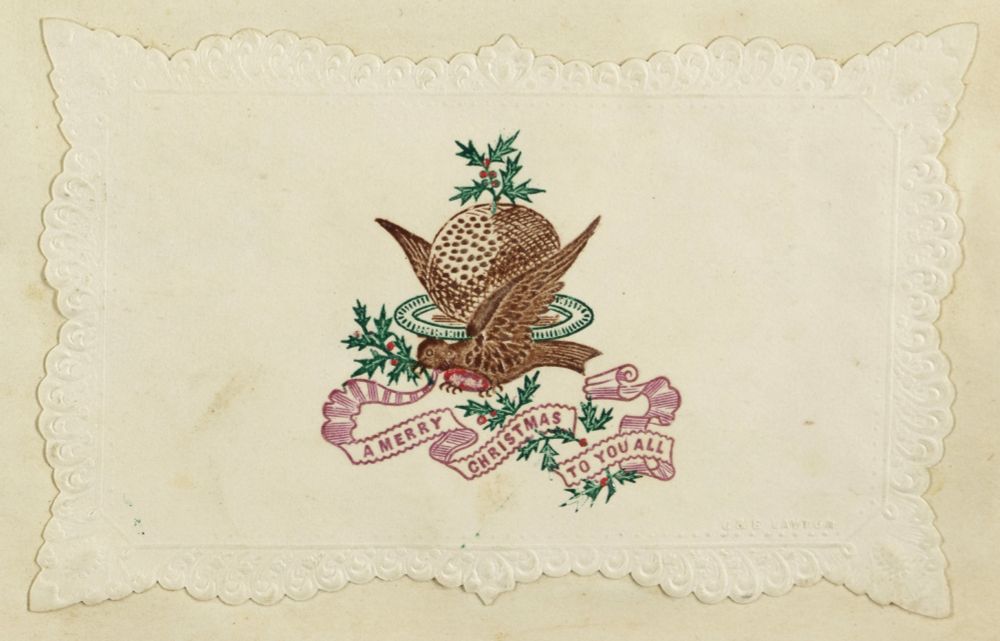
White card showing an illustration of a robin carrying a Christmas pudding on a plate on its back. There is a sprig of holly on the pudding, and a sprig of holly in the robin's beak. A ribbon under the robin has text written on it, reading: 'A MERRY CHRISTMAS TO YOU ALL'.

Portrait card with lace border, featuring an illustration of a robin. It looks as though it has just landed in the snow and picked up a sprig of mistletoe in its beak. It looks at you endearingly. Behind the robin are some snowdrops. Underneath the robin is text: 'A Merry Christmas And A Happy New Year'.
Today is Christmas Card Day! 💌🎄
Robins have been a popular motif on Christmas cards since the Victorian period. These festive cards are from a scrapbook in the library of the poet laureate John Betjeman.
📷 Betjeman Library 1957; digitised by @dhlabexeter.bsky.social
#ChristmasCardDay #Archives
09.12.2025 09:56
👍 48
🔁 10
💬 0
📌 0
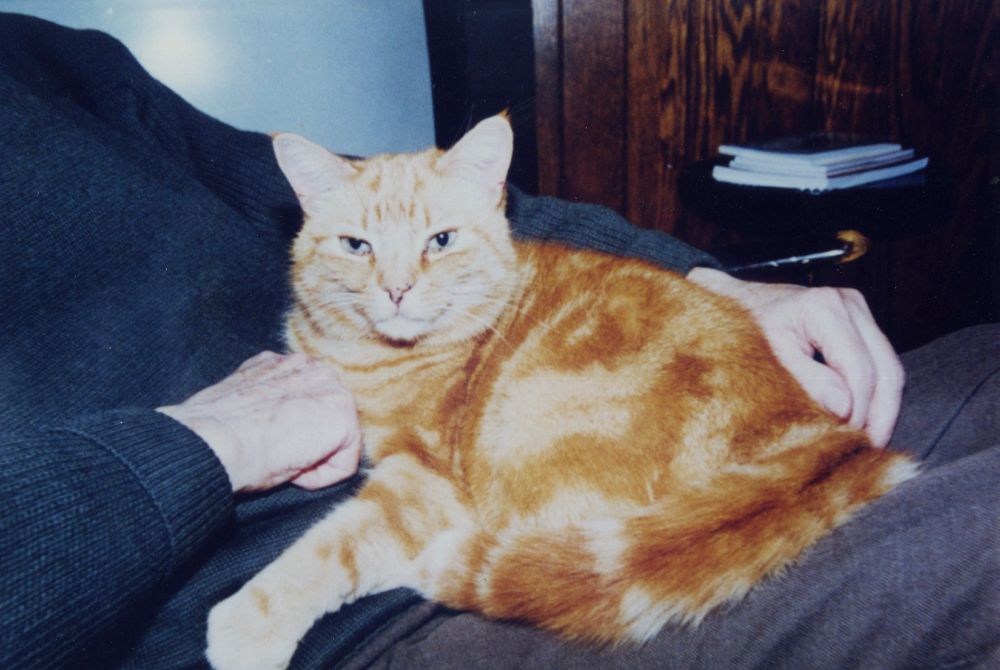
A ginger tabby lying comfortably on Charles Causley's (face not visible) lap.

Cropped image from a black photograph album page showing a black and white photograph of Jack Clemo leaning over a light-coloured Pomeranian in the foreground. The dog looks majestic, but his eyes look slightly alarmed! In the background is the cottage Goonamarris. The typed caption underneath reads: 'JACK CLEMO WITH SPARK Goonamarris August 25, 1950'.

Cropped image from a black photograph album page showing a black and white photograph (slightly blurry) of a light-coloured Pomeranian. He looks very regal and the wind is billowing through his fur! The typed caption underneath reads: '"SPARK" August 25, 1950'.
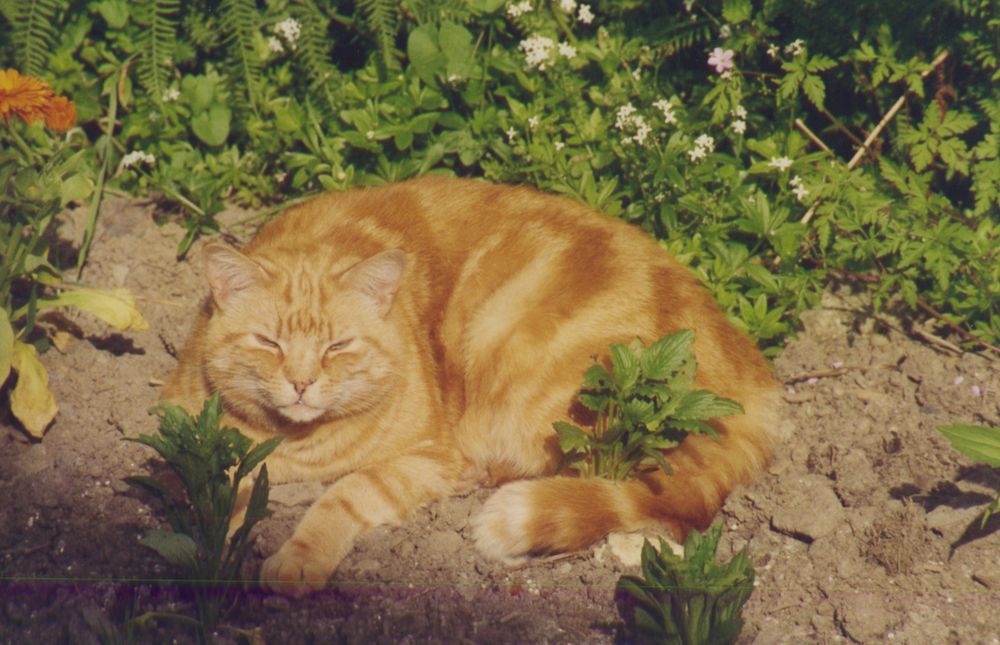
Colour photograph of a large ginger tabby cat lying in bright sunshine in a flowerbed. His tail is hooked around a small plant. He is looking towards the photographer with his eyes half closed.
The Cornish poets and writers Charles Causley and Jack Clemo were close friends - and they also loved their pets!
Two of the most documented pets in our archives are Causley's cat, Rupert, and Clemo's Pomeranian, Spark!
#EYAPets #Archives #ExploreYourArchive
03.12.2025 09:30
👍 21
🔁 5
💬 0
📌 1
We are all for a disco ball! It will go nicely with our Christmas tree 😂🎄
03.12.2025 09:19
👍 2
🔁 0
💬 0
📌 0
The tape has a magnetic layer and contains organic binders. When the tape ages, or if it is exposed to humanity or moisture, these materials degrade and create an environment in which mould can grow! 📹📼
28.11.2025 10:35
👍 2
🔁 0
💬 0
📌 0
Feel free to reach out to us at digitalhumanities@exeter.ac.uk !
27.11.2025 16:04
👍 1
🔁 0
💬 0
📌 0
Once in a digital format, footage can be easily backed up, copied, edited, or restored. It becomes possible to correct colour issues, stabilize shaky video, or repair damaged audio
#Digital #Humanities #DigitalHumanities #VHS #LegacyMedia #Digitisation #Interns #Internship #HASS #DigitalResearch
27.11.2025 11:55
👍 2
🔁 0
💬 0
📌 0
Even if tapes remain in good condition, the equipment needed to view them is disappearing as VHS players are no longer commonly manufactured and working units grow rarer. By converting to digital files, we free recordings from depending on obsolete technology and prevent their contents being lost
27.11.2025 11:55
👍 2
🔁 0
💬 1
📌 0

Recently, our DH interns have learned the importance of digitising legacy media like VHS. Over time and with improper storage, VHS tapes steadily deteriorate with the magnetic tape losing quality. This leads to warping or mould, which renders it unplayable!
#Digital #Humanities #Internships #DH
27.11.2025 11:55
👍 10
🔁 2
💬 3
📌 0


