We discuss Bush in the article. He did use it, but much less than Trump and he did apologize that one time.
14.01.2026 01:45
👍 2
🔁 0
💬 0
📌 1

@davidkarol
Govt & Politics prof, UMD. Billy Wilder fan. Has "Someone is wrong on the internet!" tendencies. Author: Red, Green and Blue & Party Position Change in American Politics. Co-author: The Party Decides. No replies to anons. https://gvpt.umd.edu/faculty
We discuss Bush in the article. He did use it, but much less than Trump and he did apologize that one time.

There is more and more of this lately and conservative media was the early adopter on the right, before Trump: journals.sagepub.com/doi/abs/10.1...
Sadly, those are pretty good sales numbers for a new polisci book, but I think this one has to be classified as a study in abnormal psychology.
Yes, they threw away several seats, but that was a simpler time when things mattered.
He DID eventually plead guilty though! Maybe he wasn't confident last summer that Trump would win and come through.
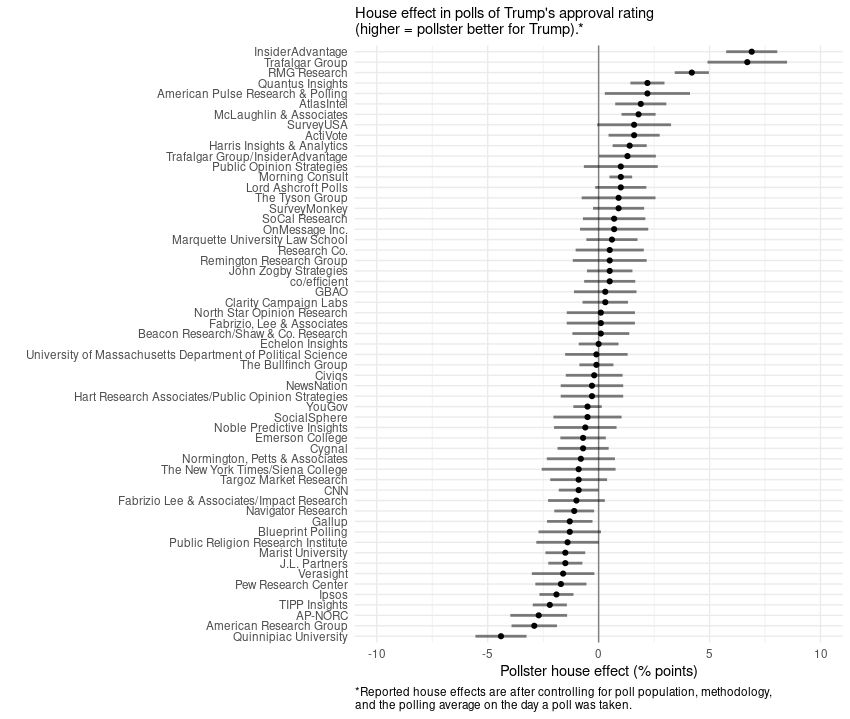
Current house effects for Trump approval polls:
Trump wasn't anti-immigration in his Reform phase. He called Pat Buchanan a racist. Trump was pro-choice then too and not with the NRA. Buchanan beat him. When Trump resurfaced ten years later, he'd stolen Buchanan's act. That, plus a big boost from The Apprentice Buchanan lacked, is the story.
We also don't know if Musk isn't trying to use this initiative for leverage or won't simply get bored and walk away. All in all, many reasons to question whether much results from this.
3. What will the election-eve economy be? In 1992 Perot benefitted from a recession. If one developed, it might be easier for some Republicans to vote 3rd party than Democratic. But we're more polarized now, and it'd be harder for Musk to avoid blame if there are problems between now and then. 4)
2. Would this party have an agenda many voters care about and find absent in the major parties? There is always SOME interest in an anti-system protest, but Musk's association with Trump complicates this and his stated concerns (anti-debt+clean energy subsidies) aren't a focus for many. 3)
Bigger questions: 1. Is Musk a charismatic figure like Ross Perot? YMMV, but, unlike Perot, he can't run for President. That matters because this is a midterm election and 3rd parties get less attention at the sub-presidential level, where their candidates tend to be obscure. 2)
There are MANY reasons for skepticism re this 3rd party effort! But ballot access isn't the biggest. With enough money and effort it CAN be secured in most if not all states. Hurdles vary by state, but it's a myth that ballot access rules are a key bulwark of the two-party system. 1)
Freedom Caucus really caused trouble for GOP Speakers before Trump. Their rebellions actually pushed policy leftward as leaders from Boehner to Johnson needed Democratic votes to "keep the lights on" and this limited cuts. Trump has tamed them. Would this have happened with any GOP President?
Interesting piece. A counterfactual is what if the Iran strike had gone very badly, i.e. US planes crashed or serious Iranian retaliation ? But the broader point that power may be based on faulty or exaggerated perceptions is valid. Remember Grover Norquist?
Such a claim must rest on the totality of her record. Did she sink anything that needed her support? It's hard to assess whether private objections result in withdrawn or modified proposals. But providing the key vote for Kavanaugh while insisting he wouldn't undo Roe is part of her reputation.
Also, while Trump's "specific authoritarian vision" differs from that of previous GOP leaders, at least in degree, we don't know yet if he is an outlier, or this is the new normal for his party. We'll only find out once he leaves the scene.
The words "tariffs" & "Russia" don't appear in this piece! Bouie concedes, "you can attribute some of the worst of this administration to the specific authoritarian vision of Trump and his allies." OTOH Trump's breaking of his pledge to protect Medicaid undermines claims for his distinctiveness. 1)
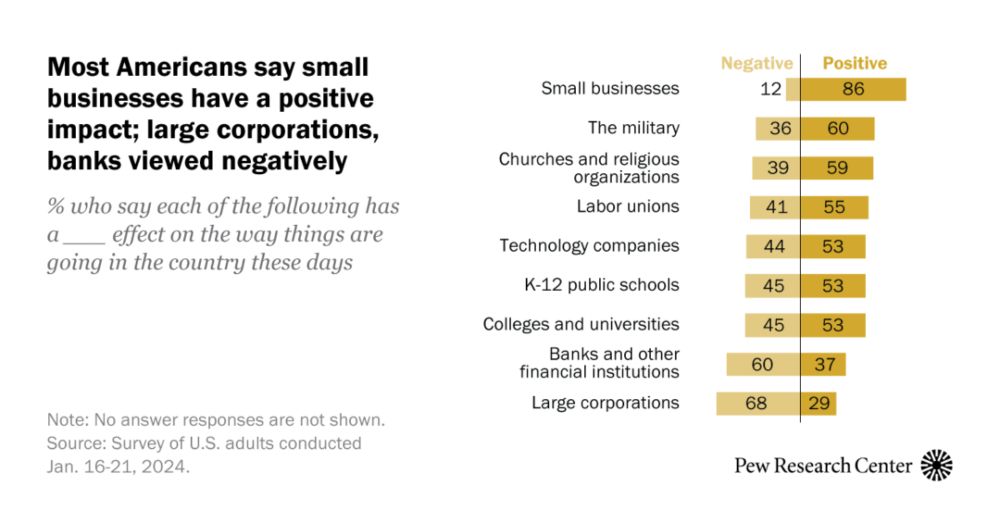
GOP doesn't trust/like universities anymore. That's a separate factor. "Only about a third of Republicans and Republican leaners express positive opinions about the impact of colleges (31%) or K-12 public schools (34%)." www.pewresearch.org/politics/202...
Of the two GOP defectors, one said it went too far and the other said it didn't go far enough. Many others made similar complaints, but, predictably, folded.
The context worth noting that she does this when they don't need her vote. That's a cynical, image-making exercise. The only important case when this was not true was ACA repeal, when she and Murkowski thought it was "safe" to vote no, but they were blind-sided by McCain.
The House has passed H.R. 1, the one big ugly bill. The final vote is 218-214, with all Democrats plus Thomas Massie (R-KY) and Brian Fitzpatrick (R-PA) voting no and all other Republicans voting yes.
"AI Peer Reviews"- the most shamefully unprofessional and unethical thing I can imagine in the academic context. Why do you even want to do this job?
Only GOP losses greater than normal, factoring in election day economic conditions would really support this interpretation. For that to happen, the provisions of the bill probably have to be an ongoing story and voters would need to feel them. Key provisions don't take effect immediately though.
In 2026 given normal midterm dynamics, a polarizing President and a tiny GOP majority, Democrats flipping the House is to be expected. So that alone would not be enough to say they paid a real price for pushing through this very consequential and unpopular bill. 4)
More imperfect comps: Studies suggest the ACA cost Democrats seats in 2010 and the Iraq War hurt the GOP in 2006. But the ACA was only passed in the election year and of course the war was ongoing. Even then there were maybe more swing voters than today 3)
Republicans House gains were less than expected and they actually lost a seat in the Senate, with Dems retaining control. It was a "could have been worse" result that helped Biden run again. But the GOP also had some poor Senate candidates, e.g. Herschel Walker, pushed on them by Trump. 2)
We don't, but we know swing voters have short attention spans. There's no perfect "comp", but Dobbs decision was very unpopular and DID seem to hurt the GOP in 2022. It wasn't done by Congress directly. BUT it also was less than 5 months before the election & GOP still flipped the House. 1)
This amounts to most of the major Republican priorities, passed relatively quickly via a partisan majority with limited compromises. This is not the norm & more successful than previous two unified governments. It's also a partial repeal of the IRA, Obamacare, & farm bill deals
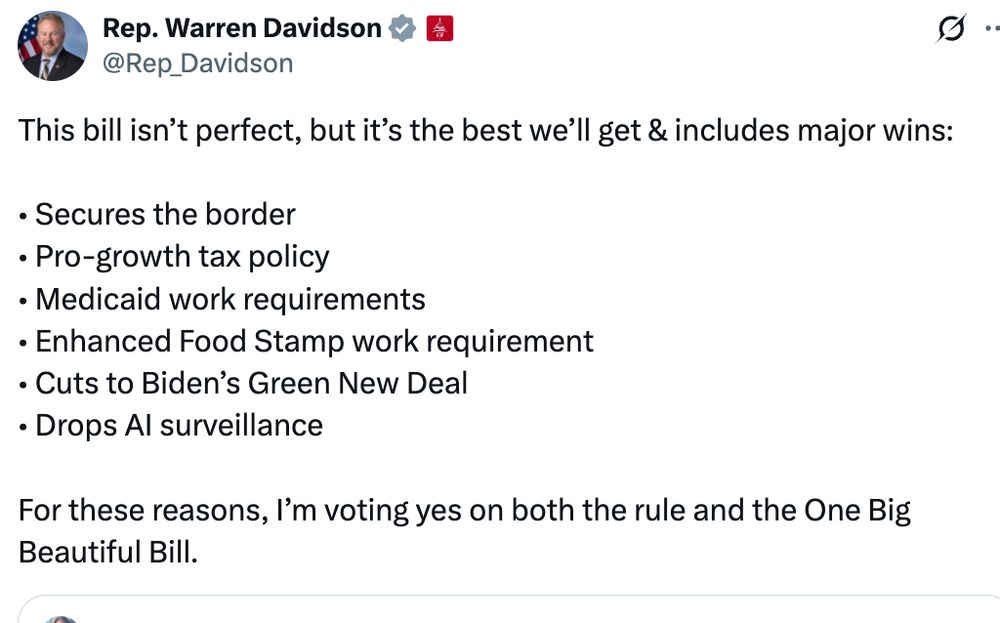
Rep. Davidson (R.-OH.) voted AGAINST the House version of the bill. He is now voting FOR the Senate version, which is supposedly further from his preferences:
