Post-Doctoral Associate
Job Description Summary Organization's Summary Statement: The Department of Biology at the University of Maryland, College Park seeks applications for three quantitative biology postdoctoral fellow po...
Exciting announcement! My new department is launching a postdoc fellowship in quantitative biology. Fellows will be co-advised by two Bio faculty, one that is quant focused (not me) and one that is not (me???). I would love to co-sponsor a postdoc and build a collaboration so please reach out!
11.02.2026 15:54
👍 34
🔁 43
💬 2
📌 1
It's also incredibly difficult and expensive to eradicate, adding a very real financial consideration to any conversation efforts.
12.02.2026 21:35
👍 0
🔁 1
💬 0
📌 0

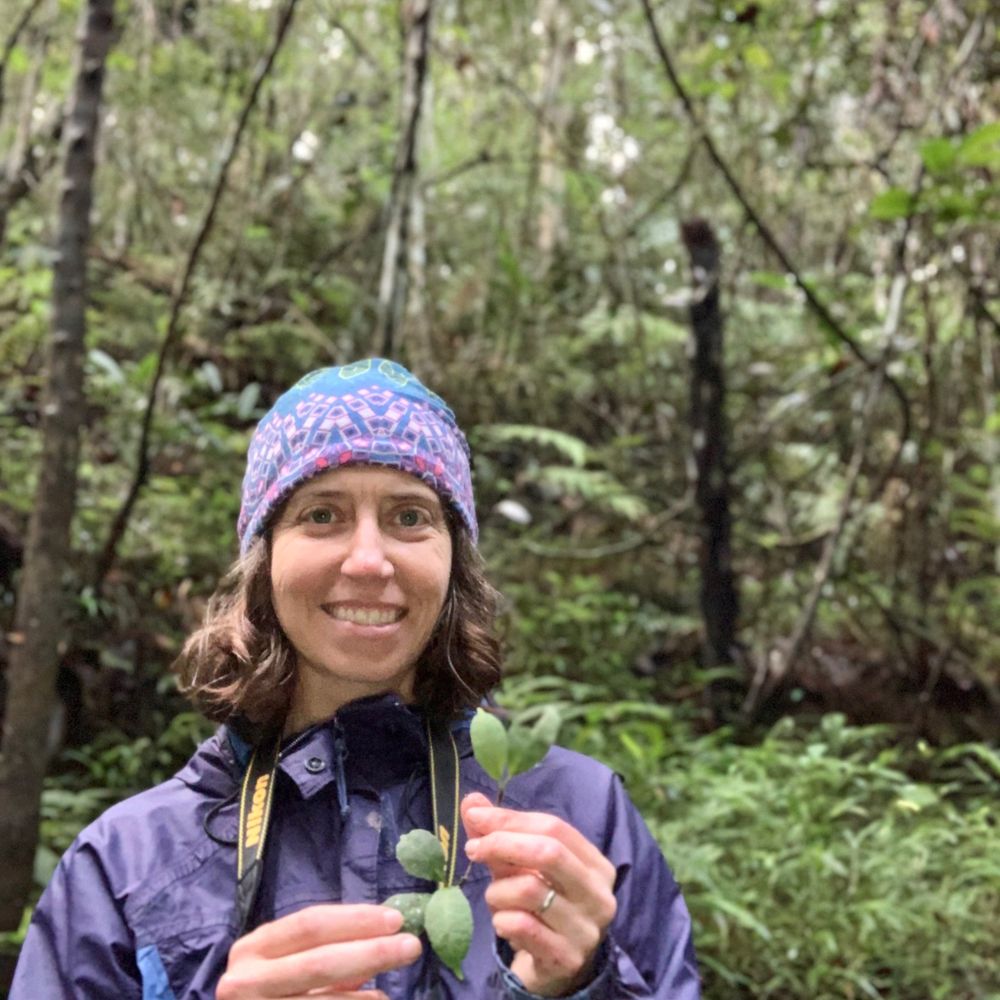
The stunted tree growth prevents regeneration of the rainforest after deforestation, even decades after deforestation has stopped.
But the plant isn't hated - its straight stalks (bottom left) make for good building materials, and its fruits (bottom right) attract beloved lemurs.
12.02.2026 21:35
👍 1
🔁 1
💬 1
📌 0

But strawberry guava can only grow in disturbed (deforested) parts of the rainforest. Once it's established, this study found it causes:
decreased soil quality
changed arthropod populations
stunted tree growth
12.02.2026 21:35
👍 0
🔁 1
💬 1
📌 0
Lemurs, the most well-known Madagascar animal, eat the strawberry guava fruit. (Humans do too!)
So the plant can have a very positive association - lemurs tend to be found around its groves.
12.02.2026 21:35
👍 1
🔁 2
💬 1
📌 0

Invasive strawberry guava is a favorite food of endangered Madagascar lemurs.
It also prevents native trees from growing past the seedling stage, halting the regeneration process after deforestation.
Study led by Amy Dunham and Matt McCary.
news.rice.edu/news/2026/st...
12.02.2026 21:35
👍 3
🔁 2
💬 1
📌 0

Photo looking down at a meadow with hundreds of yellow and red flowers.
Texas ground update.
08.05.2025 19:56
👍 77
🔁 7
💬 1
📌 0

A head on picture of a Parsons Chameleon standing next to two lichen covered leaves
Ahead of International #ChameleonDay here is a pic of a female Parson’s Chameleon (Calumma parsonii) looking like a lichen covered leaf
08.05.2025 18:53
👍 5
🔁 0
💬 0
📌 0

Environmental Science students @RiceUniversity learn a little bit about beekeeping during last class of the semester 🐝🐝
25.04.2025 03:55
👍 5
🔁 0
💬 0
📌 0

Rice University Ecology & Evolutionary Biology grad students enjoying a #PaintYourPhD workshop. #sciart
25.04.2025 03:48
👍 4
🔁 0
💬 0
📌 0
Our 1st Biodiversity Science-Policy 'starter pack' is now full (150 accounts). Access at: go.bsky.app/LjV86zg
There's a 2nd starter pack already filling up: go.bsky.app/GzM8eok
NB: these are mainly IPBES authors & stakeholders regularly engaged with IPBES work. Please follow & share widely! 🌍🧪
26.02.2025 14:05
👍 295
🔁 110
💬 18
📌 3

Purple Martin male perching on top of a Martin house
Two years in a row our Purple Martins have made first appearances on Valentines Day ❤️❤️❤️🐦 (Houston)
15.02.2025 01:01
👍 7
🔁 0
💬 0
📌 0

A frog in center frame, viewed from the side as it clings to a twig, diagonally with its head looking up to the upper right corner. The frog's belly is a stark white, and its back, head, and limbs are all black and covered with bright yellow oval spots. The eye is the same color as the belly, with a black pupil.
A White-bellied Reed Frog (Heterixalus alboguttatus) from near Ranomafana, Madagascar. Also called the Starry Night Frog ❤️ A species I had hoped to see on my visit, and I saw exactly one. This one. #herps #NaturePhotography #FrogFriday
23.11.2024 00:47
👍 850
🔁 166
💬 28
📌 11
We're relieved to hear from our friends at Centre ValBio that the #fire in Ranomafana National Park is finally out. Heavy rainfall finally came after months, ending an unseasonably long dry spell, and the community worked tirelessly each day to stop the fires from spreading.
17.01.2025 00:20
👍 7
🔁 2
💬 1
📌 0

A photo of Kory Evans, winner of the 2025 Carl Gans Award
Congratulations to Kory Evans @sternarchella.bsky.social, winner of this year’s @J_Exp_Biol sponsored Carl Gans Award at #SICB2025. His #biomechanics research examines the role of modularity in the evolution of the #fish skull. Don't miss his talk: 7 Jan at 13:30 in Marquis D
Please repost
06.01.2025 07:52
👍 146
🔁 31
💬 2
📌 2

red-bellied lemur eating fruit in a tree canopy
New paper led by former group member Jadelys Tonos! Simulations/empirical data reveal just a few trees bearing the most fruit in the landscape are critical for driving patterns of lemur movement & seed dispersal 🐒🥭🌱https://besjournals.onlinelibrary.wiley.com/doi/pdfdirect/10.1111/1365-2435.14702
19.12.2024 22:57
👍 8
🔁 6
💬 0
📌 0
Defaunation doesn’t just affect large-seeded plants needing big animals like tapirs 🐾. Even "generalist" plants with small seeds and a range of dispersers can suffer. Losing long-distance dispersers alters forest dynamics in ways we’re only beginning to grasp. (4/5)
13.12.2024 16:51
👍 1
🔁 0
💬 1
📌 0
Why does this matter? When seeds aren't dispersed far:
📉 Gene flow drops
📈 Inbreeding risks rise
⚠️ Long-term resilience of plant populations may decline
(3/5)
13.12.2024 16:49
👍 1
🔁 0
💬 1
📌 0
Our study focused on Euterpe precatoria, a hyperdominant and small-seeded palm in Peru. Despite remaining small-bodied dispersers, seedlings in defaunated forests showed:
📍 Higher clustering
🧬 Increased genetic similarity
🗺️ Shorter seed dispersal distances
(2/5)
13.12.2024 16:45
👍 1
🔁 0
💬 1
📌 0
👇👇
11.12.2024 01:03
👍 1
🔁 0
💬 0
📌 0

Image of the first page and abstract of the paper "The ecology of plant extinctions
Author links open overlay panel
Richard T. Corlett 1 2
Show more
Add to Mendeley
Share
Cite
https://doi.org/10.1016/j.tree.2024.11.007
Get rights and content
Highlights
The fossil record suggests that climate change was the major driver of plant extinctions and regional extirpations from the Pliocene until recently, when anthropogenic habitat loss became dominant.
Known recent plant extinctions are disproportionately few in comparison with well-studied animal taxa, but many more species are probably committed to inevitable extinction unless given targeted support.
Recent warm-edge extirpations demonstrate the growing impact of anthropogenic climate change and show that predictions of massive climate-driven extinctions later this century are plausible.
The proximate causes for population extirpations are still rarely known but are likely to be highly varied and both species and location specific."
An important review - The ecology of plant extinctions - "Recent warm-edge extirpations demonstrate the growing impact of anthropogenic climate change & show that predictions of massive climate-driven extinctions later this century are plausible" www.sciencedirect.com/science/arti... 🌾🌎🧪🌐
07.12.2024 11:59
👍 225
🔁 87
💬 5
📌 0
The theme of our symposium is #Primates and Regenerating Forests: Futures in #Restoration.
If you or someone in your network has research they'd like to share on this topic, send me a message so we can get you involved in this work.
Hope to see you in Tana! 🐒🦍🦧🇲🇬 @ips-primatenews.bsky.social
21.11.2024 18:19
👍 2
🔁 3
💬 0
📌 0

A banner image of a brown lemur's face as it clings to a tree trunk next to a title in block letters reading "It's brown, it's stick, it's lemur poop." An inset includes the subtitle "Analyzing seed dispersal impacts on reforestation." Cursive text reads "By: Nayounghee Tuetkin." Title is from an undergraduate-authored article in Rice's Catalyst journal highlighting some of Eric's doctoral research.
That's one way to sum up my PhD research lol
Thanks to Rice undergraduate Nayounghee Tuetkin for writing and designing a cool story about my work in Madagascar. Check out her work and the features from other writers in the new edition of Rice's Catalyst journal!
ricecatalyst.com/catalyst-vol...
22.11.2024 21:18
👍 6
🔁 1
💬 1
📌 0

Eric wearing a face mask and holding a notebook in pen in a rainforest looking upward (toward unpictured lemurs) during research in eastern Madagascar.
I've been here a while but now that it's getting busy I should reintroduce myself!
I'm an ecologist & conservation biologist interested in restoring ecological interactions and supporting community-led stewardship 🌱🐒
I am currently privileged to work in Madagascar 🇲🇬 with incredible local partners.
18.11.2024 17:03
👍 13
🔁 1
💬 1
📌 0

Just moved over from twitter give me a follow if you want to see cool CT scans of fishes!
12.11.2024 23:41
👍 269
🔁 45
💬 26
📌 5