Academic writers often feel uncomfortable but that’s often OK Here’s why patthomson.net/2026/03/08/g...
08.03.2026 07:57
👍 26
🔁 16
💬 3
📌 4
Academic writers often feel uncomfortable but that’s often OK Here’s why patthomson.net/2026/03/08/g...
Met someone who spent their career building programs to support underrepresented scientists at all career stages. We asked what he wished he knew earlier. He said he wished he knew how to make these programs sustainable, so that his life work didn't crumble with a change in leadership.

🚨TALK 🚨
How is Racialization leveraged and reproduced in genomics labs?
Register to Duana Fullwiley’s online talk (Tuesday Feb 3, 18:00 GMT) to figure it out.
#philsci #philsky #STS #HPbio

Black and white photo of Gertrude B. Elion. She is wearing a long white lab coat, with her hands in the coat's pockets, and standing in front of a wall of lab equipment. Her hair is short and wave. Her focus is on something off to the right of the photographer.
Biochemist Gertrude B. Elion was born #OTD in 1918.
Co-winner of the 1988 Nobel Prize in Medicine, she developed a remarkable array of important pharmaceuticals using “rational drug design” that focused on differences in the biochemistry of healthy cells and pathogens. 🧪 👩🔬 🦠

Dear Sir Paul, Re: Royal Society Code of Conduct I am sure that many scientists have written to you about the specific question of Elon Musk’s Fellowship and whether, under the Royal Society’s Code of Conduct, his retaining that Fellowship is appropriate. I will not rehash these issues. Instead, as a female scientist with extensive experience of activities aiming to increase equality, diversity and inclusion in the engineering and physical sciences sector, I am writing to you (in a personal capacity) to ask you to reconsider the statements you have recently made in this context to the UK press about the Royal Society’s Code of Conduct and how it is applied. A 2018 report from the joint National Academies of the United States of America, concluded that “sexual harassment is common in academic science, engineering, and medicine” and that “greater than 50 percent of women faculty and staff and 20–50 percent of women students encounter or experience sexually harassing conduct in academia”. This report described codes of conduct that make clear that sexual harassment is unethical and will not be tolerated as a “powerful incentive for change”. The authors also noted that sexual harassment can have significant and damaging effects on the integrity of research. In my own praxis, I have found that clear and consistently-implemented codes of conduct that address these issues make female scientists and engineers safer, and allow them to focus more effectively on their research. For codes of conduct to have such a positive effect, it is vital that sanctions for actions which transgress the code are meaningful and substantial.

I was hence aghast to realise that in an interview with the Financial Times published on 9/1/26, you appear to have suggested that the Royal Society “should only expel fellows if their science proved “faulty or fraudulent or highly defective””. Moreover, in a further interview with the Guardian on 11/1/26 you suggested that the code “may need to be looked at again”, with the implication that your aim would be to remove the option of sanctions on Fellows for reasons not strictly related to faults or defects in their research. I suggest that changing the Royal Society’s code of conduct so that the likelihood of serious sanctions for sexual harassment is reduced, would directly endanger women who interact with the Royal Society at events or otherwise, and would provide a licence to harass to the already powerful people on whom the Society bestows fellowship. The implications of your words - that under your leadership the only infringements of the code which are likely to receive the sanction of the Fellowship being removed are those related to research misconduct - already risk empowering harassers. You stated, in the Financial Times interview, that “there’s many bad people around, but they have made scientific advances”. Given this awareness of the possibility of bad actors in our scientific community, it is wholly irresponsible to suggest that the Royal Society would not act to sanction these people if they harass more vulnerable scientists. I am hence writing to request that you retract any suggestion that the Society’s Code of Conduct should be changed so that the only reason a Fellow might be sanctioned by the removal of their Fellowship is “faulty or fraudulent or highly defective” research. This action is necessary to safeguard female scientists, a requirement placed on the Society by safeguarding legislation and UK statutory guidance. Yours sincerely, Professor Rachel A. Oliver.
Following coverage over the weekend of Sir Paul Nurse's comments that suggested that the only reason that a Fellow should be expelled from @royalsociety.org is scientific misconduct, I have written to him to explain the risks such an attitude poses of increasing sexual harassment in STEM.

It seems bookdown is shutting down, and so I've migrated the free online version of Evaluating What Works here:
dorothybishop-evaluating-what-works.share.connect.posit.cloud
Hard copy also available here:
www.routledge.com/Evaluating-W...

diagram showing 5 circles around a central hole - circles are labelled alpha (x2), beta (x2) and gamma. 3 crescent shapes are arranged outside the circles. Other circles nearby are connected with arrows - these circles are labelled Cl- and GABA.
I sometimes wonder if I'm a little pedantic but this figure just published in the British Journal of Clinical Pharmacology is just wrong. It's a mash-up of other diagrams which makes me think it's GenAI-created. But then who knows...
#pharmacology #neuroscience

Is having an Irish parent the same with having Irish DNA?
open.substack.com/pub/kostaska...

Wombat architecture critics. Two wombats see a cube-shaped house and one comments: Well that looks like shit.
For the Aussies, the zoologists and the architects out there.
💩🧊🧪
By @chazhutton.com
If you believe either that Franklin discovered the double helix, and / or Watson and Crick stole her data, ask yourself how you know this. Then take a read of this article.

Here is our latest pharmacology education paper: Deciphering the Language of Assessment in Pharmacology Summative Written Assessments - Pharmacology Research & Perspectives - Wiley Online Library bpspubs.onlinelibrary.wiley.com/doi/10.1002/...
The Place of Pharmacology in an Integrated Curriculum – Workshop 2. IUPHAR-Education Online Meetings
We have a number of short talks lined up...
REGISTER NOW (Scroll down to the 18 Nov meeting iuphar.org/sections-sub...)
Date: 18 Nov 2025
Time: 1-2.30pm New York; 6-7.30pm London
via Zoom

Prof. Sarah Abel (Instituto de Investigaciones Filosóficas, UNAM) continues our online speaker series with the talk "Should genomic knowledge change our personal conceptions of race? (And, if so, how?)" on November 4th. You can Register to attend via zoom: hugera.org/lecture-seri...

Blast from the past! @profmarciniak.bsky.social
Thanks for linking to this article. I'm a pharmacology educator so interested in how Ed researchers make parallels to evidence based medicine. So many drug RCTs throw up more questions than answers bc causal understanding is incomplete and nuance around population is complex.
My number one tip for researchers that do a significant amount of non peer reviewed paper publication/outreach:
Create an excel table, every time you give an interview, talk, write an oped or white paper, etc. take 5 seconds to immediately note it in the excel.

“For Gurdon to continue in biology would be a complete waste of time both for him and for those who would have to teach him”
He proved them wrong! RIP John Gurdon
www.cell.com/current-biol...

📢 Calling all pharmacology educators and academics!
Our Education Grant could fund your next project! We're awarding up to £2,500 to help develop educational tools/ resources to support pharmacology teaching.
✅ Eligible:BPS member 12+ months
📅 5 November 2025
👉Apply: www.bps.ac.uk/membership-a...
Like, sorry guys, welcome to the problem of existence. Find your purpose without a system that privileges you at the cost of everyone around you. It’s genuinely liberating
In discussion with a computer scientist from the University of Cambridge last night:
Me: "you've described some of the things that AI is good at. How would you describe the category of things it's not good at?
**pause**
Him: "Anything where it has to be right".
The Cambridge course structure makes it more feasible to devote plenty of time to it. A grad entry course has so little time! But I think by carefully choosing the papers it's possible to gradually introduce reading papers even from the start and build from there.
I agree but wonder how many medical doctors (not PhDs) would agree with you? And at what point in medical education should a doctor (or med student) be learning to do this?
Thoughtful piece by Abdel on social science genetics - I am definitely taken by “one person’s confounder is another person’s signal”. Also humble about dark histories here and his own perspective
As is the case for many aspects of inclusive research and education - social justice for individuals and the business case for improved working practices are two sides of the same coin.

"Hostility, exclusion and academic bullying should be formally recognised as research integrity issues because they directly impact who gets to succeed and whose voices are silenced."
By @maddipow.bsky.social
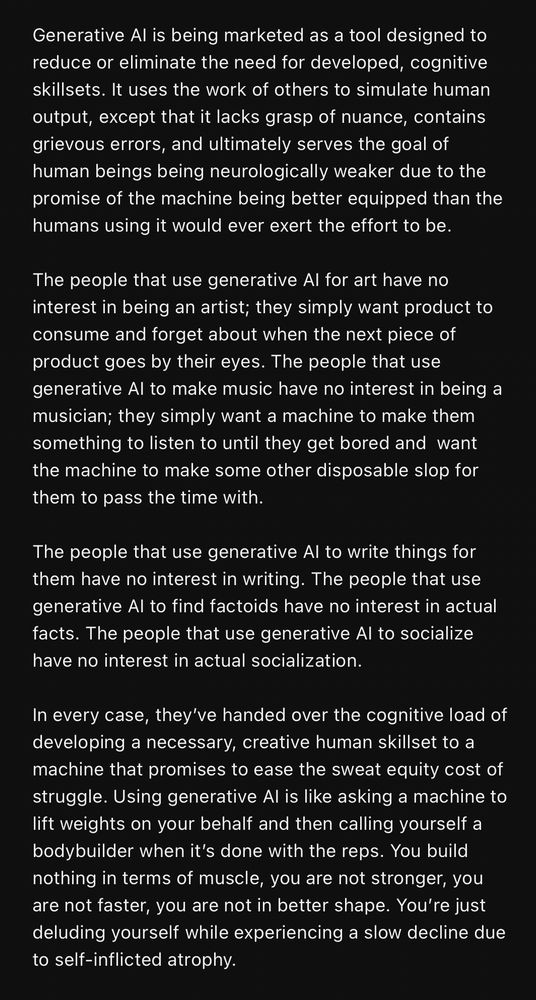
Generative Al is being marketed as a tool designed to reduce or eliminate the need for developed, cognitive skillsets. It uses the work of others to simulate human output, except that it lacks grasp of nuance, contains grievous errors, and ultimately serves the goal of human beings being neurologically weaker due to the promise of the machine being better equipped than the humans using it would ever exert the effort to be. The people that use generative Al for art have no interest in being an artist; they simply want product to consume and forget about when the next piece of product goes by their eyes. The people that use generative Al to make music have no interest in being a musician; they simply want a machine to make them something to listen to until they get bored and want the machine to make some other disposable slop for them to pass the time with. The people that use generative Al to write things for them have no interest in writing. The people that use generative Al to find factoids have no interest in actual facts. The people that use generative Al to socialize have no interest in actual socialization. In every case, they've handed over the cognitive load of developing a necessary, creative human skillset to a machine that promises to ease the sweat equity cost of struggle. Using generative Al is like asking a machine to lift weights on your behalf and then calling yourself a bodybuilder when it's done with the reps. You build nothing in terms of muscle, you are not stronger, you are not faster, you are not in better shape. You're just deluding yourself while experiencing a slow decline due to self-inflicted atrophy.
re: generative AI
I have finally fully and accurately explained my problem with how it’s marketed and used.
And now, you can use it, too.
'Language imposes structure on our thinking and forces us to project a tangled network of thoughts into a linear, logical string of words and ideas. We often do not even know what we are thinking until we express it, either in writing or in speech.' www.nature.com/articles/s41...
The First Peoples in the Americas. Ancient DNA with Dr Jennifer Raff @jenniferraff.bsky.social is now ported to Spotify
See it on YouTube here: youtu.be/TcWPRdtT2B8
Spotify here: open.spotify.com/episode/0F9V...

Making Science Public in a chaotic world
As you know, I am now gradually moving from my old ‘Making Science Public’ blog home at the University of Nottingham to my new personal blog home here. This wasn’t easy and lots of people supported me directly or indirectly in this move (by listening to my…