
05.09.2025 09:20
👍 1
🔁 0
💬 0
📌 0
Delighted that PINE Lab will be accepting applications for PhD students to start Fall 2026! Please share with applicants looking for developmental & neuroscience programs? Our website is updated with current studies, questions, and guidance about fit: www.plasticityinneurodevelopmentlab.com/join-us

New paper 🚨! Our class project on Illusions of the Mind: Laurel vs. Yanny and Sometimes Behave So Strangely #speech2songillusion now out www.nature.com/articles/s41... with 3 undergrad, 2 postgrad, & 1 postdoc, & 3 PI authors #musicscience
thank you!

this also seems like the right time to mention that this academic year ill be on the lookout for post doc opportunities related to #musicscience #development #affect + #memory
celebrating my birthday this yr with a recent first author paper acceptance! here, we found that perceptual biases towards lower frequencies—but not individual differences in music reward sensitivity—modulate the perception of the classic speech-to-song illusion. preprint 🔗 tinyurl.com/3sca8vr2

Nick’s actual poster title is Finding the Self in Others' Music: Self and Other Representations in Prefrontal & Parietal Cortices During Music (two people discussing a poster with lots of brain images)
Last but certainly not the least, @nickkathios.bsky.social on Finding the Self in Others' Music: Self and Other
Representations in Theory of Mind Network During Music Listening
New preprint! Do individuals with musical anhedonia perceive illusory speech in song? Sort of! They rate all speech stimuli as less musical than controls, but hear increased musicality with repetition. And they don't like hearing speech, whether or not it transforms into song. osf.io/preprints/ps...
You can read our new paper on modelling multiple data streams with varying dimensionality (alternately titled "What am I going to do with all these dimensions?!") if you want to.
It's not even a little bit illegal.
Dear musician friends, My PhD student, Aliya, is doing a survey asking musicians to describe how they use imagining music in their heads in their work. It will likely take you less than 20 minutes, and you can win an Amazon voucher. Thanks in advance! durhamuniversity.qualtrics.com/jfe/form/SV_...
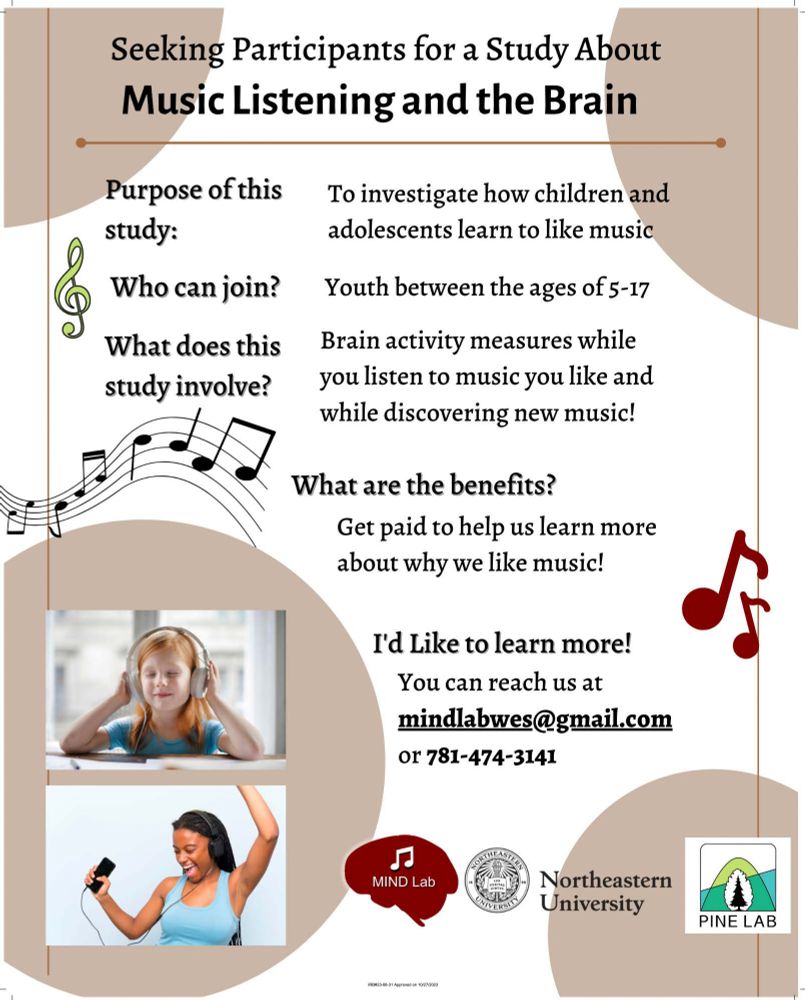
Flyer describing research opportunity for individuals between the ages of 7-17 years old at Northeastern University in Boston, MA.
Help us learn more about why we like listening to music! Our collaborative study at Northeastern University is seeking participants ages 7-17 years old local to the Boston area. For more info, email mindlabwes@gmail.com & pls share! 🎸🕺🎧

🚨 New-er pub! We studied the effects of an art intervention on teen mental health
This comes from my post-bacc at U of Minnesota working w/ a team of incredible scientist & artists (none on 🦋)
Feel free to check it out - it’s open access! All thoughts welcome 💖
link.springer.com/article/10.1...
this work wouldnt have been possible without constant support from @psycheloui.bsky.social, @mariamaly.bsky.social, and nim tottenham along with coauthors on @paulbloom.bsky.social @michaelle.bsky.social + others not on bsky!

this is a hypothesis we flesh out in a recent perspective paper, headed by ⭐️ undergrad student rishi kudaravalli with @psycheloui.bsky.social & juliet davidow. we argue increases in music reward valuation during adol. may support greater music-related memories from this time tinyurl.com/2r8ccs3d
and 2) given that childhood + adolescent music still had a greater likelihood of eliciting MEAMs even after covarying for differences in familiarity, developmental process during this dev. window may support this music-related reminiscence bump effect in adulthood
we think this may suggest: 1) methods used to elicit the music-RB effect (i.e., drawing from billboard charts during and identifying popular songs during participants' childhood/adol/adulthood) may be selectively better at IDing music participants *actually* heard during adolescence vs. childhood ..

plot showing differences in MEAM probability (log odds) across music popular in listeners' childhood (5-9) vs. adolescence (14-18) vs. adulthood (20-25). there are greater log odds of MEAM occurrence for adolescent music over both childhood + adulthood music. childhood music also had greater log odds than adulthood music.

plot showing differences in MEAM probability (log odds) across music popular in listeners' childhood (5-9) vs. adolescence (14-18) vs. adulthood (20-25) with an additional covariate of self-reported familiarity. there are greater log odds of MEAM occurrence for adolescent music over adulthood music, and childhood music over adulthood music. however, there is no difference between childhood + adolescent music.
we also replicated the reminiscence bump effect in our familiar music condition: adolescent music elicited the most MEAMs compared to child + adult music. however, when we covaried for self-reported familiarity across these time periods, there was no difference in MEAMs btn child + adolescent music

plot showing the relationship between self-reported familiarity of music clips and the probability that that music evoked an autobiographical memory for music manipulated to be familiar or unfamiliar. the relationship is significant + positive in the familiar music condition, but non-significant in the unfamiliar music condition.
self-reported if the music elicited a MEAM + how familiar the music was. we found that self-reported familiarity was positively related to MEAMs in response to familiar, but not unfamiliar music. we think this may suggest unfamiliar may music access autobio memory differently than familiar music ..
how can music we haven’t heard before elicit music-evoked autobio memories (MEAMs)? in a secondary analysis, we tested the perception of such music sounding familiar as supporting this phenomenon. older adults listened to preselected familiar + unfamiliar music (genre+acoustically matched) and ...
with an uptick in #musicscience interest on here i thought i’d take the time to introduce myself w a few recent pubs! im a 4th yr phd candidate @ northeastern u interested in music, reward, and development. to start off is a recently in press paper at memory: tinyurl.com/2r6jed9r
For all the newcomers, here is a starter pack of people to follow on #musicscience, music cognition and related topics.
just comment below if you want to be added!
go.bsky.app/4oZbDpj
#musicskyence
#ASFP2024 Roll Call! I’m a PhD student at Northeastern U
who’s helping underrepresented PhD applicants through
@asfp.io because there shouldn't be a hidden curriculum in applying to graduate school!

Image detailing the ASFP applicant process : Students applying to psychology phd programs can submit statement drafts by October 31st, to get matched with 2 double-blind reviewers, and recieve feedback on their statements by November 9th. The applicant portal is now OPEN! Remember to submit at https://www.asfp.io/applicants/submission-form by Oct. 31!
The applicant portal is OPEN!
Applicants, here's what to expect after you submit your statement drafts. ✅
Remember to submit at www.asfp.io/applicants/s... by Oct. 31!
#CognitivePsychSky #ClinicalPsychSky #DevelopmentalPsychSky
#SocialPsychSky
Flyer describing research opportunity for individuals between the ages of 7-17 years old at Northeastern University in Boston, MA.
Help us learn more about why we like listening to music! Our collaborative study at Northeastern University is seeking participants ages 7-17 years old local to the Boston area. For more info, email mindlabwes@gmail.com & pls share! 🎸🕺🎧
Revisiting the Musical Reminiscence Bump: Insights from neurocognitive and social brain development in adolescence: http://osf.io/c6d4e/
we hope this scale will help in investigating long-term associations of informal music exposure in the absence of longitudinal studies, and it is freely available with the preprint! #musicscience 🎧🧪
scores on our measure (which broadly measure the extent to which adults were informally exposed to music in their homes as a child) were related to adult socioemotional outcomes, like trait anxiety & resilience, as well as performance on a melodic perception task ...
here, we validated a retrospective version of the Music@Home scale to measure childhood home musical environments. we preserved three factors from the preschool version of this scale and identified two novel factors for retrospective reporting ...
an exciting end to #neuromusicviii was receiving word that our (myself, kelsie lopez, @laurelgd.bsky.social, and @psycheloui.bsky.social) Music@Home - Retrospective scale validation paper was accepted at behavior research methods (preprint: tinyurl.com/2h6wajrp)! a short 🧵