
It must be very hard to publish null results
Publication practices in the social sciences act as a filter that favors statistically significant results over null findings. While the problem of selection on significance (SoS) is well-known in theory, it has been difficult to measure its scope empirically, and it has been challenging to determine how selection varies across contexts. In this article, we use large language models to extract granular and validated data on about 100,000 articles published in over 150 political science journals from 2010 to 2024. We show that fewer than 2% of articles that rely on statistical methods report null-only findings in their abstracts, while over 90% of papers highlight significant results. To put these findings in perspective, we develop and calibrate a simple model of publication bias. Across a range of plausible assumptions, we find that statistically significant results are estimated to be one to two orders of magnitude more likely to enter the published record than null results. Leveraging metadata extracted from individual articles, we show that the pattern of strong SoS holds across subfields, journals, methods, and time periods. However, a few factors such as pre-registration and randomized experiments correlate with greater acceptance of null results. We conclude by discussing implications for the field and the potential of our new dataset for investigating other questions about political science.
I have a new paper. We look at ~all stats articles in political science post-2010 & show that 94% have abstracts that claim to reject a null. Only 2% present only null results. This is hard to explain unless the research process has a filter that only lets rejections through.
11.02.2026 17:00
👍 642
🔁 223
💬 30
📌 51

From our August Issue: What Can We Learn about the Effects of Democracy Using Cross-National Data? by JONATHAN STAVNSKÆR DOUCETTE. www.cambridge.org/core/journal...
02.02.2026 18:05
👍 4
🔁 2
💬 0
📌 0


So much of classic political science research is woefully underpowered.
I'm glad we're slowly coming to our senses.
02.02.2026 19:29
👍 70
🔁 21
💬 5
📌 3

📄 New WP version out: revised text, tightened argument, and new analysis.
The Politics of Evidence Selection (w/ @jesperasring.bsky.social)
Grateful for the helpful comments and presentation opportunities. Further feedback welcome!
🔗 osf.io/preprints/so...
20.01.2026 16:01
👍 42
🔁 14
💬 1
📌 2

It is hard to overstate how unlikely it was/is
14.01.2026 15:05
👍 2
🔁 1
💬 0
📌 0

Can state-building disrupt rather than stabilize society? In a new @apsrjournal.bsky.social article, @victorgayeco.bsky.social and I show that the expansion of state communication networks spurred rebellion for decades in France before the Revolution
👉 Article: doi.org/10.1017/S000...
🧵1/X
05.01.2026 20:43
👍 43
🔁 18
💬 1
📌 3

How Settlers Shaped Eastern Europe and Scandinavia
Cambridge Core - Political Economy - How Settlers Shaped Eastern Europe and Scandinavia
Very happy that my forthcoming @universitypress.cambridge.org Elements - "How Settlers Shaped Eastern Europe and Scandinavia: Economic Development, Regime Change, and State Formation, 800–1800." Can now be pre-ordered at www.cambridge.org/core/element...
08.12.2025 12:07
👍 24
🔁 8
💬 3
📌 0
How Settlers Shaped Eastern Europe and Scandinavia
Cambridge Core - Political Economy - How Settlers Shaped Eastern Europe and Scandinavia
Very happy that my forthcoming @universitypress.cambridge.org Elements - "How Settlers Shaped Eastern Europe and Scandinavia: Economic Development, Regime Change, and State Formation, 800–1800." Can now be pre-ordered at www.cambridge.org/core/element...
08.12.2025 12:07
👍 24
🔁 8
💬 3
📌 0
Now forthcoming at Quarterly Journal of Economics
Enlightenment Ideals and Belief in Progress in the Run-up to the Industrial Revolution: A Textual Analysis
Available at: digitalcommons.chapman.edu/esi_working_...
(See thread below for an overview)
19.11.2025 16:22
👍 42
🔁 15
💬 2
📌 1

HPE candidates on the job market
Job market season is here.
Looking for rising stars in Historical Political Economy? 🌍📚
Check out this year’s job market candidates: www.broadstreet.blog/p/hpe-candid...
22.09.2025 18:38
👍 19
🔁 5
💬 2
📌 0

Sometimes individual leaders can leave an imprint that persists long after their tenure. In a new paper with Jørgen Møller, we show how Pope Gregory VII used his network to spread urban political autonomy across Europe www.nowpublishers.com/article/Deta...
11.09.2025 13:45
👍 4
🔁 1
💬 1
📌 0

We use Gregory's letters to capture his influence network. Next, we demonstrate that letter-receiving towns introduced self-government earlier and to a larger extent than towns outside of Gregory's network
11.09.2025 13:45
👍 0
🔁 0
💬 1
📌 0
We argue that Gregory, as part of his papal revolution, built alliances with pious townsmen across Italy, Germany, France and the Low Countries to push his reform program. To impose reforms on unreformed lord-bishops, townsmen had to take political power and institute self-government.
11.09.2025 13:45
👍 0
🔁 0
💬 1
📌 0
Sometimes individual leaders can leave an imprint that persists long after their tenure. In a new paper with Jørgen Møller, we show how Pope Gregory VII used his network to spread urban political autonomy across Europe www.nowpublishers.com/article/Deta...
11.09.2025 13:45
👍 4
🔁 1
💬 1
📌 0
A must read, especially for anyone who thinks that making little concessions and keeping your head down will work:
28.08.2025 17:17
👍 154
🔁 49
💬 3
📌 3
The same is true for most cross-national studies www.cambridge.org/core/journal...
10.08.2025 08:45
👍 3
🔁 0
💬 0
📌 0
Jørgen Møller and Jonathan Stavnskær Doucette, "The Catholic Church and European State Formation, AD 1000-1500" (Oxford UP, 2022) - New Books Network
If you need to escape from current politics for a while, my co-author, Jørgen Møller, discusses our book "The Catholic Church and European State Formation, 1000-1500" on the New Books podcast: newbooksnetwork.com/the-catholic...
04.08.2025 11:36
👍 10
🔁 4
💬 0
📌 0
There have been a number of recent articles on statistical power in quantitative political science. This is something that I think deserves more attention and discussion. A short thread of the articles I have read. 🧵
23.07.2025 06:58
👍 74
🔁 23
💬 3
📌 1


🚨🚨 Accepted yesterday! 🚨🚨
@lenkabustikova.bsky.social and I introduce the concept of "Confessional Illiberalism" and distinguish it from two other forms of illiberalism, reactionary and prejudicial illiberalism.
We also compare the concept to other '-isms' to tidy the backsliding literature.
07.05.2025 13:49
👍 27
🔁 15
💬 2
📌 3
The family became afflicted with the disease of dynasties: inheritance by babies and buffoon, or both
That would normally be the death nail for a noble House, but not this time. The Estates of Württemberg stepped in to protect the state, deposed buffoons and ruledon behalf of the babies. (2/3)
01.05.2025 16:50
👍 3
🔁 1
💬 1
📌 0
What Can We Learn about the Effects of Democracy Using Cross-National Data? | American Political Science Review | Cambridge Core
What Can We Learn about the Effects of Democracy Using Cross-National Data?
Thrilled that my article has just been published at @apsrjournal.bsky.social! 🎉 The article argues that low statistical power is a major impediment to acquiring cumulative knowledge on questions concerning cross-national differences: www.cambridge.org/core/journal...
10.12.2024 11:14
👍 150
🔁 44
💬 8
📌 10
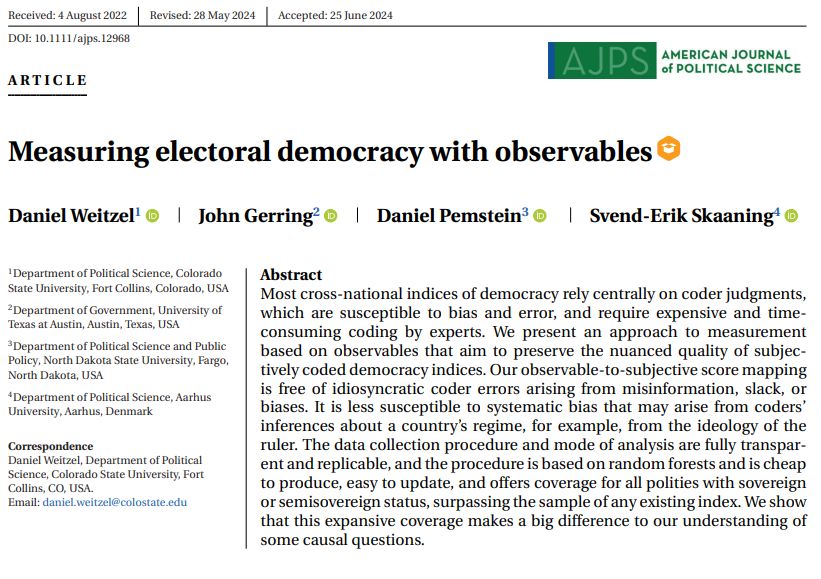
Measuring electoral democracy with observables
Most cross-national indices of democracy rely centrally on coder judgments, which are susceptible to bias and error, and require expensive and time consuming coding by experts. We present an approach to measurement based on observables that aim to preserve the nuanced quality of subjectively coded democracy indices. Our observable-to-subjective score mapping is free of idiosyncratic coder errors arising from misinformation, slack, or biases. It is less susceptible to systematic bias that may arise from coders’ inferences about a country’s regime, for example, from the ideology of the ruler. The data collection procedure and mode of analysis are fully transparent and replicable, and the procedure is based on random forests and is cheap to produce, easy to update, and offers coverage for all polities with sovereign or semisovereign status, surpassing the sample of any existing index. We show that this expansive coverage makes a big difference to our understanding of some causal questions.
A few years ago, @danweitzel.net, John Gerring, @skaaning.bsky.social and I were curious how well one could predict subjective democracy measures using easy(ish) to code observables. Turns out, *quite* well, even out of sample. onlinelibrary.wiley.com/doi/10.1111/...
30.04.2025 21:20
👍 63
🔁 23
💬 1
📌 2
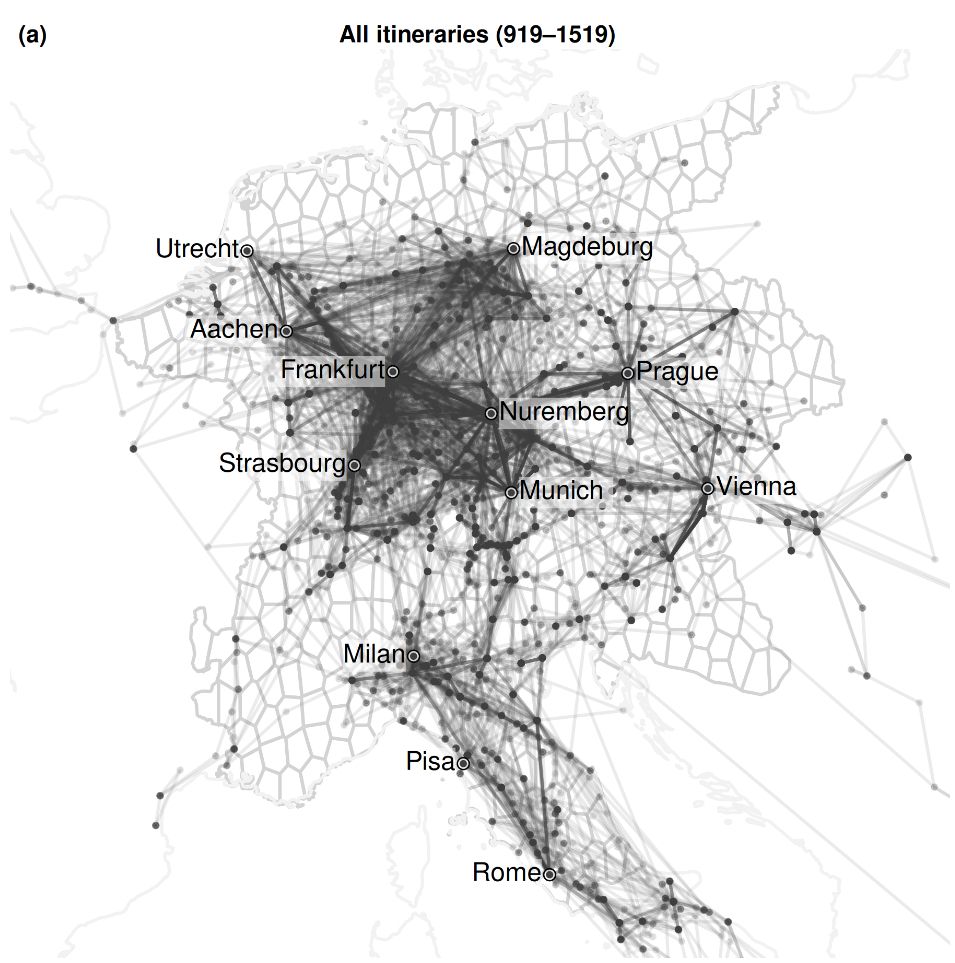
Itineraries of 25 Emperors of the Holy Roman Empire, 919 to 1519
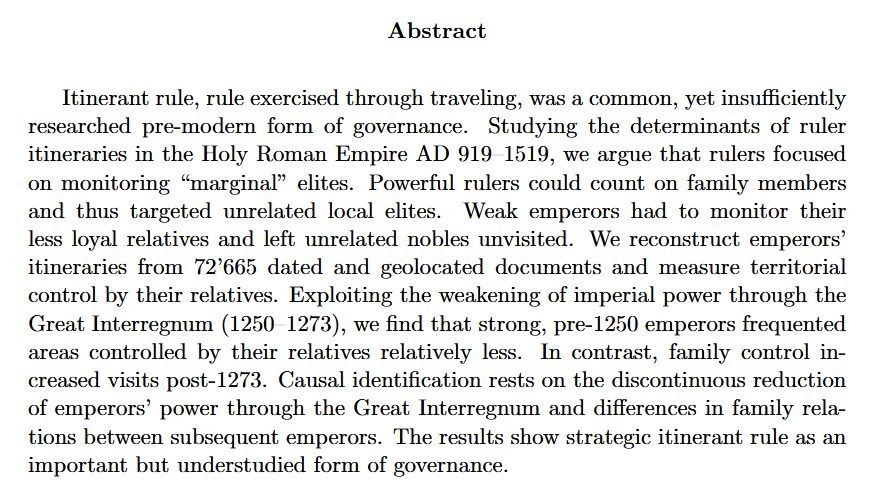
Itinerant rule, rule exercised through traveling, was a common, yet insufficiently researched pre-modern form of governance. Studying the determinants of ruler itineraries in the Holy Roman Empire AD 919-1519, we argue that rulers focused on monitoring `marginal' elites. Powerful rulers could count on family members and thus targeted unrelated local elites. Weak emperors had to monitor their less loyal relatives and left unrelated nobles unvisited. We reconstruct emperors' itineraries from 72'665 dated and geolocated documents and measure territorial control by their relatives. Exploiting the weakening of imperial power through the Great Interregnum (1250-1273), we find that strong, pre-1250 emperors frequented areas controlled by their relatives relatively less. In contrast, family control increased visits post-1273. Causal identification rests on the discontinuous reduction of emperors' power through the Great Interregnum and differences in family relations between subsequent emperors. The results show strategic itinerant rule as an important but understudied form of governance.
🚨 Very excited that our paper on *Rulers on the Road* has been cond. accepted at the AJPS @ajpseditor.bsky.social. We analyze emperors' strategies of itinerant rule in the Holy Roman Empire 919-1519. Fun working with @claranw.bsky.social, @andrejkokkonen.bsky.social & Jørgen Møller shorturl.at/Spm7z
29.04.2025 15:43
👍 168
🔁 39
💬 10
📌 8
That might be more of a feature of city-states (in a relative stateless environment) than democracy per say. Warfare was also frequent in medieval communes (see, e.g., Epstein 2000 "The rise and fall of Italien city-states")
28.04.2025 08:48
👍 3
🔁 0
💬 1
📌 0

Herbert P. Kitschelt is the winner of the 2025 Johan Skytte Prize in Political Science. 🏆
He is awarded the prize for " having increased knowledge of the functioning of democratic party systems with exquisite theoretical acuity and impressive empirical breadth and depth."
23.04.2025 18:01
👍 197
🔁 68
💬 2
📌 18


