Research Fellow in Music Science
Job Description: * 5-year Fixed-Term Contract, Full-time position at Academic Level B.
* Based at the MARCS Institute with flexible working arrangements.
* Salary: $120,908 – $142,769 per annum, plus ...
I am writing to announce a 5-year Research Fellowship in Music Science at the MARCS Institute, Australia.
You will design and lead research projects that use mathematical and computational approaches to investigate music and its cognition.
Further details: jobs.smartrecruiters.com/WesternSydne...
06.03.2026 00:48
👍 16
🔁 10
💬 0
📌 0
We provide several recommendations for future MER research, including improved transparency (models, features, analyses, and validation) and more standardized reporting practices. Study quality varied substantially across the literature.
09.02.2026 07:48
👍 0
🔁 0
💬 1
📌 0
Arousal is predicted with good accuracy (r =.81), whereas valence remains more elusive (r =.67). Emotion classification performs best (r =.87, Matthews correlation). Linear & tree-based models outperform neural networks in regression, while neural networks & SVMs perform best in classification
09.02.2026 07:48
👍 1
🔁 0
💬 1
📌 0
Computational models for music emotion recognition (MER) have steadily improved. Our meta-analysis is now out in ACM Computing Surveys. We reviewed 34 studies comprising 290 models, distilled from a much larger initial pool. #musicscience #musicpsych #emotion #MIR
09.02.2026 07:48
👍 5
🔁 4
💬 1
📌 0
I agree, it is not nearly the end of story (despite the clickbaity first sentence) and this could be done with a large-scale iteration. Artificial chord space is massive and needs some thinking (theory. hypotheses) before a those would offer an insightful design for an experiment.
31.01.2026 18:38
👍 1
🔁 0
💬 0
📌 0
Sage Journals: Discover world-class research
Subscription and open access journals from Sage, the world's leading independent academic publisher.
Does musical tension make the final resolution sweeter? 🎵 New research says perhaps no! We found that high dissonance in the penultimate chord actually makes the final tonic sound less pleasant, debunking the long-held "contrast effect" theory. #musicscience #musicresearch
doi.org/10.1177/0305...
29.01.2026 14:20
👍 8
🔁 4
💬 1
📌 0
Research position suitable for a PhD student (or beyond), keen to work with multimodal vocal performance data in beatboxing: jobportal.uni-koeln.de/ausschreibun...
Deadline: 12 January!
Apply here: jobportal.uni-koeln.de/bewerben/2429
Feel free to contact me with questions about the position
05.01.2026 11:42
👍 4
🔁 4
💬 1
📌 0
Interesting finding. So vocal learners are not the only ones to demonstrate relatively good auditory synchronisation ability
29.11.2025 19:01
👍 0
🔁 0
💬 0
📌 0
Excited to be hosting promising scholars during SysMus26! 🎉
Check out our website for more info musicscience.net/events/sysmu...
#musicpsych #PsychSciSky #conferences
21.11.2025 11:47
👍 6
🔁 2
💬 0
📌 1
🎶 Nice write up of our recent work exploring musicians chills/frisson experiences while performing! 🎶
You can find the 🔓 #openaccess paper here - doi.org/10.1177/03057356251383805
#musicscience #musicpsych
17.11.2025 13:56
👍 7
🔁 2
💬 0
📌 0

This is a chatGPT created image about barriers to data sharing.
What prevents music psychologists from sharing primary research data?
If you are a music psychology researcher (of any level/experience), do help us and complete this anonymous 10-minute questionnaire. #musicpsych #musicscience #opendata #survey
durhamuniversity.qualtrics.com/jfe/form/SV_...
14.11.2025 15:32
👍 7
🔁 9
💬 0
📌 0
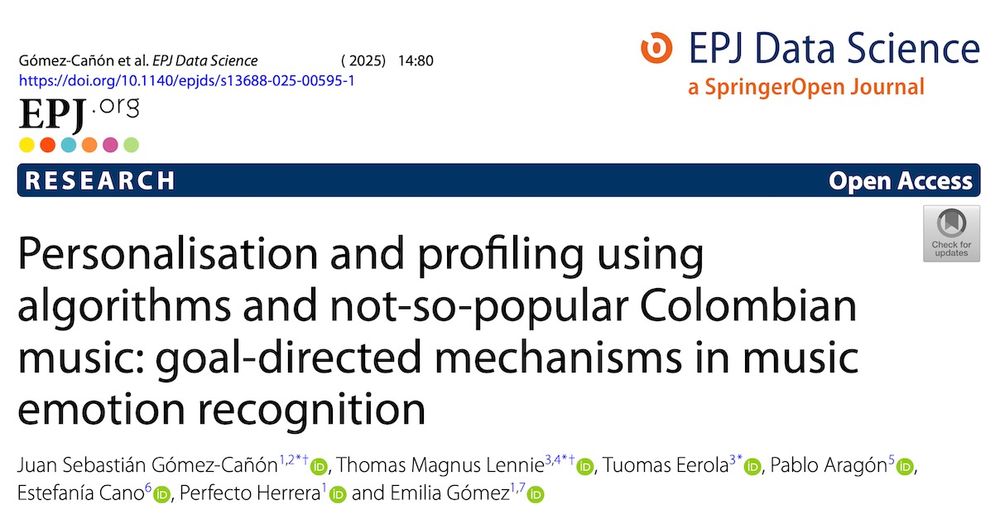
this is top portion of the article displaying the title of the study, Personalisation and profiling using
algorithms and not-so-popular Colombian
music: goal-directed mechanisms in music
emotion recognition
- Although such systems are promoted as tools for personalized listening, they *could* also be used to infer or profile individuals’ beliefs
A wonderful collaboration led by Juan Sebastián Gómez-Cañón, @lennietm.bsky.social, Pablo Aragón, Estefanía Cano, Perfecto Herrera & Emilia Gómez 3/3
13.11.2025 11:44
👍 7
🔁 4
💬 0
📌 0
- In studying traditional Colombian songs with explicit political messages, we found that listeners’ emotional responses aligned with their political leanings, and that AI could reliably detect these patterns
2/3
13.11.2025 11:44
👍 1
🔁 0
💬 1
📌 0
Personalisation and profiling using algorithms and not-so-popular Colombian music: goal-directed mechanisms in music emotion recognition
Out in EPJ Data Science @springernature.com, we show:
- Personalized music algorithms trained on emotion data can become problematic when used with politically charged music
rdcu.be/ePImC
#musicpsych #musicscience #emotion #psycsci #psychscisky #music 1/3
13.11.2025 11:44
👍 4
🔁 0
💬 1
📌 0
#musicpsych
06.11.2025 09:46
👍 1
🔁 0
💬 0
📌 0
Delighted to share our latest research on consonance. We asked participants from India and UK to rate how “tense” different harmonic intervals sound. We found that musicians across both cultures agreed almost perfectly on which intervals feel tense or relaxed, however, ....
06.11.2025 09:44
👍 7
🔁 4
💬 2
📌 3
Very nice and particularly like the specificity of the imagined content that the methods allow you to demonstrate. The stable diffusion generated images are fun and I’m surprised that the average content is as coherent as it seems!
05.08.2025 19:11
👍 1
🔁 0
💬 0
📌 0

Big cities are vibrant hubs of culture, but why exactly is that? Now out in @natcomms.nature.com, we analysed music listening patterns of over 2.5 million people and demographics to examine mechanisms driving cultural diversity. With @researchdeezer.bsky.social @norijacoby.bsky.social
Highlights ⬇
04.06.2025 17:30
👍 92
🔁 36
💬 3
📌 5
Revealing Universal and Cultural Origins of Music-Induced Emotion | Western Sydney University
We are advertising an exciting #MusicScience PhD scholarship in Sydney, Australia as part of our ARC Discovery project "Revealing Universal and Cultural Origins of Music-Induced Affect": international field trips, music cognition experiments, Bayesian analyses! Please share.
23.05.2025 01:18
👍 10
🔁 5
💬 0
📌 3

MAPLE Lab
The MAPLE lab is the world’s first music cognition lab with a percussion focus. Drawing upon the diverse skills of our team, we conduct federally funded research in a state-of-the-art facility, presen...
Forgot Mike’s Bluesky handle, @michaelschutz.bsky.social here and shout out to wonderful MAPLE lab at McMaster University, maplelab.net, who have been systematically curating various datasets for music cognition over the last decade.
13.05.2025 19:57
👍 2
🔁 0
💬 0
📌 0

GitHub - tuomaseerola/relative_mode: Relative Mode Estimation (model)
Relative Mode Estimation (model). Contribute to tuomaseerola/relative_mode development by creating an account on GitHub.
Our findings show that this model can predict expert ratings with a high degree of accuracy (r = .82). The model is fairly robust across different recordings and performers. Python implementation is available at github.com/tuomaseerola... #MusicCognition #Tonal #ComputationalMusic 3/3
13.05.2025 16:34
👍 3
🔁 0
💬 1
📌 0
To quantify relative mode, we developed an audio-based computational model that adapts key-finding methods and focusses on the difference in strength between major and minor keys. This model was evaluated against expert music analysts' ratings of relative mode. #MusicAnalysis 2/3
13.05.2025 16:34
👍 0
🔁 0
💬 1
📌 0
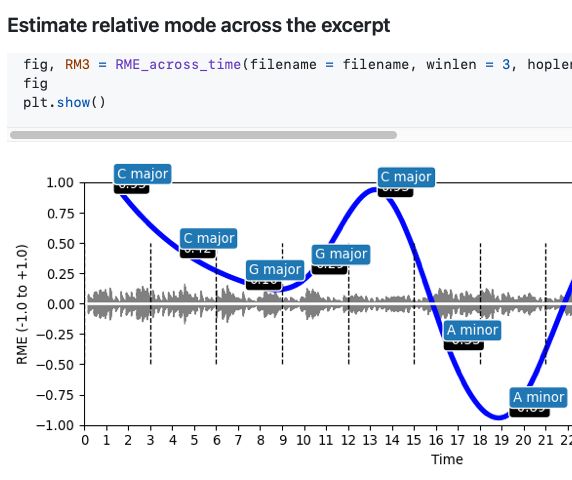
Shows a plot of audio waveform with continuously changing estimation of majorness to minorness (relative mode) in a Bach prelude. It is a screen capture from GitHub.
Want to measure how "major" or "minor" a musical passage feels on a sliding scale, not just as a simple label? 🤔 Mike Schutz and I refined the concept of 'relative mode', treating it as a continuous spectrum from minor to major. journals.sagepub.com/doi/10.1177/... #musicscience #MIR 1/3
13.05.2025 16:34
👍 17
🔁 5
💬 1
📌 1

Frontiers | Actions and feelings in sync: exploring the relationship between synchrony and empathy in children’s dyadic musical interactions
Also, brief synchronous music interactions boosted state empathy, but not overall social bonding. While induced empathy didn't have an effect, trait empathy & familiarity were linked to the experience of bonding. Interesting work from @sheffielduni.bsky.social #musicscience doi.org/10.3389/fpsy...
25.04.2025 16:48
👍 6
🔁 0
💬 0
📌 0
New study by @persatz.bsky.social on children's music-making explores empathy & synchrony! Findings show that higher trait empathy helps children synchronize better, especially when their timing is less stable. Female-female pairs also synchronized better. 1/2 #musicscience
25.04.2025 16:48
👍 14
🔁 3
💬 1
📌 1
🚨 We’re hiring! 🚨
A postdoc position is available at my lab (npa.iit.it) in Rome! Join us to explore:
🎵 Neural bases of musicality (humans, infants, macaques)
💃🕺 Dance & joint music-making
🤝 Spontaneous social behavior
⬇️ Apply through the link below! ⬇️
05.03.2025 08:58
👍 33
🔁 31
💬 3
📌 3