
At the same time, leave satisfaction declines sharply, highlighting a welfare trade-off
Paternity leave can shift norms and reduce gender inequality, but such policies comes at a cost
The broader question - beyond the scope of our paper - is how to weigh these objectives
25.02.2026 22:10
👍 1
🔁 0
💬 0
📌 0
We also find labor market effects beyond the leave period
In the second year after the child is born (i.e. after leave has been exhaused), we find
- Gender earnings gap declines by 2.8pp
- Gender hours gap declines by 1.4pp
This corresponds to ~14% of Denmark’s child penalty
25.02.2026 22:09
👍 0
🔁 0
💬 1
📌 0
Effects are larger for first-time parents and for parents who change their behavior due to the reform.
We provide evidence that larger reforms - such as policies that ensures equal parental leave - have the potential to shift norms out of the conservative domain
25.02.2026 22:09
👍 0
🔁 0
💬 1
📌 0
The reform shifts gendered beliefs in a more progressive direction
Parents become less supportive of statements like:
- Pre-school children suffer if their mothers work full-time
- Mothers should take most leave
- Mothers are better caregivers of small children
25.02.2026 22:08
👍 0
🔁 0
💬 1
📌 0

First, we document a large first-stage. The reform reallocated roughly one month of leave from mothers to fathers
After the reform, fathers take more than 20 % of all parental leave
25.02.2026 22:07
👍 0
🔁 0
💬 1
📌 0
We study an expansion of earmarked paternity leave and link administrative data to a new survey of ~40,000 parents, interviewed twice, around the reform implementation
This allows us to provide causal evidence on leave behavior and earnings, but also on gender beliefs and norms
25.02.2026 22:06
👍 1
🔁 0
💬 1
📌 0
Can family policies shift gendered beliefs, social norms, and ultimately gender gaps in the labor market?
Yes!
Read our new WP for all the details
25.02.2026 22:05
👍 13
🔁 3
💬 1
📌 2

Expanding Paternity Leave: Effects on Beliefs, Norms, and Gender Gaps
Founded in 1920, the NBER is a private, non-profit, non-partisan organization dedicated to conducting economic research and to disseminating research findings among academics, public policy makers, an...
Happy to finally see our new working paper on the effect of earmarked paternity leave out.
Joint work with: Henrik Kleven, Camillie Landais, @ansolassen.bsky.social, Philip Rosenbaum and Herdis Steingrimsdottir.
25.02.2026 07:40
👍 29
🔁 6
💬 1
📌 1

The figure shows the gender wage gap (the difference in average log hourly wages between males and females) in log points on the y-axis. The x-axis displays the gender wage premium gap, which is the sum of the sorting and pay-setting components. The diagonal lines represent scenarios in which firm wage premiums account for 10% (top line) and 40% (bottom line) of the total gender wage gap.
Early explanations for gender wage gaps focused on human capital or career choices. This column uses data from the US and ten European countries to examine the role of firms. Across all countries considered, firms account for between 10% and 30% of the gender wage gap, mainly reflecting women being more likely to work at firms that pay less to all employees, irrespective of their skills. While men move to higher-paying firms as they advance in their career, women tend to stay behind. Women also tend to sort into low-wage firms in return for more flexibility in working time. The findings suggests that there is a case for complementing family policies with policies focused on firms.
Using data from the US & 10 European countries, the OECD LinkEED 2.0 Team analysed the role of firms in the gender wage gap. They find firms account for 10-30% of the gap, mainly reflecting women being more likely to work at firms that pay less to all employees.
cepr.org/voxeu/column...
#EconSky
23.02.2026 10:03
👍 11
🔁 5
💬 0
📌 1
The gender wage gap and what firms have to do with it 👀
Read the column, covering our paper
We use harmonized data across 11 countries, producing truly comparable results
23.02.2026 10:20
👍 4
🔁 0
💬 0
📌 0


Join us for the workshop "Gender Gaps and Social Norms"
📅 December 4 📍 @upf.edu (Barcelona)
Organized with @libertadgonzalez.bsky.social as part of #MSCA project #Leave4NextGen
Full program with lineup of leading researchers: tinyurl.com/yh62scdj
📧 Register by email: sebastien.fontenay@upf.edu
17.11.2025 11:32
👍 8
🔁 3
💬 1
📌 0

📚 📣 Are you in the Stockholm area on September 22nd? Come discuss new research about gender gaps in academia at Stockholm University! Email me to sign up. Program below!
03.09.2025 08:11
👍 51
🔁 19
💬 1
📌 1

Join us at Copenhagen Business School on Sept 29, 2025 for a full-day workshop on Gender Norms, Family Dynamics, and Labor Market Outcomes
🔗 Registration: cbs.nemtilmeld.dk/1289/
Featuring: @libertadgonzalez.bsky.social, @esmeezwiers.bsky.social, @jakobsogaard.bsky.social and more 👇👀
26.08.2025 17:56
👍 10
🔁 1
💬 0
📌 0

Attention Berlin-based PhDs & early-career researchers!
On 18–19 September, join the RFBerlin Masterclass with Barbara Petrongolo and get the chance to deepen your understanding of The Evolution of Gender in the Labor Market.
Apply by 15 August: www.rfberlin.com/event/rfberl...
11.08.2025 12:12
👍 7
🔁 7
💬 0
📌 2

Really very happy to attend the NBER SI, and for our paper on the role of firms in explaining the gender wage gap - with harmonized data from 11 countries - to be included in the joint Gender & Labor session this morning!
Come say hi and enjoy @marcogpalladino.bsky.social's presentation!
22.07.2025 10:46
👍 6
🔁 1
💬 0
📌 0
Such a cool paper!
When I think about interruption at work (and mental load on which we know even less), this is my first reference!
11.06.2025 04:50
👍 4
🔁 1
💬 0
📌 0
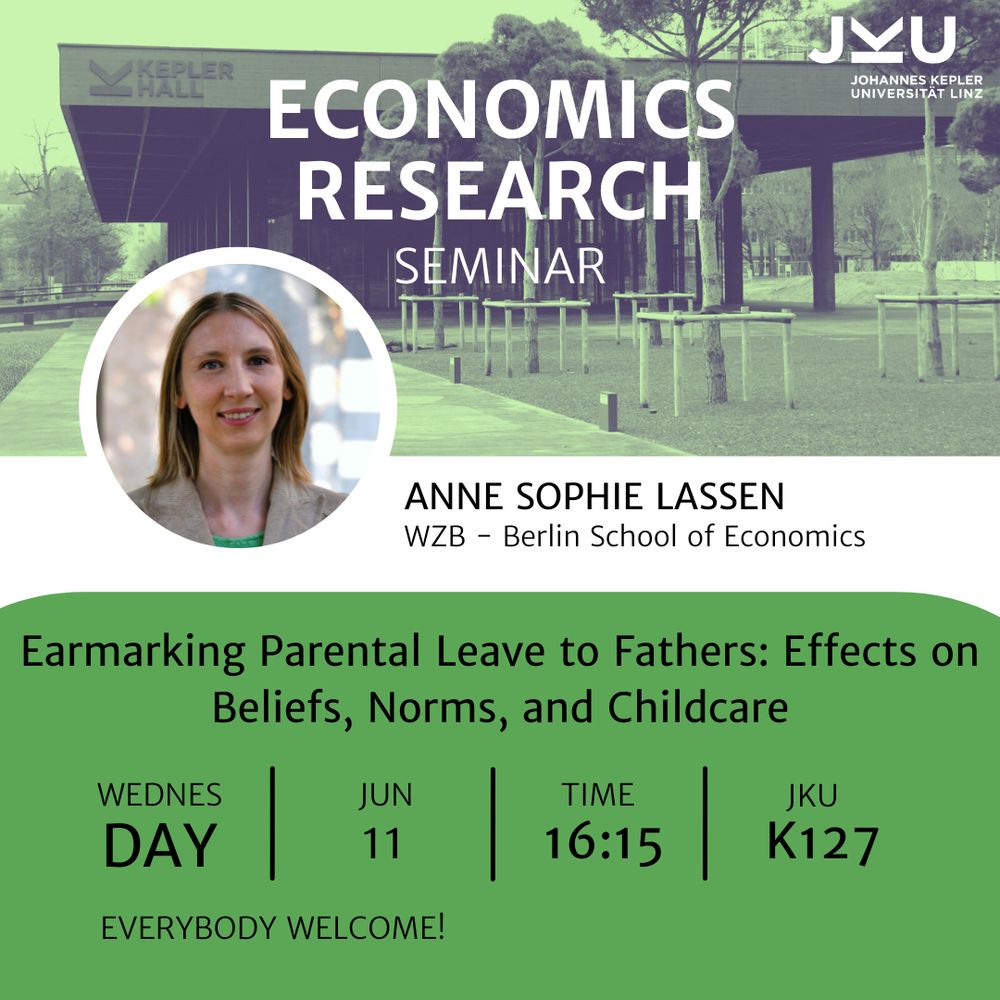
📆 Join us on June 11 at our economics research seminar with Anne Sophie Lassen (@ansolassen.bsky.social), who will present "Earmarking Parental Leave to Fathers: Effects on Beliefs, Norms, and Childcare."
More info and abstract:
www.jku.at/en/departmen...
#EconSky
10.06.2025 12:06
👍 11
🔁 3
💬 0
📌 0
I really liked Undine (movie, partly set in Berlin) and Madonna in a fur coat (book, set in 1920s Berlin and Ankara)
26.05.2025 22:37
👍 1
🔁 0
💬 0
📌 0

🚉 —> NBER Spring Meeting on Investments in Early Career Scientists
Looking forward to see some cool projects (www.nber.org/conferences/...) and get feedback on our project ‘Parenthood and the Academic Ladder’ (with @cairosofie.bsky.social @riaivandic.bsky.social @valentinatartari.bsky.social)
24.04.2025 17:31
👍 2
🔁 0
💬 0
📌 2
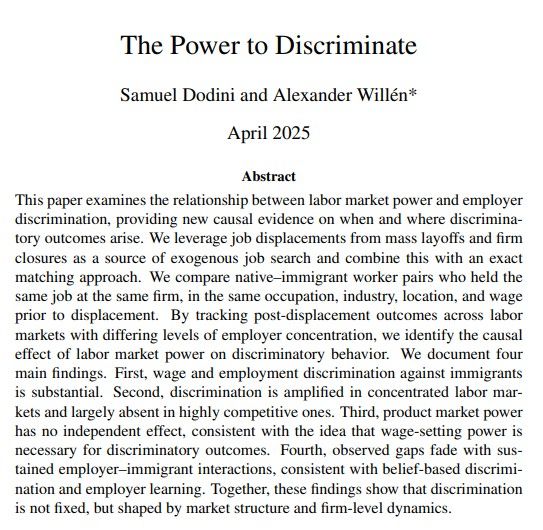
🚨🚨 Does labor market discrimination drive economic gaps? Can market competition eliminate discrimination like economic theory suggests? What *kind* of discrimination are we talking about. In a new paper, Alex Willen & I explore the question. #Econsky
16.04.2025 15:00
👍 16
🔁 2
💬 1
📌 0

Excited to be at @princetonecon.bsky.social for the next month 🌸🌸
If around, please reach out!!
14.04.2025 20:17
👍 7
🔁 0
💬 0
📌 0

🚨🆕 In a new NBER working paper out today (tinyurl.com/2vv3vnhf), with
@wsandholtz.bsky.social we ask a 🔥question: Can controversial public policies end up being political successes even when they cause lots of backlash? And if the answer is yes, what drives pol success? A thread 👇
07.04.2025 16:20
👍 39
🔁 11
💬 3
📌 3

Teaching boys home economics in school in Japan increased the amount of housework they did 20 years later
www.journals.uchicago.edu/doi/full/10....
02.04.2025 10:29
👍 176
🔁 55
💬 5
📌 4
Do men increase their support for gender equality if they have daughters?
Some papers suggest so!
Join this meta-science project as a co-author, work with SOEP data and help us all learn more!
31.03.2025 16:18
👍 11
🔁 3
💬 0
📌 0

Have you ever wondered how social networks differ by gender?
Check out my team's new dataset, which uses Facebook data to measure regional differences in social networks by gender all across the world!
A 🧵 with examples, a description of our methodology, and a link to download the data:
12.02.2025 21:48
👍 55
🔁 14
💬 2
📌 6

Looking back on our Lab² Applied Microeconomics Workshop last Friday. 📖
Thank you to all attendees who joined our half day of presentations, networking and discussions and big thanks to our invited speakers Valeria Zurla and Antoine Bertheau.🎙️
12.02.2025 15:45
👍 1
🔁 1
💬 0
📌 0
Does parenthood influence career trajectories of academics? 🥁🥁
YES!
Celebrate the International Day of Women and Girls in Science by looking at our striking graphs 👀
11.02.2025 16:01
👍 7
🔁 0
💬 0
📌 0

Families’ Career Investments and Firms’ Promotion Decisions
Founded in 1920, the NBER is a private, non-profit, non-partisan organization dedicated to conducting economic research and to disseminating research findings among academics, public policy makers, an...
Why is there a gender gap in management promotions? Is it due to families’ or firms’ decisions? In a new paper with Frederik Almar, Ben Friedrich, Ana Reynoso and Rune Vejlin, we show that the interaction between families' and firms' career investments is key!
www.nber.org/papers/w33438
#Econsky
06.02.2025 12:34
👍 24
🔁 4
💬 2
📌 0

