Me and my plants's Avatar

Me and my plants

@meandmyplants

Just me and my plants. Sometimes I water em. Sometimes I walk around the yard and show my daughter em.

245
Followers
210
Following
1
Posts
23.12.2024
Joined
Posts Following

Latest posts by Me and my plants @meandmyplants

Post image
19.01.2025 01:22 πŸ‘ 519 πŸ” 169 πŸ’¬ 23 πŸ“Œ 10
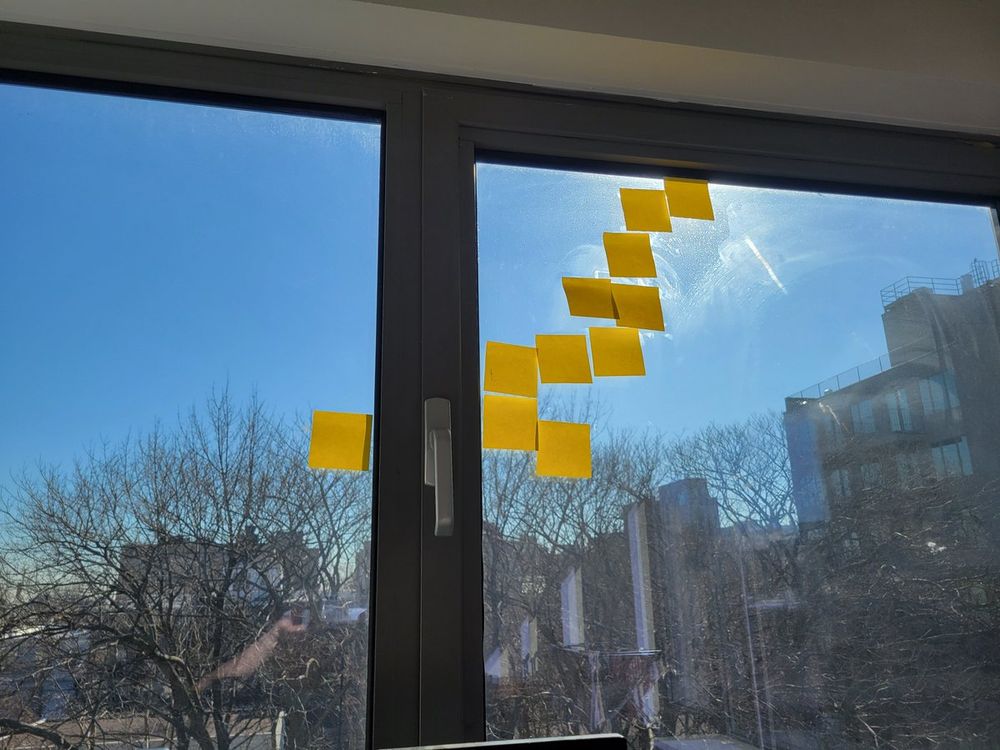
A series of sticky notes on the window that follows the path of the sun

A series of sticky notes on the window that follows the path of the sun

The sun is in my eyes... I could just buy and install blinds, or I can use my design thinking and UX tools to solve the problem creatively

12.01.2025 22:34 πŸ‘ 3021 πŸ” 279 πŸ’¬ 90 πŸ“Œ 15
Post image

Check it out – Santa’s got a new helper this year!

24.12.2024 16:51 πŸ‘ 5693 πŸ” 516 πŸ’¬ 132 πŸ“Œ 40
Black & white dog named Pants

Black & white dog named Pants

Wait a second, THIS is Pants

25.12.2024 01:36 πŸ‘ 3 πŸ” 0 πŸ’¬ 1 πŸ“Œ 0
This is a composite image of star cluster NGC 602, in vibrant and festive colors. The shape of the star cluster strongly resembles a holiday wreath. The cluster includes a giant dust cloud ring, shown in greens, yellows, blues, and oranges. The green hues and feathery edges of the ring cloud create the appearance of a wreath made of evergreen boughs. Hints of red representing X-rays provide shading, highlighting layers within the wreath-like ring cloud.

The image is aglow with specks and dots of colorful, festive light, in blues, golds, whites, oranges, and reds. These lights represent stars within the cluster. Some of the lights gleam with diffraction spikes, while others emit a warm, diffuse glow. Upon closer inspection, many of the glowing specks have spiraling arms, indicating that they are, in fact, distant galaxies.

Image credit: X-ray: NASA/CXC; Infrared: ESA/Webb, NASA & CSA, P. Zeilder, E.Sabbi, A. Nota, M. Zamani; Image Processing: NASA/CXC/SAO/L. Frattare and K. Arcand

This is a composite image of star cluster NGC 602, in vibrant and festive colors. The shape of the star cluster strongly resembles a holiday wreath. The cluster includes a giant dust cloud ring, shown in greens, yellows, blues, and oranges. The green hues and feathery edges of the ring cloud create the appearance of a wreath made of evergreen boughs. Hints of red representing X-rays provide shading, highlighting layers within the wreath-like ring cloud. The image is aglow with specks and dots of colorful, festive light, in blues, golds, whites, oranges, and reds. These lights represent stars within the cluster. Some of the lights gleam with diffraction spikes, while others emit a warm, diffuse glow. Upon closer inspection, many of the glowing specks have spiraling arms, indicating that they are, in fact, distant galaxies. Image credit: X-ray: NASA/CXC; Infrared: ESA/Webb, NASA & CSA, P. Zeilder, E.Sabbi, A. Nota, M. Zamani; Image Processing: NASA/CXC/SAO/L. Frattare and K. Arcand

In this composite image, a bright, massive star, WR 124, gleams with diffraction spikes, surrounded by a churning wind cloud in reds and purples. With its dusty rose coloring, and the bright, gleaming star at its core, the wind cloud resembles the inside of a delicate flower with opening petals. Dozens of other bright stars surround WR 124, including white dots rimmed with neon purple, and gleaming white dots with cool blue diffraction spikes. The purple dots are stars detected with Chandra.

Image credit: X-ray: NASA/CXC/SAO; Infrared: (Herschel) ESA/NASA/Caltech, (Spitzer) NASA/JPL/Caltech, (WISE) NASA/JPL/Caltech; Infrared: NASA/ESA/CSA/STScI/Webb ERO Production Team; Image processing: NASA/CXC/SAO/J. Major

In this composite image, a bright, massive star, WR 124, gleams with diffraction spikes, surrounded by a churning wind cloud in reds and purples. With its dusty rose coloring, and the bright, gleaming star at its core, the wind cloud resembles the inside of a delicate flower with opening petals. Dozens of other bright stars surround WR 124, including white dots rimmed with neon purple, and gleaming white dots with cool blue diffraction spikes. The purple dots are stars detected with Chandra. Image credit: X-ray: NASA/CXC/SAO; Infrared: (Herschel) ESA/NASA/Caltech, (Spitzer) NASA/JPL/Caltech, (WISE) NASA/JPL/Caltech; Infrared: NASA/ESA/CSA/STScI/Webb ERO Production Team; Image processing: NASA/CXC/SAO/J. Major

The is an infrared image with data from Webb. It resembles a rust brown mountain range backed by a hazy blue night sky. The entire image is filled with stars. The right half of this graphic is a large, square composite image combining the two smaller images’ data, Chandra lends its magenta touches to the top right of the original Webb frame.

Image credit: X-ray: NASA/CXC/Univ. Observ. Munich/T. Preibisch et al.; IR: NASA/ESA/CSA/STScI

The is an infrared image with data from Webb. It resembles a rust brown mountain range backed by a hazy blue night sky. The entire image is filled with stars. The right half of this graphic is a large, square composite image combining the two smaller images’ data, Chandra lends its magenta touches to the top right of the original Webb frame. Image credit: X-ray: NASA/CXC/Univ. Observ. Munich/T. Preibisch et al.; IR: NASA/ESA/CSA/STScI

Webb's view shows fluffy tan-colored nebula clouds with rust-colored highlights surrounding a black central area. Within that area, the focal point of the image is one large yellow star with eight long thin points. To the right of this star is a bright star cluster in an oval shape. The stars within the cluster look like tiny blue sparkles. The cluster is more densely packed at its core and scatters outward. Towards the bottom of the image, multiple arms appear to spiral out of a cloudy tan knob. Other blue and yellow eight-pointed stars, as well as distant galaxies, are dotted throughout. The composite view looks largely the same as the Webb view, but adds in X-ray patches of dark blue and purple overlaid on top of the cavities. The most prominent X-ray cloud resembles an upward pointing triangle in the central area.

Image credit: X-ray: NASA/CXC/Penn State Univ./L. Townsley et al.; IR: NASA/ESA/CSA/STScI/JWST ERO Production Team

Webb's view shows fluffy tan-colored nebula clouds with rust-colored highlights surrounding a black central area. Within that area, the focal point of the image is one large yellow star with eight long thin points. To the right of this star is a bright star cluster in an oval shape. The stars within the cluster look like tiny blue sparkles. The cluster is more densely packed at its core and scatters outward. Towards the bottom of the image, multiple arms appear to spiral out of a cloudy tan knob. Other blue and yellow eight-pointed stars, as well as distant galaxies, are dotted throughout. The composite view looks largely the same as the Webb view, but adds in X-ray patches of dark blue and purple overlaid on top of the cavities. The most prominent X-ray cloud resembles an upward pointing triangle in the central area. Image credit: X-ray: NASA/CXC/Penn State Univ./L. Townsley et al.; IR: NASA/ESA/CSA/STScI/JWST ERO Production Team

webb and chandra combined images 🀩

22.12.2024 03:03 πŸ‘ 2848 πŸ” 386 πŸ’¬ 29 πŸ“Œ 10