
#QJE Feb 2026, #13, “Political Foundations of Racial Violence in the Post-Reconstruction South,” by Testa (@patesta.bsky.social) and Williams: doi.org/10.1093/qje/...
15.01.2026 21:32
👍 0
🔁 1
💬 1
📌 0

@patesta
Political economist of migration, demography, geography, elections, history. Assistant Professor at Tulane University, Department of Economics and the Murphy Institute. Faculty Research Fellow at the NBER. http://patrickatesta.com/
#QJE Feb 2026, #13, “Political Foundations of Racial Violence in the Post-Reconstruction South,” by Testa (@patesta.bsky.social) and Williams: doi.org/10.1093/qje/...
My new working paper! Previous work has focused on national shocks (eg Great Migration) in bringing about racial realignment between 1940 and 1970. I show that elections themselves played a key feedback role guiding this process, by showing party investors where coalition changes were profitable

More than just select officeholders and policies, election results signal to political actors where to invest their time and resources, from Patrick A. Testa www.nber.org/papers/w34585
Recently accepted by #QJE, “Political Foundations of Racial Violence in the Post-Reconstruction South,” by Testa (@patesta.bsky.social) and Williams: doi.org/10.1093/qje/...
*predoc
My research team (w/ @andyferrara.bsky.social, Sam Bazzi, Eric Chyn, Martin Fiszbein, and Thomas Pearson) is hiring a full-time economics postdoc for the 2025-26 academic year! If you know someone who might be interested, see the link below.
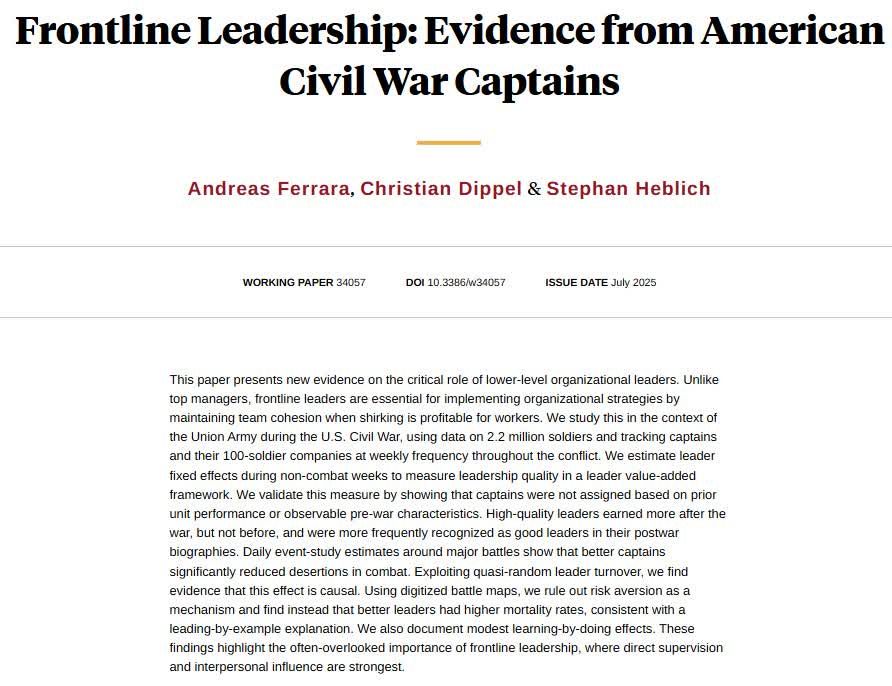
Frontline Union Army captains cut desertions and boosted cohesion through leading by example, earning postwar-wage gains and greater recognition, from @andyferrara.bsky.social, Christian Dippel, and Stephan Heblich https://www.nber.org/papers/w34057
Fantastic new work by @andyferrara.bsky.social. Thrilled to see this paper finally out after many years
Proud of this paper with Jhacova Williams!

Racial violence in the post-Reconstruction US South was closely tied to the local political performance of the Democratic Party, from Patrick A. Testa and Jhacova A. Williams https://www.nber.org/papers/w34004

An examination of when migrants shape local culture, development a framework, and illustrated with historical evidence, to explain the conditions and channels for influence, from Samuel Bazzi and Martin Fiszbein https://www.nber.org/papers/w34001

How did local legal institutions power the British Industrial Revolution?
In a new working paper (with Tim Besley, Dan Bogart, and Jonathan Chapman @jnchapman-econ.bsky.social, we show that Justices of the Peace — magistrates acting locally — were a quiet engine behind modern economic growth. 🧵👇1/7
As an example: we could have a huge trade deficit with a country that has zero trade barriers at all because they happen to have some resource we don't have and need
Read on here: papers.ssrn.com/sol3/papers....
Going to make an effort to be active here... for my first post let me advertise my new work with Jhacova Williams (at American U). We provide some of the very first systematic evidence for an old hypothesis, that political factors directly shaped the dynamics of lynching activity across the US South