
Astoria on 17th!
06.01.2025 00:31
👍 1
🔁 0
💬 0
📌 0
Astoria on 17th!
Exactly. We too often assume our ‘hybrid’ response has to be equally nefarious - certainly not the case.
Conventional strength fundamentally cannot deter hybrid threats, because it's the reason RUS/Iran employ hybrid approaches in the first place.
If we're not comfortable eating the cost of these attacks (a big if), the *only* response is also hybrid. Great to see this argument laid out effectively.

Interesting paper on Russia using the gig economy for sabotage ops.
“Available evidence suggests that Moscow has expanded its recruitment of agents-saboteurs online to go beyond the usual suspects. …Russia’s new model of sabotage appears to more closely resemble the key tenets of the ‘gig economy”
For folks not following closely, may not realize the key lever the SDF has is its control over these prisons, which Ankara has said it will handle if the SDF is routed—a willingness and capacity which people are skeptical about

What’s this “hedge” concept you speak of it seems too logical to be a real thing
I really hope that Austin Tice is found and released quickly for the sake of his family, ending their 12 year nightmare.
External combat power is not a substitute for internal popular will to fight - as true for Russia/Iran in Syria as it was for the US in Afghanistan.
It can keep the dam from breaking for awhile, but a resilient state it does not create.
Me, walking into a meeting with literally anyone in the USG: hello
Literally anyone in the USG: saw what you posted on Twitter last night
Me:
Questions so far in Syrian rebel offensive, with lots to unpack:
1) Syrian Kurd internal dynamics with Arab SDF elements, and cooperation with non-SDF Arab rebels
2) Impact of Ukraine on Russian munitions, ISR, and general readiness to suppress an offensive
3) Centrality of HTS to Aleppo operations
Been a minute since I had to pull out the [checks notes] *Syrian* @liveuamap.com

The increase use of #remotesensing is providing much needed details on the wider impact of war on #foodsecurity and #environment in #Ukraine. New research uses satellite imagery to show mass crop losses from affected and abandoned agricultural land www.science.org/content/arti...
For new folks out there, I’m a researcher and data scientist @rand.org focused on conflict studies, coercion, SOF, and defense strategy. Some work on developing economies, GIS, and labor markets too.
Excited to connect with what already feels like a stronger network here than I ever had on Twitter.

Excited to have joined @warontherocks.bsky.social's members-only 'In Brief' newsletter this week to discuss how the U.S. is balancing trying to de-escalate tensions with China, while preparing for war all the same: warontherocks.com/2024/09/in-b...

We're launching a new Master of National Security Policy degree at Pardee RAND.
The program focuses on the tools of defense policy analysis, taught by RAND policy experts.
Applications are now open for fall 2024. Learn more. ⬇️
www.pardeerand.edu/programs/mas...
New podcast out this week from West Point's Modern War Institute discussing my @rand.org research - I joined Chris Maier, ASD SO/LIC, to discuss SOF's strategic potential to disrupt great powers. irregularwarfare.org/podcasts/str...
This research ideally provides a rubric for how future campaigns can disrupt competitors' efforts to win without fighting, particularly when potentially escalatory options rooted in conventional deterrence are ill-suited or infeasible to achieve similar disruptive effects.

SOF’s main contributions are therefore to create time, space, and opportunities for other elements of national power – diplomatic, informational, military, and economic – to achieve friendly strategic objectives, and not necessarily to deliver strategic effects themselves.

We find that strategic disruption campaigns primarily seek to disrupt an adversary’s preferred approach, forcing them onto suboptimal strategies or activities that create openings for friendly strategic gains.

1. The resist pillar involves efforts to enable a resistance or insurgency to coerce, dis-rupt, or overthrow a government or occupying power or deter an occupation. 2.Thesupport pillar involves efforts to build the capacity of foreign security forces and enable their own efforts to defend against internal or external threats to their security. 3.Theinfluence pillar involves efforts to inform and shape the attitudes, behavior, and decisions of foreign actors in support of U.S. interests. 4.Theunderstand pillar involves efforts to extract strategically relevant information from politically sensitive, contested, or denied environments. 5.Thetarget pillar involves efforts to seize, destroy, disrupt, or secure key personnel, equipment, or infrastructure in politically sensitive, contested, or denied environ-ments.
We explore 50+ historical cases of disruptive campaigns by SOF and similar forces across five pillars of capability for strategic disruption – resist, support, influence, understand, and target.
Much has been written about the need for special operations forces to create dilemmas and impose costs on great power adversaries. Less has been written on how such campaigns actually deliver friendly strategic effects and not just unintended escalation in response.
How can special operations forces disrupt the strategic aims of nation-state competitors short of war?
We present a new concept for 'strategic disruption' by SOF in @rand.org research published this week.
www.rand.org/pubs/researc...
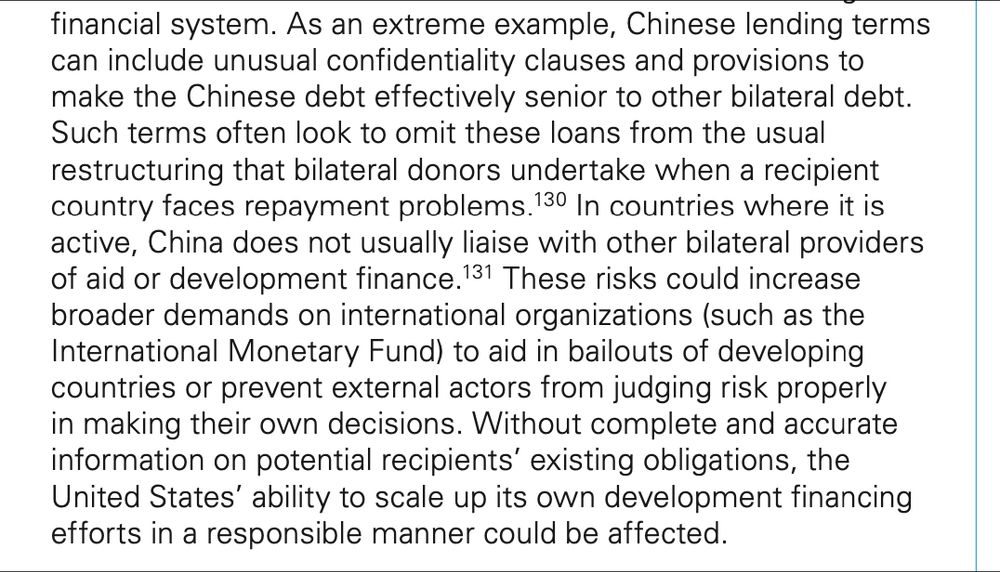
Text drawn from the report that says "As an extreme example, Chinese lending terms can include unusual confidentiality clauses and provisions to make the Chinese debt effectively senior to other bilateral debt. Such terms often look to omit these loans from the usual restructuring that bilateral donors undertake when a recipient country faces repayment problems.130 In countries where it is active, China does not usually liaise with other bilateral providers of aid or development finance.131 These risks could increase broader demands on international organizations (such as the International Monetary Fund) to aid in bailouts of developing countries or prevent external actors from judging risk properly in making their own decisions. Without complete and accurate information on potential recipients’ existing obligations, the United States’ ability to scale up its own development financing efforts in a responsible manner could be affected."
Finally - the biggest threat to U.S. competitiveness in the next decade of BRI may come from the systemic risks BRI has introduced in developing countries - placing greater demand on U.S. resources to help countries reduce this fragility.
And a big shoutout to AidData at William & Mary for their years of leadership in this space through their canonical China Development Financing dataset. They've single-handedly supported the entire research community on this issue for years, and to great effect.

Lots more to unpack in the report, including recommendations for how to boost U.S. competitiveness going forward - www.rand.org/pubs/researc...
Text drawn from the report discussing Chinese lending and confidentiality practices.
Finally - the biggest threat to U.S. competitiveness in the next decade of BRI may come from the systemic risks BRI has introduced in developing countries - placing greater demand on U.S. resources to help countries reduce this fragility.

A figure drawn from the report comparing U.S. and Chinese investments in different types of infrastructure, including energy, hard infrastructure, financial support, and agriculture.
Third, while much of the public consciousness about BRI focuses on roads, trains, bridges, and ports - the data suggest that China's real focus has been on energy. This is where the U.S. remains radically out-spent and out-competed.

Text drawn from the report that says "These criticisms demonstrate a more general problem that researchers have noted: The short-term appeal of China’s approach to developing countries does not necessarily generate longer-term positive perceptions of China, at least not more so than the United States’ more diffuse assistance. One study of public opinion polling in Africa, for example, found that U.S. development programs are just as closely correlated with friendly perceptions among local populations compared with China’s more expansive efforts, in part because public attitudes are less driven by individual project–level spending than they are by broader perceptions of donor nation’s goals in supporting a given country.115 Already, Chinese political and financial leaders appear to be reevaluating the political and financial returns on their"

Text drawn from the report that says "investments.116 For example, some Chinese banking executives—looking to limit their accountability in the event of a default—have threatened to stop financing projects likely to be unprofitable absent clear direction that such loans serve some broader policy objective for China.117 Senior Chinese government officials also have begun to push for greater risk controls in China’s lending practices and to reduce lending perceived to be reckless.118 With the majority of China’s overseas loans held by countries in financial distress, Chinese banks have also been forced to begin accepting losses when creditors fail to repay loans on time—rather than simply extending the maturity of such loans as they have done in the past—in some cases even working with such international institutions as the Paris Club to negotiate debt relief.119 Overall, this suggests that U.S. concerns over China’s transactional influence gained through major infrastructure lending..."
Second, while China's approach may be better suited towards accruing influence in the short term, China is beginning to acknowledge that its approach isn't sustainable over the long run.

A figure drawn from the report comparing U.S. and Chinese foreign direct investment figures.
This bias leads to an over-reliance on U.S. aid agencies in response, and an undercounting of the competitive benefits accrued to the U.S. from our own private sector, non-profit, diplomatic, and military engagement in these same countries.