
I’m excited to share my PhD work on localized mRNAs and protein synthesis in cortical layer 1 on bioRxiv! www.biorxiv.org/content/10.1...
25.11.2025 16:58
👍 15
🔁 6
💬 1
📌 0
I’m excited to share my PhD work on localized mRNAs and protein synthesis in cortical layer 1 on bioRxiv! www.biorxiv.org/content/10.1...

Ever wonder if there are spatial maps in the brain outside the hippocampal-entorhinal regions? In this preprint, we describe a novel spatial map in the orbitofrontal cortex (OFC) that preserves the topological arrangements and distance between locations. However, ...
www.biorxiv.org/cgi/content/...

Gene editing of single, targeted neurons in vivo is now feasible. We are proud to present our preprint for highly efficient single-cell electroporation using RNA. With @alex-fratzl.bsky.social, @munzlab.bsky.social, Botond Roska @iobswiss.bsky.social
#neuroskyence
www.biorxiv.org/content/10.1...
In vivo single-cell gene editing using RNA electroporation reveals sequential adaptation of cortical neurons to excitatory-inhibitory imbalance https://www.biorxiv.org/content/10.1101/2025.09.13.672380v1
www.biorxiv.org/content/10.1...
Excited to share our Nature Neuroscience paper!
We explored how the human #retina keeps signals in sync despite big differences in axon length.
Great collaboration with @iobswiss.bsky.social + @bel-bsse.bsky.social — special thanks to @ffranke.bsky.social
#neuroskyence
🧠👁️⏱️
bsky.app/profile/natn...
It is my great pleasure to share this paper from my postdoc in which we developed an implantable biohybrid neural interface toward synaptic deep brain stimulation. Great collaboration with @tobiasruff.bsky.social and team at ETH!
- We propose a theoretical model that explains the joint computation of head direction and reflexive eye movement from visual and vestibular input
- The visual motion signals to the head-direction system originate in direction-selective retinal ganglion cell activity
- The head-direction representation and the slow phase of reflexive eye movement are tightly correlated
In brief, we find that:
- Visual motion cues dominate the head-direction representation at slow speeds, while vestibular cues dominate at high speeds
- Visual motion cues play a key role in navigational behavior relying on head-direction computation

How do different sensory signals combine in the computation of cognitive maps? I’m thrilled to share our new preprint, in which we investigate this question in the context of the head-direction system:
www.biorxiv.org/content/10.1...
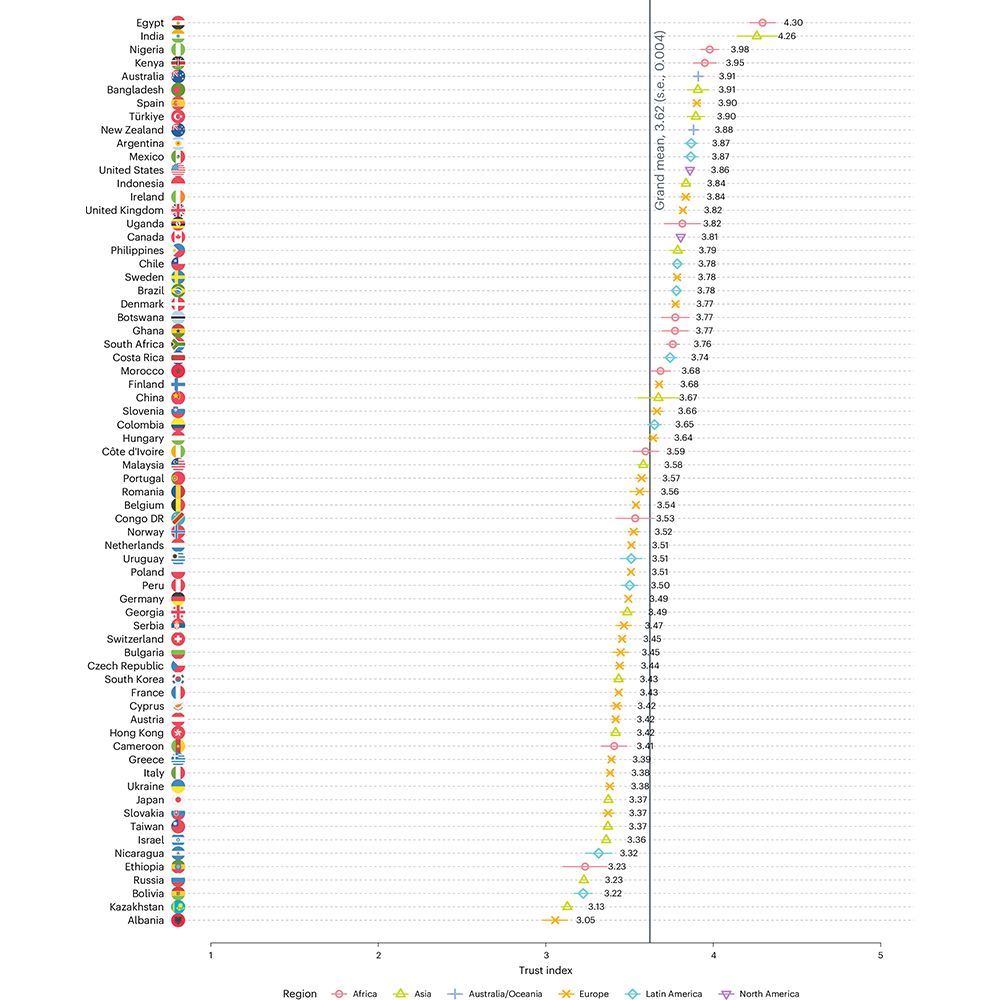
This is figure 1, which shows weighted means for trust in scientists across countries and regions (1 = very low, 3 = neither high nor low, 5 = very high).
What is the state of trust in scientists around the world? A study in Nature Human Behaviour reports on a survey of 71,922 respondents in 68 countries and finds that trust in scientists is moderately high. https://go.nature.com/3PLgKKU 🧪
I'm thrilled to be opening my own lab this Fall at the @maxplanck.de MPI for Brain Research in Frankfurt. The lab is going to investigate the neuronal and genetic underpinnings of behavioral evolution. We are hiring on all levels. Don't hesitate to share widely and reach out if interested.
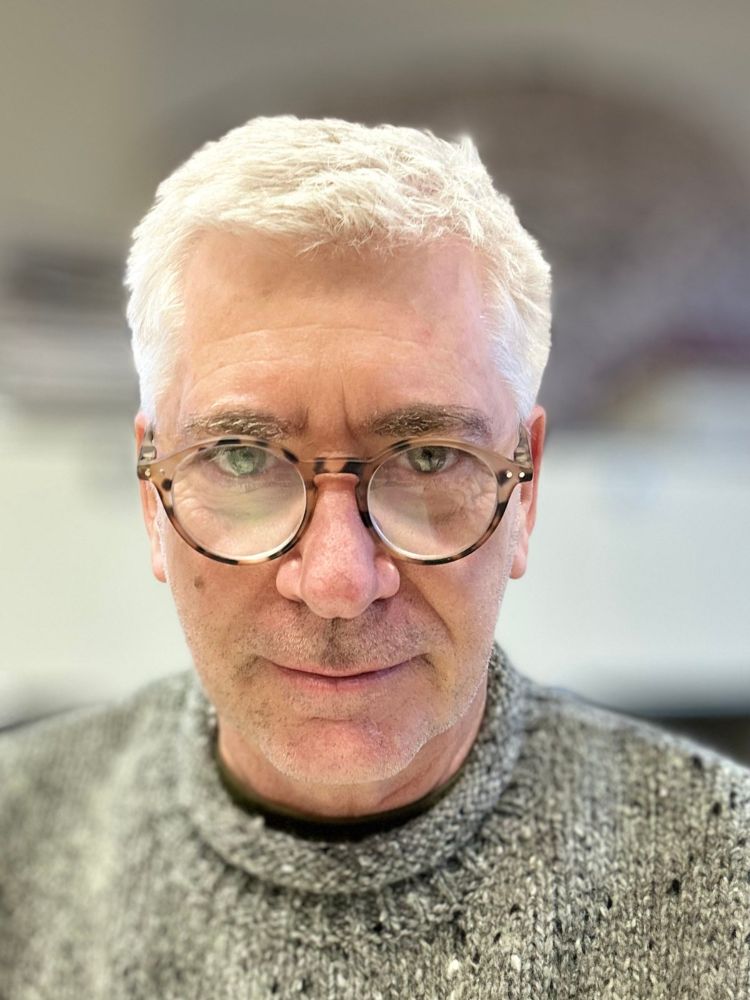
Congratulations to @mpibrain.bsky.social director Gilles Laurent for being awarded the 2025 Louis-Jeantet prize for Medicine! The @louisjeantetfdn.bsky.social recognizes Laurent's pioneering work on the operations of #neurons and dynamics of neuronal networks. More infos 👉 bit.ly/4hqk6ie
✨Scientific breakthrough: IOB researchers have achieved a significant advance in developing a new treatment for Stargardt disease, the most common form of inherited macular degeneration.
Read more: www.nature.com/articles/s41...
Watch full movie: iob.ch/news-view-al...
#AcademicSky #neuroscience

🚨New(ish) preprint
In mice, visual objects are encoded in the navigation syst, not much in the visual cx, certainly because they are used for orientation.
This new version now includes cool comp work from @dlevenstein.bsky.social using @kenmiller.bsky.social's SSNs.
www.biorxiv.org/content/10.1...
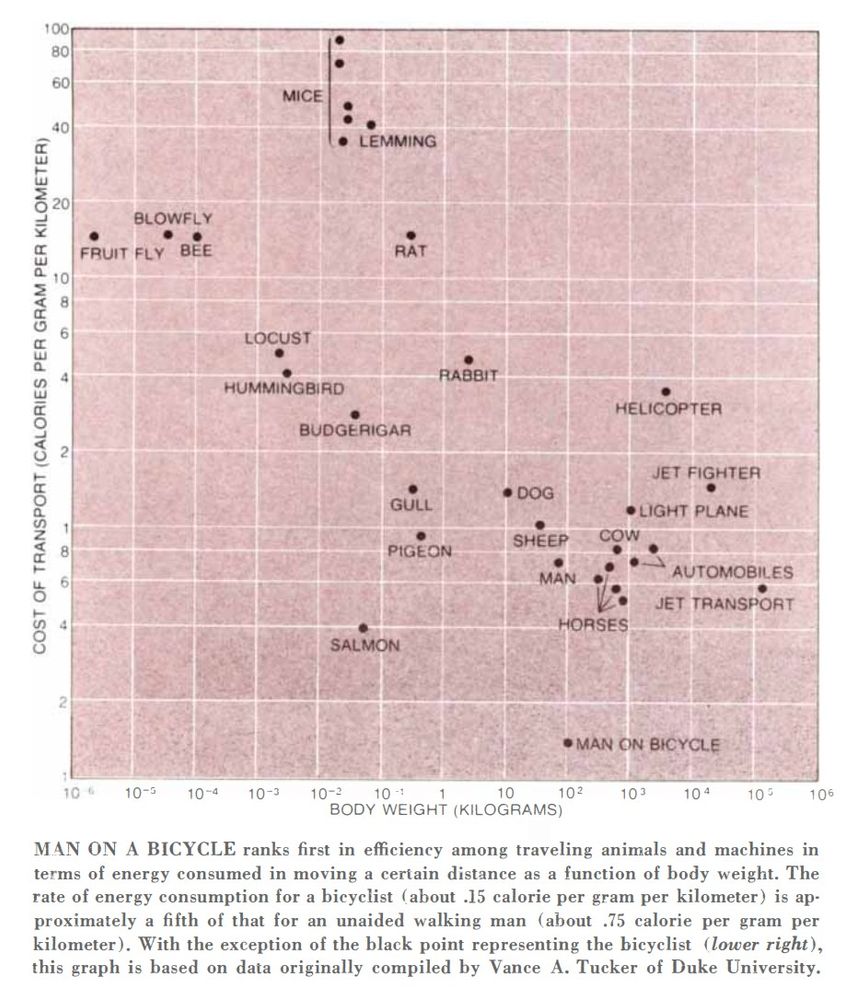
A graph titled "Cost of Transport" showing the relationship between body weight (in kilograms) and energy consumption for distance traveled (calories per gram per kilometer) for various animals and machines. It highlights that a person on a bicycle ranks first in efficiency.
A person on a bicycle is by far the most energy-efficient among animals and machines per distance traveled relative to body weight. The bicycle is magic.
www.jstor.org/stable/24923...
