
The paper is out in ApjL if you want to read it! iopscience.iop.org/article/10.3...
04.02.2025 15:16
👍 1
🔁 0
💬 0
📌 0
The paper is out in ApjL if you want to read it! iopscience.iop.org/article/10.3...
Supporting that this evolutionary pathway is possible. For the dynamics-minded, this system will also allow for really strong constraints on the DM halo shape and DM distribution, as the rings are clean tracers of the potential out to large radii, something we’re following up with!
Some simulations have suggested that these ring galaxies can evolve into giant low surface brightness galaxies, another enigmatic population. Here we find faded rings in the distant outskirts of the system that rival the size of such galaxies, making this the first observational evidence…
These rings formed in the aftermath of the smaller blue galaxy flying through the center of a massive spiral. We were able to measure the ring positions and spacing, and it turns out to match predictions from analytic theory extremely well over a wide range. But there’s more…

Happy to share my latest paper, characterizing a rare-to-catch post collision galaxy with nine rings! Nice write up from stsci hubblesite.org/contents/new...
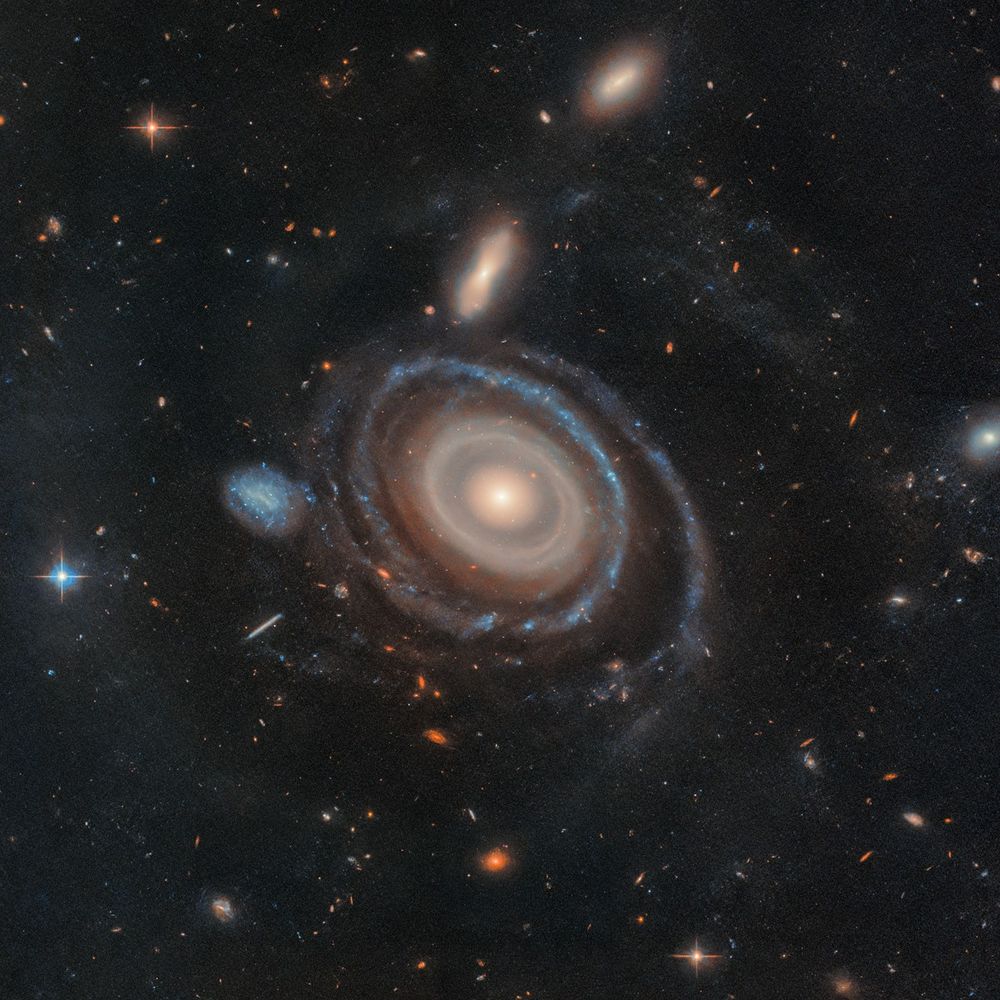
A large galaxy is at center, and a significantly smaller galaxy is to its left. The large galaxy, nicknamed the Bullseye, is mostly face-on, but the top appears slightly tilted away. It has several rings. Its circular core is bright white at the very center, but light yellow overall. Going outward, there are gaps between the rings. The core is surrounded by two slightly lighter yellow rings, which also appear to be overlapping. The next ring is slightly more transparent and yellow. The two or three rings that are farther out are bluer, sometimes with blue clumps. The widest ring is also blue, but also the most transparent. At 9 o’clock is a small dwarf galaxy. It is about the same size as the yellow core of the Bullseye. The dwarf galaxy is blue, with many dots. It looks like the edge of the Bullseye might touch the dwarf galaxy. Both galaxies are set on the black background of space, which is dotted with a range of galaxies in different shapes, colors, and sizes.
Bullseye! Researchers using Hubble found a massive galaxy rippling with nine star-filled rings after an “arrow,” the blue dwarf galaxy to its center-left, plunged through its core 50 million years ago. A thin trail of gas still links the pair: bit.ly/4hcX52n 🔭 🧪
Applications are open for the 2025 Dorrit Hoffleit Research Fellowship program for current undergraduate students to conduct summer research in the Yale Department of Astronomy!
Open to 2nd/3rd year undergrads of any nationality — due February 15th 🪐🧪🚀 astronomy.yale.edu/undergraduat...
Awesome job opportunity for PhDs with observational astronomy and software engineering skills!
🔭
Looking for speakers for Yale's Galaxy Lunch! If you're a grad student or postdoc working on galaxy formation/evolution research, we'd love to have you present at our seminar. Reach out to me (chloe.neufeld@yale.edu) or find more information about the seminar here:
yalegalaxylunch.github.io/about/
Can I be added if I defended this week? I’m clinging on to the grad status for at least a month…
Feel free to reach out to me if you have questions or want to chat about the position!
Interested in working on the development of novel data analysis techniques? Our team at Dragonfly is hiring for a data algorithms position for a forthcoming 1000 lens array observatory in Chile! 5 year position w/great benefits and location flexibility: aas.org/jobregister/...
I hear i'm supposed to add a 🔭
We hope to create an "amortized" version of this framework, which would require many more simulations (think millions or more), but which then for a given survey, could produce inferences for new input galaxies in a matter of seconds. A challenge, but super useful in the upcoming era of surveys.
So what's next? At the moment, the training/fitting process is "bespoke" to every galaxy, because we fix things like sersic index/PA and survey depth/noise based on the appropriate values for every input galaxy. This takes time (~12 hr) and resources (GPU access). But...

In this paper we focus on distances, as there is a ground truth measurement of comparison. But there are some early signs that we are getting reasonable estimates for, e.g., stellar mass here as well (below: an injection/recovery test placing a logM=7.4 galaxy at many distances).


The method actually appears to be working rather well! Below is an example of one real input galaxy and three random draws from the posterior. On a sample of ~20 nearby galaxies with literature distances from TRGB/SBF, silkscreen almost always recovers the distance within the 5-95% posterior.

To do this we created Silkscreen, a code which uses neural posterior estimation and rounds of simulation and training to fit a set of galaxy properties given input images. In short, we simulate galaxy images with artpop, and use a ResNet to extract summary statistics before passing to the sbi code.
Given this fidelity, we wondered if one could "fit" the basic properties (distance/mass especially) using artpop as a simulator. Such a method would be dramatically cheaper than the gold-standard of TRGB, and might be able to marginalize over some of the uncertainties in SBF from Z/stellar pops

Our idea stems from the ability for the Artpop code to make realistic galaxy images from first principles -- i.e., create stellar populations sampling IMFs and place them "star by star" in some distribution (e.g., Sérsic), while also simulating survey depths and noise properties.

New Paper! With tim miller, @avapolzin.bsky.social, and pieter van dokkum, we explore whether forward modeling+simulation based inference can provide a robust, likelihood-free way to estimate galaxy distances in the distance range of 2-20 Mpc (too close for hubble-flow)🧵 arxiv.org/abs/2407.04091
Also, I have a new textbook coming out with IOP/AAS later this year expanding on the above! You may also check out astro-330.github.io, which is the course site for a slightly higher level astro coding class I ran at Yale. Also, astro-rps.github.io has resources we're using for an intro seminar
Definitely! The exercises in the astrocodex will be open source and available publicly; the solution sets repository will be available to registered instructors.
And so I would hope the materials end up being complementary! I took part in carpentries as part of the LSST DSFP and think they're doing great work, particularly around the concepts of bootcamps and workshops. Our focus is on the "exercise"/materials portion for a classroom setting. 2/2
good q: i think the key diffs are: 1) focus on standalone exercises/materials more at the assignment level rather than workshop-style walkthroughs 2) much expanded focus on various astronomy topics 3) no (public/immediate) solutions 4) interoperability for inserting into existing curricula 1/2
These I know about! :) saw them I believe back when you originally shared.
Thanks for sharing this! It looks awesome. We'll be using notebooks (as part of the myst ecosystem for translatable content) and I bet there's some info in here that will help us both with motivating and describing that usage to attendees, if they're not yet using notebooks in their classes!
I want to massively shout out @malenarice.bsky.social, who is co-organizing this event with me, as well as the astronomy department and Yale Center for Astronomy and Astrophysics for helping us make this happen. Don't hesitate to reach out to me with any questions! astrocodex.github.io
If this sounds like your cup of tea, please register to attend! It's free, and we have some travel support to help if you otherwise wouldn't have funding. For this first event at Yale, we're hoping those within a car/bus/train ride a way could make the trip. 9/n
It's more fun to hack together! In hosting hack day conferences, we aim to bring in key voices to lead discussions on computational pedagogy, and provide some focused time to build a set of problems. Then, we trade, try each other's problems, and provide feedback. 8/n