First new histCAT release in 5 years! Please help to shape the next updates by participating in our very short survey!
29.10.2025 17:40
👍 1
🔁 0
💬 0
📌 0
@denisschapiro
Group leader @schapirolab.bsky.social at the Heidelberg University Hospital focusing on #HighlyMultiplexedImaging and #spatialomics #spatialbiology technologies and analysis. President of the European Society for Spatial Biology e.V. (ESSB)
First new histCAT release in 5 years! Please help to shape the next updates by participating in our very short survey!


We're excited to be at GloBIAS 2025 in Kobe Japan! Come say hi to @arojhada.bsky.social (presenting cell phenotyping) and @miguelib.bsky.social (presenting micronuclAI)


Last week our lab came together for our annual lab retreat, kindly hosted by @hlsalliance.bsky.social! We exchanged ideas about our research, spatial omics, and took part in some fun (albeit slightly competitive) activities.

Happy to co-chair the #Pathology Working Group of the European Society for Spatial Biology (ESSB) e.V. #ESSB with Francesca Maria Bosisio, MD, PhD and Christian Matek, MD!
Please join the group and let us promote science together!
Link to join: docs.google.com/forms/d/e/1F...
Are you at #EMBLSpatialBiology #ESSB2025? Catch our posters this evening:
- Nils Englert, Poster 83
- @arojhada.bsky.social, Poster 97
- @loggas.bsky.social, Poster 185
- @jawadalaaedeen.bsky.social, Poster 187

Excited to be at #EMBLSpatialBiology #ESSB2025 this week and present our new 3D imaging and analysis pipeline ‘LeGO-3D’

New lab pic dropped 📸 #schapirolab

And we’re off

We’re excited to be at @embl.org this week for Spatial Biology: the melting pot. We’re looking forward to hearing about some awesome science 🔬 #EMBLSpatialBiology

On location for a short video about the innovation campus Heidelberg/Mannheim @embl.org and @dkfz.bsky.social
Thanks to @denisschapiro.bsky.social and Nina Papavasiliou for sharing your research and the precious time of your students and postdocs for our video team.
#sciencecommunication
This work exemplifies how our Translational Spatial Profiling Center (TSPC) at @uniheidelberg.bsky.social @hlsalliance.bsky.social is exploring the translational potential of spatial omics technologies.
Our findings underscore spatial context as a critical factor in understanding multiple myeloma pathogenesis — and highlight the potential of spatial analyses to improve risk stratification in clinical practice.
Key insights:
- Spatial interactions between plasma cells and immune cells were linked to shorter progression-free survival.
- Neighbor preference between plasma cells and CD4⁺ T cells emerged as an independent predictor of disease progression.
Congratulations to @loggas.bsky.social, Ingrid Roseth, Therese Standal, and all co-authors!
In our latest work, we leveraged @standardbiology.bsky.social Imaging Mass Cytometry to analyze bone marrow biopsies from multiple myeloma and precursor disease patients.
www.biorxiv.org/content/10.1...

I am excited to share my first work in @schapirolab.bsky.social on Multiple Myeloma (MM) in collaboration with the Standal Lab from NTNU Norway. We use Imaging Mass Cytometry (IMC) on bone marrow biopsies from MM and precursor patients (details below): www.biorxiv.org/content/10.1...

Register by 2 Sep and join us in Heidelberg for #EMBLSpatialBiology 👉 https://s.embl.org/spb25-01-bs
Co-organised with #ESSB, this conference will bring together top scientists and young investigators for 4 days of cutting-edge science and networking ✨
📅 14–17 Oct | 📍EMBL Heidelberg and Virtual


Big congratulations to @sabrinalewis.bsky.social on being awarded 2nd place for her talk at the Heidelberg Postdoc Symposium 🥳🎉


We're excited to be at the Kick Off Heidelberg Spatial-Omics Lunch Seminar Series with our very own @chiaraschiller.bsky.social presenting some of her PhD work!

Don't forget to submit your abstract for #EMBLSpatialBiology by 8 July 👉 https://s.embl.org/spb25-01-bl
📅 14 – 17 Oct 2025 | 📍 EMBL Heidelberg and Virtual
✨ Top 100 abstracts will get a €350 reg fee subsidy from ESSB! To be eligible, enter your membership number when submitting ✨
#ESSB2025
Our new call for VIB.AI group leaders is online! Junior and senior positions available to develop innovative ML methods in biology. With professorship at CS or Medical Faculty. Deadline 14th June. DM for more info.
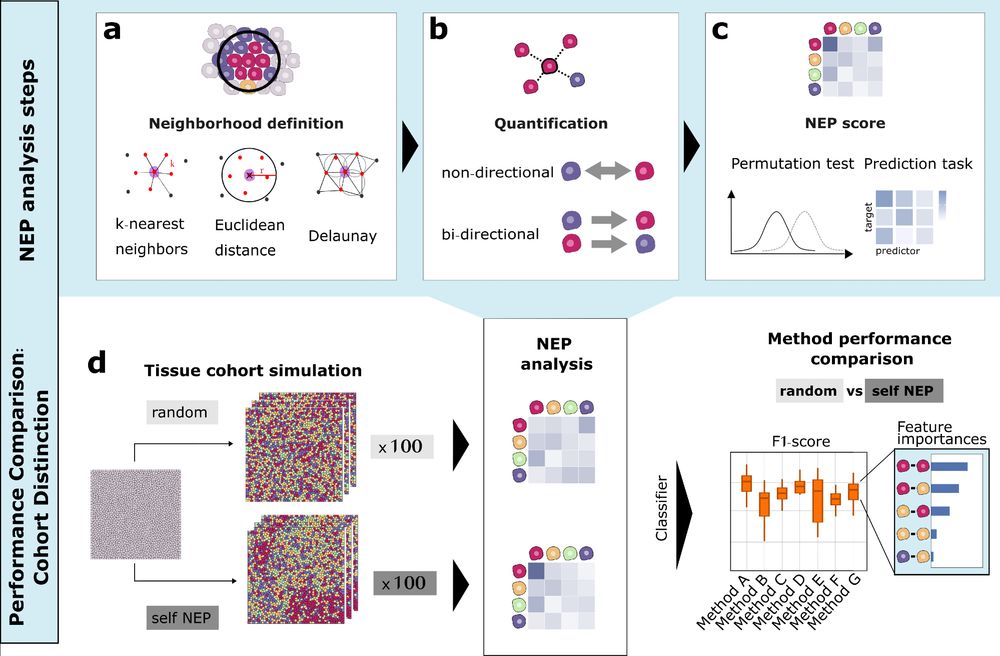
Schematic overview of NEP analysis steps (Neighborhood definition, Quantification and NEP score) and the systematic method performance comparison using simulated data for cohort distinction.
1/
Ever wondered how to best quantify cell-cell neighbor preferences in tissues?
We compared 9+ neighbor preference (NEP) methods for analysing spatial omics data and propose a novel approach that combines the most relevant analysis features which we call COZI 🔬✨
Read more: doi.org/10.1101/2025...


Laser tag lab edition #happyholidays 🎄🎁🎅🏼

We are searching for a highly motivated and talented computational postdoc with an interest in translational spatial omics to join our team in Heidelberg. Apply now!
karriere.klinikum.uni-heidelberg.de/index.php?ac...

✍️ New Bioconductor blog post on the SpatialData hackathon and workshop, organized by https://buff.ly/4j1UidT with Bioconductor participation. Check it out: https://buff.ly/4fM1qrH
Thanks @arturmansl.bsky.social !
#Bioconductor #SpatialData #scverse #Bioinformatics #OpenScience #RStats
Interested in our research? We've created a starter pack so you can now follow our current lab members and alumni. Be sure to check it out! 🥳


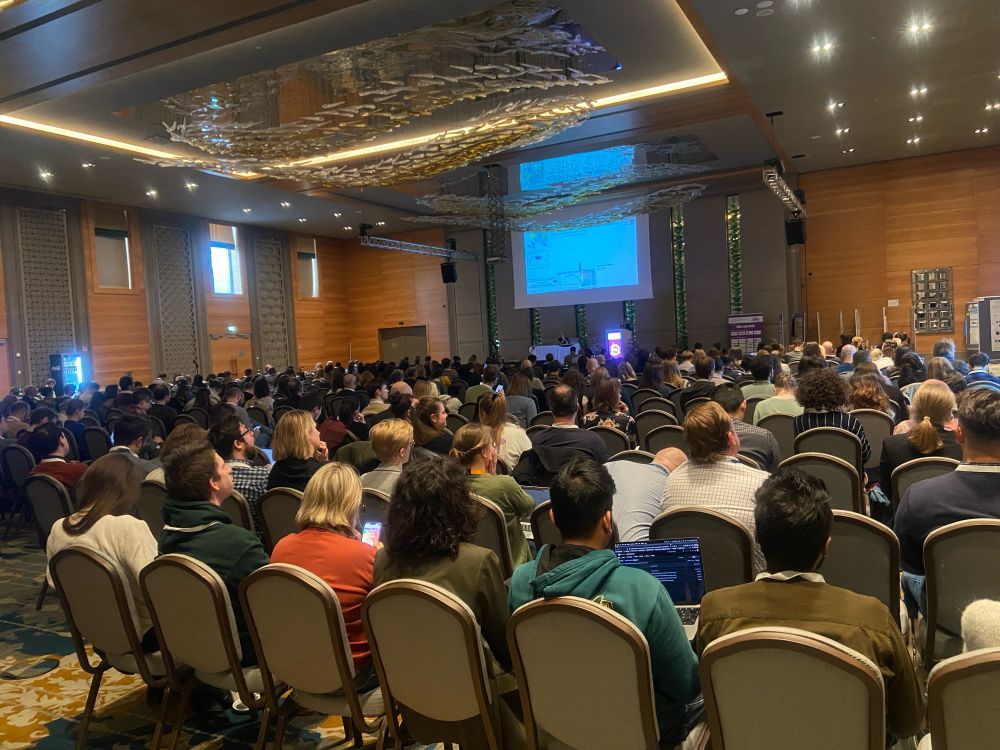

Amazing experience to share the stage with spatial biology experts @European Society of Spatial Biology (ESSB) and present our work of 3D spatial-Omics to an audience of 550 plus from 26 countries 🤩 Kudos to the founding members of @SpatialBio for putting together such a fantastic event 🎉👏 #3D #Omic


Schapiro lab does #ESSB 🔬🍷


We are excited to be in Berlin for the Inaugural Conference of the European Society of Spatial Biology (#ESSB). We sure to checkout our posters tonight! 🧵
Excited to join the ESSB!
If you're at the ESSB join me at Poster 21 for a discussion about spatial multi-omic applications in cardiology investigating myocardial infarction and best practices for image processing!