Don’t know yet! Have a lot of sequencing and IDing work to do. We saw some weird tunicates, ctenophores, and clams - but I’m really the microbe person :)
05.03.2026 04:41
👍 1
🔁 0
💬 0
📌 0
Don’t know yet! Have a lot of sequencing and IDing work to do. We saw some weird tunicates, ctenophores, and clams - but I’m really the microbe person :)
What a missed opportunity - there was a ton of dry ice, bags of big tubes full of seawater, boxes of little tubes with filters from filtering seawater, and a few tubes with individual organisms in them that we want to ID, also a marine sediment core and little baggies of deep sea mud
Oh wow I should have done that.

Large box wrapped in silver bubble wrap filled with dry ice and all the samples I worked for a year to be able To go collect and then spent 35 days at sea collecting! 🤞they are in good shape and tell us interesting things about the ocean and the world!
Little shred of good news - box1 of the samples my colleagues and I collected near Antarctica have completed their long and arduous journey through customs and ports and airplanes and trucks to my lab. Now the real work starts!! 😬😬😬 #oceanography
🌊➡️🚢➡️✈️➡️🚛➡️👩🔬

Come to BIOS this fall for an undergraduate #NSFREU internship!
bios.asu.edu/education/ns...

📢 Now accepting proposals for the Graduate Research Excellence Grants! These provide evolutionary biology research funds for early and advanced Master’s and PhD students. Applicants must be members of SSE. Deadline: May 18, 2026
www.evolutionsociety.org/content/soci...
Next time ;)
Need instructors?

MicroSEA (Microbial Sea Eukaryotes) course is a one-week, field-based summer school to train early-career researchers in the diversity, ecology, and single-cell biology of marine protists. MicroSEA course integrates lectures, field sampling, and lab-based practicals in advanced techniques, such as flow cytometry, microscopy, culturing, and molecular analysis. The main objectives of MicroSEA course are: Fostering a deep understanding of marine protist diversity, ecology and biology; Providing hands-on training in advanced single-cell methods that are not commonly available in university programs; Building participants' confidence in designing and conducting research projects from field to data analysis; Promoting international collaborations and peer networking among students and speakers/trainers. The course will take place at the Station Biologique de Roscoff - SBR (France) - 7th to 12th of June, 2026 (arrival on the 6th, departure on the 13th). 20 participants will be selected, including 10 from EuroMarine member institutes. https://opbc.sciencesconf.org/
Protist lovers: Please apply for a week of rhapsody! Learn by doing:
MicroSEA (Microbial Sea Eukaryotes) course is a one-week, field-based summer school to train early-career researchers in the diversity, ecology, and single-cell biology of marine protists. opbc.sciencesconf.org
#protistsonsky

It is happening again! Consider taking our course on the Molecular and Cell Biology of Symbiosis at
@mblscience.bsky.social. Application deadline March 4th! www.mbl.edu/education/ad...
Nope not wrong. But also not exactly helpful.
Today, my mom asked me if I ever considered publishing in Science Magazine to reach a broader audience... Thanks, Mom. #oceanography 🌊🤦♀️🙄

Noctiluca scintillans is a bioluminescent dinoflagellate that often causes coastlines to glow and crashing waves to sparkle. It is commonly called the sea sparkle. This lofi artist in my feed combined the words noctiluca and bioluminescent to name their song.
Dinoflagellate reference in my Spotify feed today 🤓🌊🦠

Learn more and register for free virtual #NASA_PACE applications workshop here: pace.oceansciences.org/events_more.... 🌊
And we got sweet stickers :)


Our Antarctic cruise on the Sikuliaq (based in AK) hosted the Antarctic triple ARRR 100k challenge: run 🏃♀️, row, & ride 🚴♀️a total of 100k with at least 10k of each. Collectively, we completed 14,682 km, which is more than the distance Sikuliaq traveled from Alaska to Antarctica! #oceanography 🌊🇦🇶🐧
Who gets dizzy first?!
Wow! This is so inspiring. The things I see while bike commuting everyday ……


PSECCO logo and text that says 'Apply for a PSECCO Conference Travel Grant. Find more information about how to apply on the ‘News’ page of the PSECCO website; deadline is March 15, 2026.' on top of a purple background. A photo of five people gathered at a conference in front of twinkle lights is shown in the middle.
U.S.-based scientists are invited to apply for PSECCO Conference Travel Grant funding by March 15, 2026. Learn more about who is eligible to apply and how here: psecco.org/news/psecco-...
The term eDNA makes me seethe with rage.
I’ve literally been looking for something exactly like this.
If you figure it out tell me because that would speed up library prep considerably!
I’m not sure if that would work with how the kit is set up, but could probably be hacked. I imagine you would just need your own bioinformatics pipeline. The barcodes in the native barcode kit have some adapters and are auto recognized by the minknow software.
The native barcoding kit gives more flexibility - do whatever pcr you want and then the nanopore library prep and barcoding is pcr-free. We got this advice from the nanopore rep when we were choosing kits and because we wanted to do 18s too. But I do think adjusting cycle number willl work.
We actually haven’t been using the 16s kit, we have been using the native barcoding kit on our pcr products. Do you mean low input to the pcr or low input post pcr? We are low input pre-pcr.
Yes we do

Our group of early career women scientists Celebrating our last science day and our (bittersweet) departure from Antarctica with seltzers from Palmer station :) :)

The three project leads on the glacier hike at Palmer station. We had a few hours after finishing up science ops this morning to explore Palmer Station.

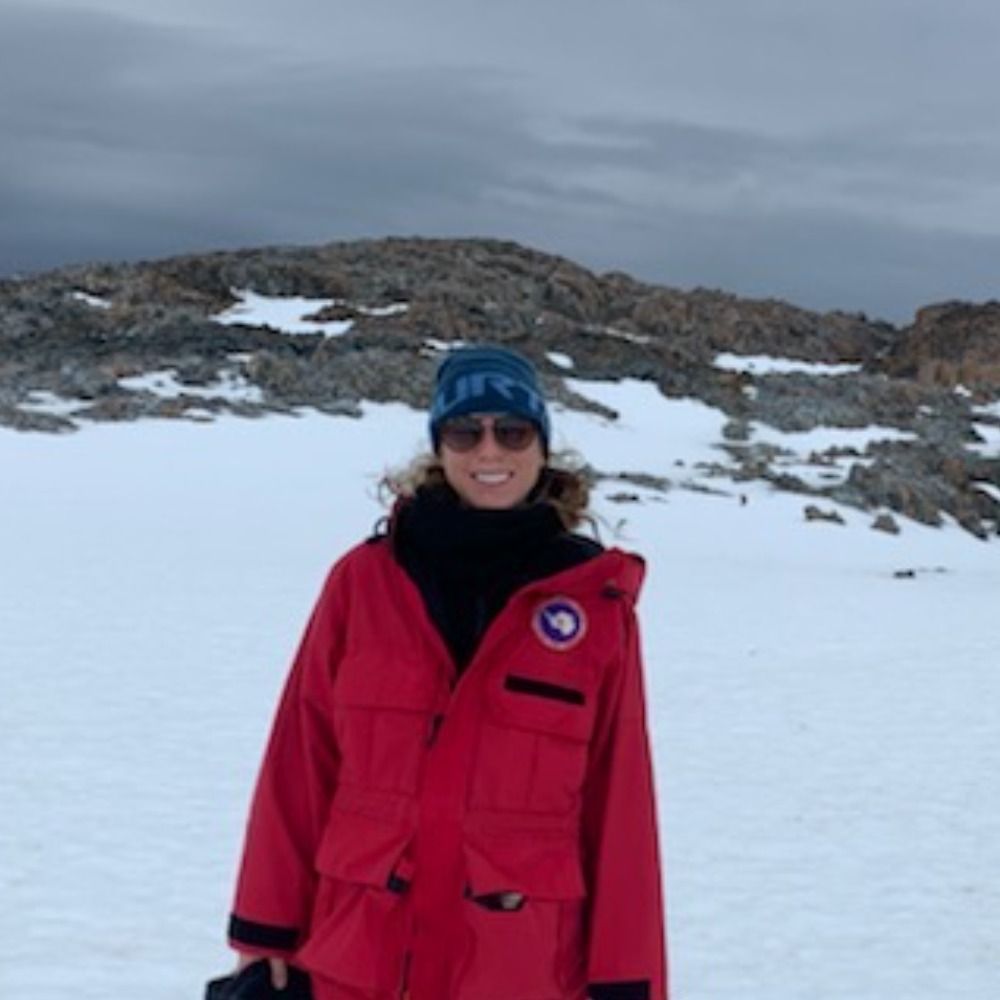
Me at Palmer Station. When I did Antarctic research in 2021, we were not allowed to come to station because of COVID. It felt like a huge win to finally make it here :)

The mess hall at Palmer Station.
After dropping equipment and materials at Palmer station and picking up a few people getting a ride back with us, we have officially left Antarctica. We celebrated with some seltzer we were able to acquire from Palmer with the helping a friend. Headed back into the Drake passage! 🇦🇶🌊🐧#oceanography

A PBS kids post of buster from Arthur with sunglasses on waving with the caption “we always loved a bad bunny”
PBS kids is sending me

After yrs of planning & preparing, things didn't work @ the last minute. I deeply feel for these scientists. Our Antarctic project is smaller scale—but we faced continuous setbacks, from govt, Mother Nature, tech. We get so little time to do our work here; setbacks are heartbreaking #oceanography 🇦🇶🌊