Una buena expresión corporal y oral es clave para dar clase 🗣️, presentar en congresos 🎤y participar en la divulgación científica 📢
📍Te invitamos a inscribirte a un taller para mejorar estas habilidades (dirigido a estudiantes de la Fac. de Psicología y PDI)
Más info
cimcyc.ugr.es/informacion/...
06.03.2026 13:49
👍 0
🔁 0
💬 0
📌 0

The "Experimental and Applied Speech Therapy" Group Registers the INVENTAPALABRAS Platform
Investigadores del Centro de Investigación Mente, Cerebro y Comportamiento (CIMCYC) de la Universidad de Granada, pertenecientes al grupo de investigación Logopedia Experimental y Aplicada, coordinado...
The CIMCYC research group “Experimental and Applied Speech Therapy” has developed the INVENTAPALABRAS software to teach reading and intervene in reading difficulties in a personalized and inclusive way, both in the classroom and in individual sessions.
Learn more about this tool 👇
05.03.2026 14:07
👍 1
🔁 0
💬 0
📌 0
El grupo Logopedia Experimental y Aplicada registra la plataforma INVENTAPALABRAS
Investigadores del Centro de Investigación Mente, Cerebro y Comportamiento (CIMCYC) de la Universidad de Granada, pertenecientes al grupo de investigación Logopedia Experimental y Aplicada, coordinado...
El grupo de investigación del CIMCYC "Logopedia Experimental y Aplicada" ha desarrollado el software INVENTAPALABRRAS para enseñar a leer e intervenir en las dificultades lectoras de manera personalizada e inclusiva, tanto en el aula como en sesiones individuales.
Conoce más de esta herramienta 👇
05.03.2026 14:07
👍 5
🔁 2
💬 0
📌 0


Celebrating #AndalusiaDay at CIMCYC with a classic: bread, oil and sugar.
🥖✨ It was a wonderful opportunity to socialize, laugh and enjoy music.
Happy #28F from our center!
27.02.2026 12:21
👍 6
🔁 2
💬 0
📌 0

Celebrando el #DíaDeAndalucía en el CIMCYC con un clásico: tostada aceite y azúcar.
🥖✨ Fue un bonito espacio de socialización, risas y música.
¡Feliz #28F desde nuestro centro!
27.02.2026 12:20
👍 0
🔁 0
💬 0
📌 0

Emotional distractors modulate event-related potentials even at very low contrast levels
Emotional visual stimuli, whether appealing or aversive, preferentially capture exogenous attention due to their evolutionary significance. This study…
Overall, the human visual and attentional system is highly efficient: it can detect and prioritize emotionally relevant stimuli even with minimal or barely conscious visual input.
This helps explain intuitive danger detection and automatic attraction to positive stimuli.
27.02.2026 10:09
👍 0
🔁 0
💬 0
📌 0
Later, positive images elicited stronger activation than negative or neutral ones.
📍 This may reflect a complementary tendency: after detecting dangers, the brain also prioritizes pleasant stimuli that encourage exploration and approach.
27.02.2026 10:09
👍 0
🔁 0
💬 1
📌 0
In the first fractions of a second, negative images triggered stronger brain responses than positive ones, suggesting an evolutionary bias toward quick threat detection.
27.02.2026 10:09
👍 0
🔁 0
💬 1
📌 0
Brain activity was recorded using EEG.
👉 Results: even when images were almost invisible, the brain responded differently depending on emotional content.
27.02.2026 10:09
👍 0
🔁 0
💬 1
📌 0

In the study, participants performed a perceptual task while background images with negative, neutral, or positive content (threatening or pleasant scenes) were shown at varying contrast levels, including low contrast, where images couldn’t be consciously recognized.
27.02.2026 10:09
👍 0
🔁 0
💬 1
📌 0
The question: Does the brain still prioritize emotional information when we can barely perceive it?
The group of researchers studied how emotional images capture attention even when they are very difficult to look at.
27.02.2026 10:09
👍 0
🔁 0
💬 1
📌 0
Our brain 🧠 is wired to quickly detect what’s important for survival, like threats or pleasant signals. But in daily life, many visual cues are present under difficult conditions: low light, fog, shadows, or low contrast.
27.02.2026 10:09
👍 0
🔁 0
💬 1
📌 0
Emotional distractors modulate event-related potentials even at very low contrast levels
Emotional visual stimuli, whether appealing or aversive, preferentially capture exogenous attention due to their evolutionary significance. This study…
El sistema visual y atencional humano es altamente eficiente: puede detectar y priorizar estímulos emocionalmente relevantes incluso con información visual mínima o apenas consciente 👀
Esto ayuda a explicar la detección intuitiva de peligros o la atracción automática hacia estímulos positivos.
27.02.2026 09:24
👍 0
🔁 0
💬 0
📌 0
En etapas posteriores, las imágenes positivas provocaron mayor activación que las negativas o neutras.
👉Esto podría reflejar una tendencia complementaria: después de detectar peligros, el cerebro también prioriza estímulos agradables que favorecen la exploración y el acercamiento.
27.02.2026 09:24
👍 0
🔁 0
💬 1
📌 0
En las primeras décimas de segundo, las imágenes negativas generaron respuestas cerebrales más intensas que las positivas, reflejando un posible sesgo evolutivo hacia la detección rápida de amenazas.
27.02.2026 09:24
👍 0
🔁 0
💬 1
📌 0
Al tiempo, la actividad cerebral se registraba mediante EEG.
👉Resultados: incluso cuando las imágenes eran casi invisibles, el cerebro respondía de forma diferente según el contenido emocional.
27.02.2026 09:24
👍 0
🔁 0
💬 1
📌 0
En el estudio, las personas realizaron una tarea perceptiva mientras veían imágenes con contenido negativo, neutro o positivo ( amenazantes o agradables) con distintos contrastes, incluyendo muy bajos en el que las imágenes no podían reconocerse conscientemente.
27.02.2026 09:24
👍 0
🔁 0
💬 1
📌 0
La pregunta es: ¿Sigue el cerebro priorizando la información emocional cuando apenas podemos percibirla?
El grupo de investigadores/as estudió cómo las imágenes emocionales captan la atención incluso cuando son muy difíciles de ver.
27.02.2026 09:24
👍 0
🔁 0
💬 1
📌 0
Nuestro cerebro 🧠 está preparado para detectar rápidamente lo que es importante para la supervivencia, como amenazas o señales agradables. Pero en la vida cotidiana, muchas señales visuales aparecen en condiciones difíciles: poca luz, niebla, sombras o bajo contraste.
27.02.2026 09:24
👍 0
🔁 0
💬 1
📌 0
Mar Montoya Lozano y Sofía Schwartz Salazar "La desigualdad es algo que anda por las calles"
YouTube video by Hablando de Ciencia Divulgacion
78. "La desigualdad es algo que anda por las calles" por @sofiaschwartz.bsky.social y Mar Montoya del @cimcyc.bsky.social en #Desgrana9
24.02.2026 13:08
👍 2
🔁 2
💬 1
📌 0
The results showed that causal illusion is common and difficult to eradicate.
💡 However, teaching scientific thinking, even with a brief explanation, proved to be more effective than offering financial rewards.
24.02.2026 13:18
👍 0
🔁 0
💬 1
📌 0
How can we develop it? We could use rewards to motivate people or teach them to think scientifically with clear, practical guidance.
To evaluate the effectiveness of the above options, three experiments were conducted.
24.02.2026 13:18
👍 0
🔁 0
💬 1
📌 0

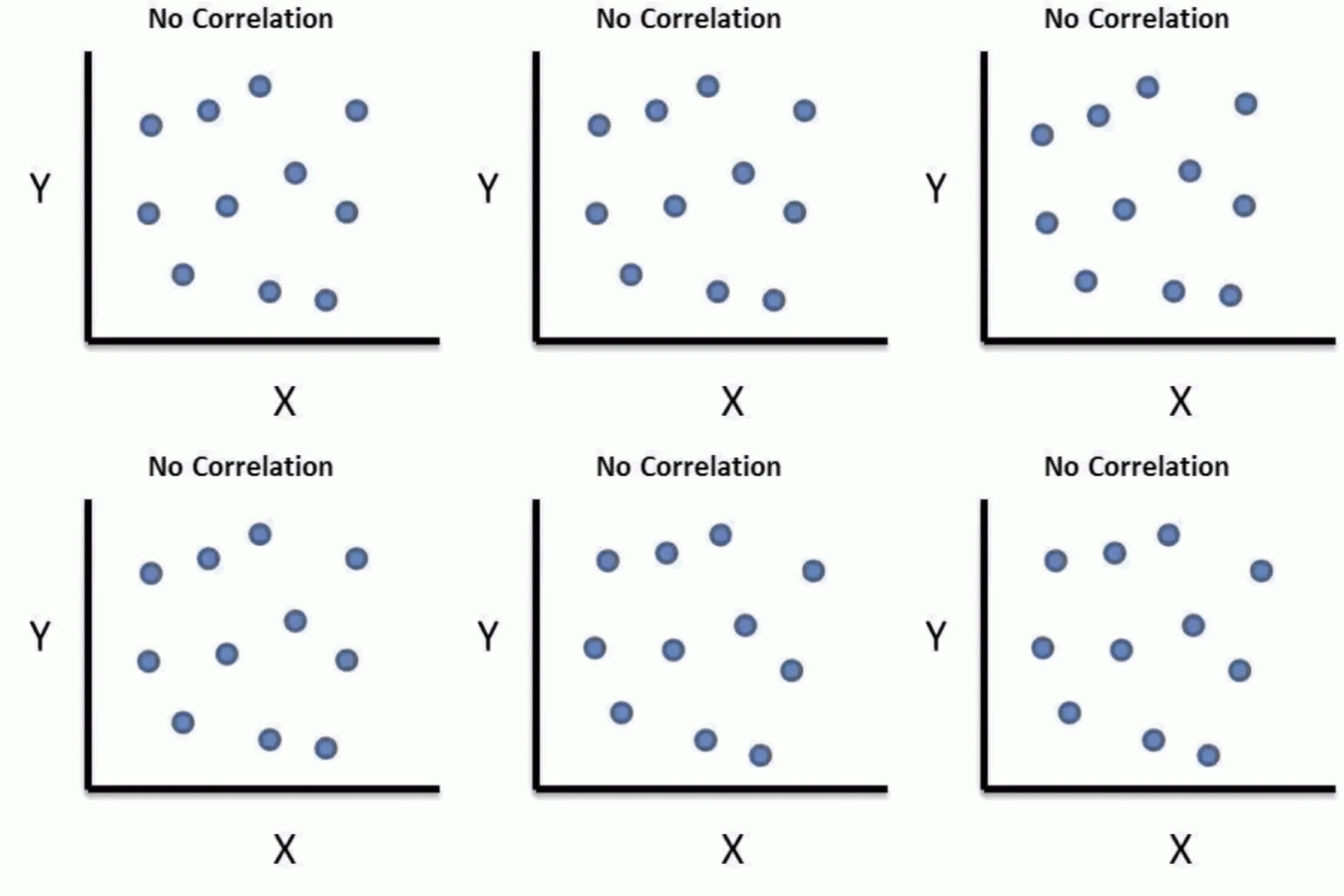
a graph showing a no correlation between y and x
ALT: a graph showing a no correlation between y and x
A causal illusion happens when we believe one event causes another, even though they are actually independent.
👉That’s why we need scientific thinking, which is based on evaluating evidence before concluding causal relationships.
24.02.2026 13:18
👍 0
🔁 0
💬 1
📌 0
Humans are experts at detecting cause-effect relationships. This helps us learn, predict, and adapt. But sometimes we see connections that don’t exist, falling into the so-called causal illusion 🤔.
24.02.2026 13:18
👍 0
🔁 0
💬 1
📌 0

Reducing the causal illusion: a question of motivation or of information?
Abstract. The causal illusion is a cognitive bias that involves believing that one event causes another when it does not. It has negative consequences in d
👉 Enseñar cómo evaluar evidencia puede ayudar a tomar decisiones más acertadas y reducir errores de percepción de causa-efecto.
@helenamatute.bsky.social @fernandoblancopsy.com
Más información sobre los resultados y experimentos: doi.org/10.1098/rsos...
24.02.2026 13:08
👍 6
🔁 3
💬 0
📌 0
Los resultados mostraron que la ilusión causal es común y difícil de erradicar. Sin embargo, enseñar a pensar científicamente, incluso con una explicación breve, resultó ser más eficaz que ofrecer recompensas económicas.
24.02.2026 13:08
👍 3
🔁 0
💬 1
📌 0