Happening *today* at 1pm! Data Products and Tools from the Project Infrastructure Teams (PITs) may be useful for you to utilize and build upon for your #NASARoman Cycle 1 proposals.
24.02.2026 13:01
👍 0
🔁 0
💬 0
📌 0
Happening Now!
17.02.2026 18:02
👍 0
🔁 0
💬 0
📌 0

🚨 Community Forum Reminder🚨
Join Roman Community Forum #22 for an overview of the Roman Research Nexus—connecting the community to tools, data & collaboration!
⭐ Jan 21, 2026 • 4–5 PM ET
🔗 bit.ly/49GUtXW
20.01.2026 17:25
👍 2
🔁 2
💬 0
📌 0

a cat wearing a pair of sunglasses with a picture of a cat in them
ALT: a cat wearing a pair of sunglasses with a picture of a cat in them
This pathfinder shows what’s possible right now with archival JWST data.
The early Universe is exploding—we’re finally watching. 💥
Paper link ⬇️
ui.adsabs.harvard.edu/abs/2026arXi...
#JWST #NASARoman #Supernova #COSMOS
n/n
15.01.2026 15:10
👍 1
🔁 0
💬 0
📌 0

a man in a blue shirt stands in front of a screen that says together
ALT: a man in a blue shirt stands in front of a screen that says together
And this is just the start.
📡 Roman will deliver cadence + area
🔭 JWST delivers depth + spectroscopy
Together: a complete picture of explosive transients in the early Universe.
11/n
15.01.2026 15:10
👍 1
🔁 0
💬 1
📌 0

a man in a suit and tie stands in front of a group of people and says " can you imagine "
ALT: a man in a suit and tie stands in front of a group of people and says " can you imagine "
🚀 Imagine a dedicated JWST time-domain survey:
• multiple epochs
• wide area
• planned cadence
We’d measure SN rates, test stellar evolution, and push SN Ia cosmology to z > 3.
10/n
15.01.2026 15:09
👍 1
🔁 0
💬 1
📌 0

a woman sitting in front of a laptop with the words it 's a compliment below her
ALT: a woman sitting in front of a laptop with the words it 's a compliment below her
Previous JWST transient work (e.g. JADES) went ultra-deep but narrow.
COSMOS-Web + PRIMER show the power of scale—5× the area, dozens of new SNe.
Different strategies, complementary science.
9/n
15.01.2026 15:09
👍 0
🔁 0
💬 1
📌 0

📊 These results show that area beats depth for high-z SN discovery.
Going fainter than ~28 mag helps less than going wider.
This has huge implications for how we design future JWST & Roman surveys.
8/n
15.01.2026 15:08
👍 0
🔁 0
💬 1
📌 0

The sample already hints at something exciting:
➡️ Wide-area JWST surveys preferentially find
🟦 younger
🟦 bluer
🟦 more extreme explosions
Exactly what we expect at high-z—but rarely see.
7/n
15.01.2026 15:08
👍 0
🔁 0
💬 1
📌 0

Even with just 1 epoch, combining:
• host photometric redshifts
• colors & magnitudes
• SN models
lets us probabilistically classify SNe and rank them for scarce JWST follow-up time.
6/n
15.01.2026 15:07
👍 0
🔁 0
💬 1
📌 0

Two highlights:
🔹 SN 2023aeab — a blue, Type IIP CCSN at z > 3
🔹 SN 2023aeax — a young, normal SN Ia at z > 2
Yes—a normal SNe Ia at cosmic noon and beyond.
5/n
15.01.2026 15:07
👍 0
🔁 0
💬 1
📌 0

💥 Result: 68 supernovae detected
📈 Host photo-z out to z ≲ 5
🧠 Single-epoch data, but enough info to classify & prioritize follow-up
This is the largest wide-area JWST SN sample to date.
4/n
15.01.2026 15:07
👍 0
🔁 0
💬 1
📌 0

So we asked: what can we already do with existing JWST data?
The trick: difference imaging between two massive JWST surveys
➡️ COSMOS-Web + PRIMER
➡️ ~1 year separation
➡️ 133 arcmin² overlap
Neither was designed for transients—but together, they are 👀💀
3/n
15.01.2026 15:06
👍 0
🔁 0
💬 1
📌 0

High-z transients are notoriously hard: rest-frame optical shifts to IR and ground-based surveys hit sensitivity limits.
JWST changes the game, but time-domain surveys are expensive and few have been TAC approved with the necessary sensitivity/wavelength coverage/cadence.
2/n
15.01.2026 15:04
👍 1
🔁 0
💬 1
📌 0

I'm excited to announce my newest paper out on arxiv: Expanding the High-z Supernova Frontier with JWST 🚀
We just used JWST to push transient astronomy to z ~ 5, discovering 68 supernovae...all without a dedicated time-domain survey.
Here’s what we found 👇🧵
1/n
15.01.2026 15:04
👍 6
🔁 0
💬 1
📌 0
It's been an exciting 2025. I haven't done a great job promoting my work on social media, so over the next couple weeks, I'll make an attempt to summarize three of my biggest papers. Stay tuned...we'll see if I actually get this done.
12.01.2026 15:37
👍 2
🔁 0
💬 0
📌 0
Roman Time Domain Session at 10am! #AAS247
08.01.2026 16:09
👍 0
🔁 1
💬 0
📌 0
As I have the past 3 years, I am organizing the a “Foodie Dinner” on Wednesday night, January 7th at 7pm. Location will be sent to those who sign up. At the current time, I have 3 spots left. PM if interested. #AAS247
06.01.2026 22:29
👍 1
🔁 0
💬 0
📌 0
Check them out #AAS247
04.01.2026 13:02
👍 3
🔁 0
💬 0
📌 0
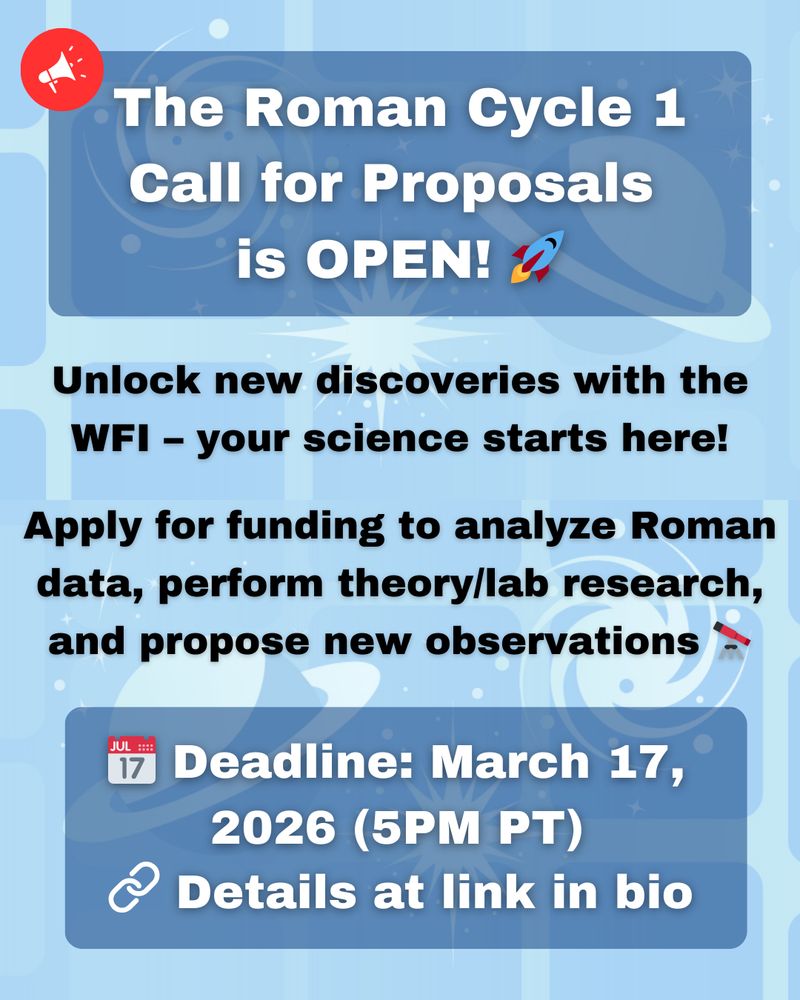
🚀The Roman Cycle 1 Call for Proposals is OPEN!
Unlock new discoveries with the Wide Field Instrument—your science starts here! Apply for funding to analyze Roman data, perform theory/lab research, and propose new observations. 🔭☄️
📅 Deadline: Mar 17, 2026 (5 PM PDT)
📝 bit.ly/4q3jbbL
10.12.2025 17:01
👍 20
🔁 16
💬 0
📌 4


Got a look at @nasaromantelescope.bsky.social this morning. And it was looking right back.
12.11.2025 14:44
👍 6
🔁 3
💬 0
📌 0
🔭☄️
03.11.2025 20:16
👍 2
🔁 0
💬 0
📌 0

🚀The Roman Coronagraph Community Participation Program (CPP) is meeting this week at IPAC in Pasadena, CA!
The team is gearing up for commissioning, observations with the Coronagraph, and preparing for the launch of Roman next year. Exciting times ahead! ✨🪐
www.romancoronagraph.space
12.09.2025 16:14
👍 4
🔁 2
💬 0
📌 0

I don't post a lot, but I am particularly proud of this paper. It's the first observational sample of binary companions to stripped envelope supernovae. And places constraints on the binary evolution physics.
It only took me 10 years to build with HST!
arxiv.org/abs/2508.12677
19.08.2025 12:51
👍 11
🔁 1
💬 0
📌 1


In these turbulent times for science, I can't resist putting out my "Case For Space". It's sometimes a little scary to speak up, but here I go. I hope this doesn't go viral. 😉
01.07.2025 13:59
👍 1
🔁 0
💬 0
📌 1

🚨Get Ready for #AAS246!🚨
Follow us daily for your dose of #NASARoman at AAS: talks, posters, booths, sessions (and stickers) —we’ve got it all. 🔭📡📸
06.06.2025 14:35
👍 9
🔁 5
💬 1
📌 0
thehill.com/homenews/adm...
01.06.2025 00:21
👍 2
🔁 0
💬 0
📌 0
This just came out
30.05.2025 20:12
👍 1
🔁 0
💬 1
📌 0
www.nasa.gov/wp-content/u...
30.05.2025 20:11
👍 0
🔁 0
💬 0
📌 1

🚀Want to get involved with #NASARoman before it launches? You can tune-in, interact, or actively contribute.
It's a great way to gear up for the Cycle 1 Call for Proposals coming in late 2025! 👩🚀🛰️
Find out more: bit.ly/4kigJM9
#ExpandOurView
23.05.2025 14:28
👍 6
🔁 2
💬 1
📌 0