
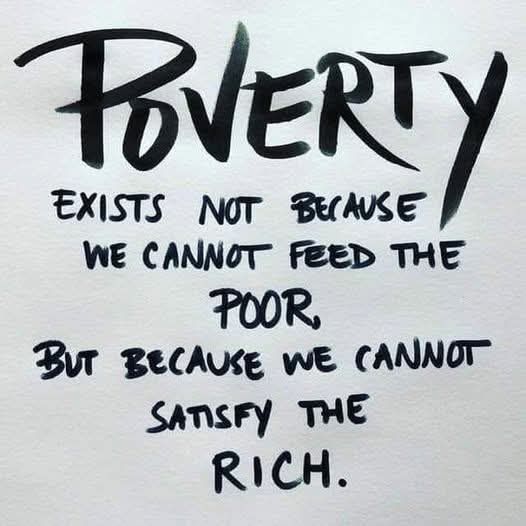
I'm not about to let capitalism gaslight me into being a shitty person. You don't think everyone deserves food, shelter, and drinkable water?? That's sad as fuck, maybe you should reevaluate yourself.
01.07.2025 22:10
👍 1517
🔁 406
💬 21
📌 9

The image is a satirical poster with the title "IS YOUR CHILD A FAR-LEFT EXTREMIST?" in bold letters. The words "FAR-LEFT EXTREMIST" are highlighted in red. To the right, there's a red hammer and sickle symbol, often associated with communism.
Below the title, it lists "warning signs" in bullet points:
- Expresses sympathy for poor and working people
- Expresses concern over the treatment of marginalized groups
- Expresses concerns with fascism and the current political climate
- Accepting of all sexualities, religions, genders, races, etc.
- Wishes for a world where all people are treated equally
- Takes an interest in history and philosophy
- Talks about solving various injustices in society
03.07.2025 03:20
👍 857
🔁 199
💬 39
📌 16
24.06.2025 05:31
👍 31118
🔁 7820
💬 375
📌 245
Imo, any strategy that aims to be "more sustainable than having to keep winning elections" must involve moving away from electoral politics entirely. A political system that can be brought down by a handful of charismatic bad actors is not a robust political system;
20.06.2025 14:13
👍 1
🔁 1
💬 1
📌 0
This isn't to say that we shouldn't vote - only that we shouldn't think of voting as sufficient to protect democracy. If we are really committed to building a more robust society, our participation in the running of it must extend far beyond writing on a slip of paper once every four years.
20.06.2025 14:13
👍 0
🔁 0
💬 0
📌 0
Such projects would provide the goods and services that the State usually does, but without a central point of control that can be obtained, for example, fascists, and corrupted towards their own ends.
20.06.2025 14:13
👍 0
🔁 0
💬 1
📌 0
To create a political system that is robust, we have to create dual-power; that is, systems of meeting the needs of individuals in society which operate without dependence on hierarchical forms of organization.
20.06.2025 14:13
👍 0
🔁 0
💬 1
📌 0
Imo, any strategy that aims to be "more sustainable than having to keep winning elections" must involve moving away from electoral politics entirely. A political system that can be brought down by a handful of charismatic bad actors is not a robust political system;
20.06.2025 14:13
👍 1
🔁 1
💬 1
📌 0

The Reality of My Surroundings by Garth German
Man: "... BUT THE FOUNDING FATHERS DIDN'T INTEND..."
Woman: "I'MMA STOP YOU RIGHT THERE. THE FOUNDING FATHERS DIDN'T INTEND FOR BLACK SLAVES TO GO FREE. NOR FOR ME TO VOTE. NOR FOR YOU Το VOTE SINCE YOU DON'T OWN LAND. I'M KINDA OVER THE FOUNDING FATHERS' INTENT."
Copyright 2020 Garth German.
garthtoons.com
#socialism #communism #capitalism #anarchism #anarchy #marxism #anticapitalism #revolution #classwar #politics
02.05.2025 01:23
👍 10
🔁 3
💬 0
📌 1
If our society weren't so broken, many jobs would become unnecessary yes. But that does not always mean that do nothing to mitigate the harms that our broken society inflicts.
12.04.2025 16:15
👍 0
🔁 0
💬 0
📌 0
Treating the roots of a problem is better than treating symptoms. But is treating the symptoms of the problem worse than not treating it at all?
12.04.2025 16:15
👍 0
🔁 0
💬 1
📌 0
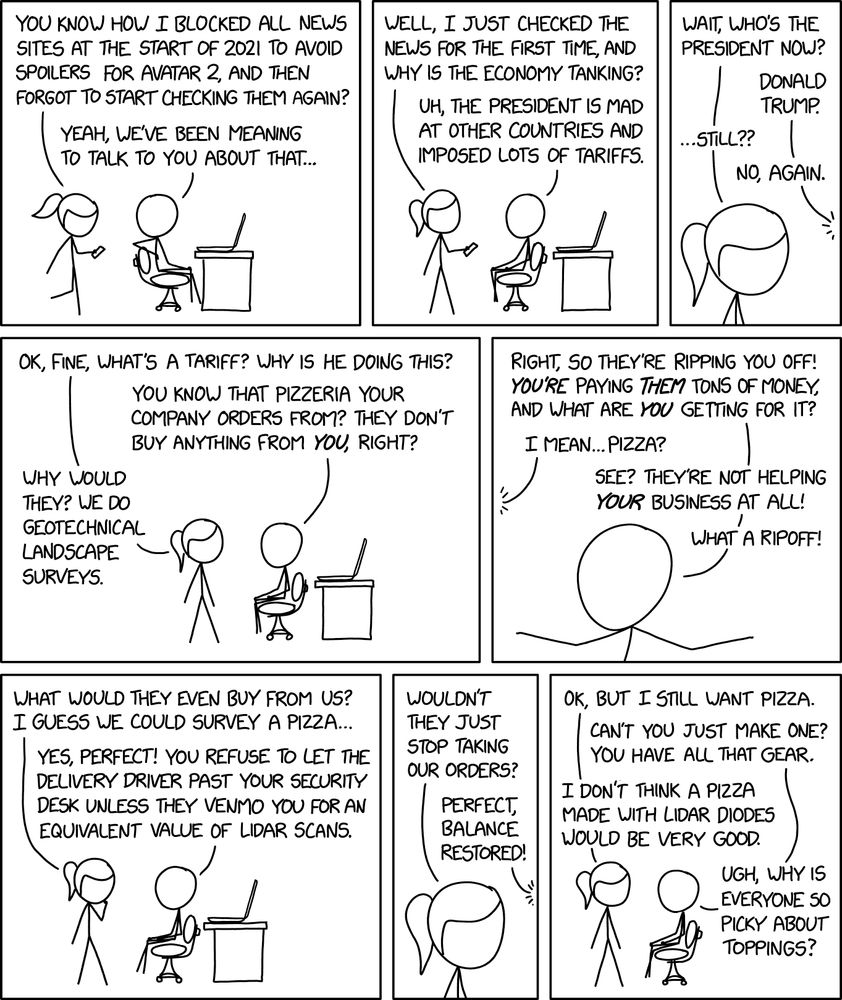
Tariffs xkcd.com/3073
08.04.2025 00:03
👍 31371
🔁 8767
💬 258
📌 466
Additionally "democracy" is often used only in the political sense - democracy in the workplace is less frequently discussed. Anarchists generally favor consensus, participatory, and direct democracies - both in politics and in the workplace - as these are less easily corrupted to favor the few.
06.04.2025 19:45
👍 1
🔁 0
💬 1
📌 0
Yes in a sense; a society being beholden to the many rather than the few is the definition of democracy. However some things which we call democracies do not meet this definition. For example representative democracies are often behold to corporations through lobbying.
06.04.2025 19:45
👍 0
🔁 0
💬 1
📌 0

06.04.2025 00:32
👍 209
🔁 40
💬 3
📌 4
This is part of why the Black Panthers & the old unions were dismantled.
They offered food distribution, healthcare access, policing, childcare & education which threatened the legitimacy of the state.
Anarchism does't begin with a gun, but with an outstretched hand, offering help unconditionally.
03.04.2025 11:10
👍 5
🔁 1
💬 0
📌 0
Totally! Plus, all progress makes future progress easier. Even relatively minor gains like increasing minimum wage give people greater means, which makes them more able to organise. We should always take opportunities to make things better, even if those opportunities aren't complete revolution.
03.04.2025 18:55
👍 2
🔁 0
💬 0
📌 0
Wait what? I'm a leftist and I think all of those things friggin' rule. What leftists are you speaking to?
03.04.2025 18:38
👍 0
🔁 0
💬 0
📌 0
Anarchists aren't against organisation though - just centralised, hierarchical organisation. Instead they favor decentralised horizontal approaches - which allow all members to participate in society's organisation - rather than only particular classes of people (e.g. politicians and the wealthy).
01.04.2025 16:39
👍 0
🔁 0
💬 0
📌 0
This is something I've experienced as well, and I'm aligned with their ideology (anarchism that is, not "ACAB includes teachers"). The number of times I've seen left-leaning people assert some statement and then get mad at anyone who asks follow up questions is saddening.
01.04.2025 16:34
👍 1
🔁 0
💬 0
📌 0
Can anarchists succeed in their goals without converting non-anarchists to the cause?
01.04.2025 16:23
👍 0
🔁 0
💬 0
📌 0
Yes! Being bigoted towards someone you don't like doesn't just harm that person - it normalises bigotry as a legitimate form of disapproval, which hurts everyone.
01.04.2025 16:06
👍 1
🔁 0
💬 0
📌 0
I wonder how many different systems of organising were present during that "primitivism" section - which we'll never know about because organizational structures alone leave no fossils.
31.03.2025 18:15
👍 1
🔁 0
💬 0
📌 0

26.03.2025 23:53
👍 63
🔁 17
💬 5
📌 1
I can’t emphasize enough that cynicism is a dictator’s best friend. Stay outraged. Believe in and work for democracy.
27.03.2025 01:06
👍 3048
🔁 699
💬 40
📌 35
When anarchists oppose laws, they are only opposing one particular *type* of response to harmful behavior: the one where you consult a particular set of rules which say things like "if someone does x, they should be punished with y" and follow those rules to the letter when deciding what to do next.
26.03.2025 21:30
👍 1
🔁 1
💬 1
📌 0
They may still consult community guidelines when making a decision, but the crucial difference between this and law is that if the community thinks that community guidelines do not properly address the situation, they will take a different course of action.
26.03.2025 21:30
👍 1
🔁 0
💬 1
📌 0
Anarchists consider this approach inflexible, and prefer a response which is more tailored to the situation. In practice this usually means that the local community would come together and discuss the circumstances of the event, and decide what to do by their own judgement.
26.03.2025 21:30
👍 1
🔁 0
💬 1
📌 0
When anarchists oppose laws, they are only opposing one particular *type* of response to harmful behavior: the one where you consult a particular set of rules which say things like "if someone does x, they should be punished with y" and follow those rules to the letter when deciding what to do next.
26.03.2025 21:30
👍 1
🔁 1
💬 1
📌 0
You are correct, anarchism does entail a complete lack of law. However when anarchists oppose law they are not saying that we should stand by when someone engages in harmful behavior (e.g. murder), and do nothing about it afterwards.
26.03.2025 21:30
👍 2
🔁 0
💬 1
📌 0
