What is the computational role of dendritic excitations? Byung Hun Lee and team mapped voltage dynamics throughout the dendritic trees of CA1 pyramidal neurons in mice navigating in virtual reality. www.biorxiv.org/content/10.6...
04.01.2026 06:17
👍 130
🔁 50
💬 3
📌 2
Excited to share my PhD paper! In it, we use targeted 2-photon optogenetic stimulation to determine how V1 activity is read-out in a detection task. We found that network influence, not visual coding properties, predicted the impact of ensembles on behavior - contradicting our expectations (1/5).
15.05.2025 16:38
👍 111
🔁 36
💬 5
📌 2
Speak up! Important to register widespread opposition to transitioning NIH to funding ideologically-motivated science. If you want advancements in knowledge and eventual cures, it is critical that research is steered by knowledgeable scientists, not political appointees
26.04.2025 12:17
👍 22
🔁 11
💬 0
📌 0
🗣️AMPLIFY AMPLIFY AMPLIFY!!! Please comment!
23.04.2025 21:14
👍 4
🔁 3
💬 0
📌 0
🚨iGluSnFR4 is finally out!🚨🧪
We present iGluSnFR4f and 4s, a novel pair of genetically-encoded glutamate indicators designed for high-fidelity imaging of synaptic activity in the living brain. ⬇️
www.biorxiv.org/content/10.1...
🎥 Below: iGluSnFR4s detecting minis in cultures w/ TTX
#Neuroscience
25.03.2025 12:10
👍 170
🔁 58
💬 7
📌 4
Thrilled to share the latest paper from the lab! Huge congrats to first author Dr. Celine Drieu and the amazing team of Ziyi Zhu, Sarah Elnozahy, Joy Wang, Aaron Wang, and Kylie Fuller! Lots of fun stuff in the paper so check it out - and let us know what you think :)
21.03.2025 21:06
👍 50
🔁 18
💬 1
📌 1
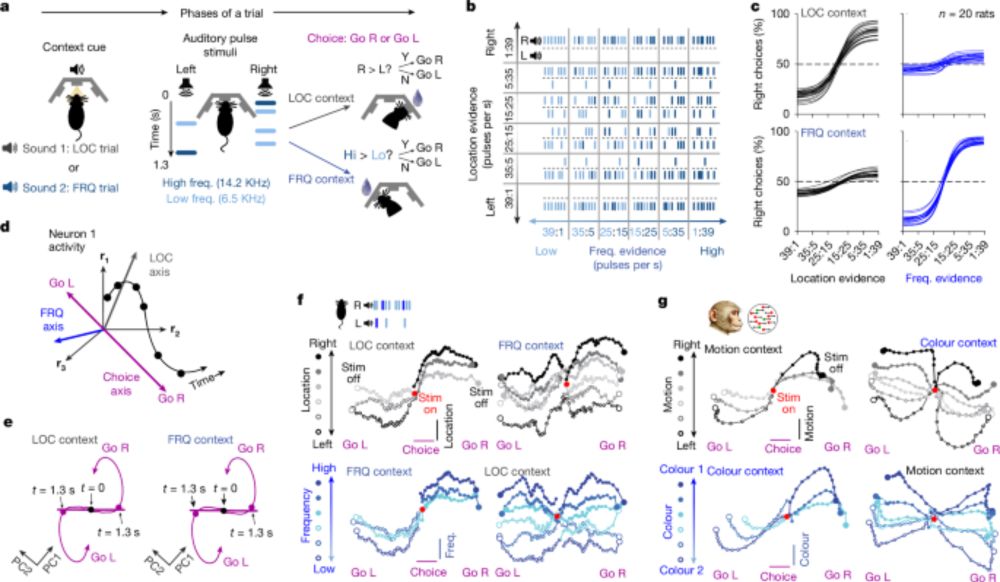
Individual variability of neural computations underlying flexible decisions - Nature
Behavioural experiments to study decision-making in response to context-dependent accumulation of evidence provide testable models that are consistent with the heterogeneity in neural signatures among...
1/7 Our paper on individual variability in decision-making is finally out in @nature.com! Inspired by the classic work by Mante and Sussillo, we trained many rats to solve context-dependent decision-making, and we found that different brains use different neural mechanisms to solve the same task!
21.03.2025 13:28
👍 237
🔁 86
💬 7
📌 5
Join us for SAND in June - Abstracts due this Friday!
The focus is on joining experimental and computational neuroscientists to drive progress in analyzing neural data
18.03.2025 17:25
👍 4
🔁 3
💬 0
📌 0
10/n We are extremely grateful to the funding from NIH that allowed this work to happen, and for the continuing support: we are now using these methods to understand local computations performed by inhibitory interneurons and their state dependence.
17.03.2025 16:56
👍 1
🔁 0
💬 0
📌 0
9/n We think that this differing balance of local excitation and inhibition allows for A1 to maintain its sparse representation of sensory stimuli, and for PPC to integrate information across more neurons and trigger attractor states.
17.03.2025 16:56
👍 0
🔁 0
💬 1
📌 0

8/n In PPC, the central zone was wider, and the surround was weaker
17.03.2025 16:56
👍 0
🔁 0
💬 1
📌 0

7/n In A1, the central zone was narrow, and the surround was strong and wide.
17.03.2025 16:56
👍 0
🔁 0
💬 1
📌 0
6/n BUT the relative sizes of the network center and surround were different in auditory and parietal cortex:
17.03.2025 16:56
👍 0
🔁 0
💬 1
📌 0
4/n We stimulated single excitatory neurons in A1 and PPC, and mapped the influence of each neuron on the surrounding population in layer 2/3 by imaging GCaMP.
17.03.2025 16:56
👍 0
🔁 0
💬 1
📌 0
3/n Previously, we compared population activity dynamics in auditory (A1) and posterior parietal cortex (PPC): In A1 population activity is sparse and decorrelated, while in PPC activity is more highly correlated, and wondered if these differences are driven by intrinsic network structure.
17.03.2025 16:56
👍 0
🔁 0
💬 1
📌 0
2/n We were motivated to do the study to try to explain differences in the spatial and temporal dynamics of population activity that have been described across the cortical processing hierarchy by many groups.
17.03.2025 16:56
👍 0
🔁 0
💬 1
📌 0
5/n We replicated the stereotyped influence pattern seen previously by others (heavily inspired by @selmaan.bsky.social's work in V1): positive influence is restricted to a tight spatial zone closely neighboring the stimulated neuron, while activity in the surrounding region tends to be suppressed.
17.03.2025 16:56
👍 0
🔁 0
💬 1
📌 0

Three images with figure excerpts from the paper, highlighting 1) single-spike detection analysis, 2) autocalibration analysis, and 3) non-linearity of calcium-to-fluorescence transfer functions and their effect on the reporting of complex spiking events.
Are you using GCaMP8 or are planning to switch from GCaMP6? Then check out this new preprint from our lab! www.biorxiv.org/content/10.1...
- Calcium imaging
- GCaMP8 vs. GCaMP6
- Spike inference
- Imaging + ephys ground truth
With F. Helmchen, K. Svoboda, M. Rozsa & X. Fang.
11.03.2025 11:30
👍 76
🔁 24
💬 2
📌 1
Happened to be at that one too, would have been nice to run into you!
07.03.2025 21:56
👍 1
🔁 0
💬 1
📌 0

A rotating 3D-rendered volume showing ocular dominance columns as vertically extending structures (red) in the mouse visual cortex
Can the mouse visual cortex harbor a functional organization for stimulus features? TLDR: Yes, we found ocular dominance columns in this tiny cortical region! Check our paper, open access in @naturecomms.bsky.social www.nature.com/articles/s41... and/or read the 🧵 below. @mpiforbi.bsky.social (1/7)
25.02.2025 10:43
👍 20
🔁 9
💬 3
📌 2
Does anyone know if zoom study sections also have to be posted to the federal register?
25.02.2025 21:42
👍 0
🔁 0
💬 1
📌 0

Join us for the Stand Up for Science local rally in Pittsburgh on March 7, 2025, from 11 AM to 1:30 PM at Schenley Plaza
#StandUpforScience local rally in Pittsburgh is confirmed!
📅 March 7, 2025
⏰ 11 AM-1:30 PM
📍Schenley Plaza, Pittsburgh
Follow the local rally’s Instagram @savesciencepgh for updates
Spread the word 🔥
@standupforscience.bsky.social
#StandUpForScience2025
#ScienceForAll
#ScienceNotSilence
#STEM
25.02.2025 19:33
👍 103
🔁 45
💬 3
📌 17
SAND - 2025
SAND - 2025
📣 The 11th Statistical Analysis of Neuronal Data (SAND11) workshop will be held June 11-13, 2025 in New York at the @flatironinstitute.org with generous support from @simonsfoundation.org
Submissions for talks+posters are due March 21. See our website for details 👇
sandworkshop.github.io
17.02.2025 16:03
👍 30
🔁 13
💬 0
📌 1


