Seems to be the trend across Europe unfortunately.
11.03.2025 22:04
👍 1
🔁 0
💬 0
📌 0
Seems to be the trend across Europe unfortunately.
German conservatives set to dominate the government are sadly heading towards a policy that defies all odds for better mental health of refugees, pushing to block family reunions of recognised refugees.
Read the full paper and share your thoughts.
Let’s cultivate online discussion & push for better policies. /10
#Refugees #MentalHealth #FamilyReunification #MigrationPolicy #HumanRights
Huge thanks to #HelenBamberFoundation & #FreedomFromTorture @freedomfromtorture.bsky.social for supporting this research. And above all, to the participants who bravely shared their stories. /9
Refugee policies must reflect human realities, not just bureaucratic processes. Family separation is not just a legal issue—it’s a mental health crisis. /8
In Greece, we need:
⚖ Quicker asylum & reunification processes
🩺 Better mental health services for refugees
💼 Work permits & financial support—so men can provide without exploitation
🚫 Challenging stereotypes—single male refugees ≠ threat. Their stories matter.
/7
🌍 What about #Greece?
These findings aren’t just relevant to the UK. Greece remains a major refugee entry point, where slow #asylum processes prolong separations & increase distress. /6
What needs to change?
✅ Faster family reunification—delays worsen mental health outcomes.
✅ Trauma-informed mental health support—tailored to the realities of separation.
✅ Policy shifts to recognise gendered impacts—acknowledging the unique struggles of male refugees.
/5
📌 Key Findings:
> Severe mental health impact—depression, suicidality, emotional numbness.
> Pressure to provide—masculinity & fatherhood ideals intensify distress.
> Systemic barriers—racism & hostile asylum policies make it worse. /4
Many described guilt, helplessness, & powerlessness—trapped between protecting their families from afar & navigating racism, discrimination, and economic hardship in the host country. /3
We interviewed refugee men in the UK & found severe emotional distress, loneliness, and identity struggles, worsened by prolonged uncertainty & restrictive immigration policies. /2
Forced family separation is a huge but overlooked issue in #refugee mental health. Male refugees are often the first to migrate, leaving loved ones behind. The psychological toll is profound. /1

Publication Alert! 🚨
Our latest study, "Family Against the Odds: The Psychological Impact of Family Separation on Refugee Men in the UK", is out now in Social Sciences.
A thread on why this matters & what we found. 🧵⬇️
www.mdpi.com/3212182
#psychology folks. Are there any insurance providers to cover remote work with UK-based clients for HPCP registered clinicians who have moved abroad? 😅 please comment if you are aware
Has anyone watched #Stateless on Netflix? What an incredible series about the harms of detention centres and current immigration policies. It’s a tough but essential watch.
The key message we hope this review communicates is that housing isn’t just a shelter—it shapes mental health, especially for people who have experienced trauma. Policy changes need to happen to improve asylum seekers health.
#MentalHealth #AsylumSeekers #HumanRights #PolicyChange
What can you do as a clinician if you are supporting asylum seekers?
> Screen for housing-related stress in asylum seekers
> Advocate for better housing & social support
> Offer psychosocial interventions, not just psychiatric treatment
> Address isolation through community programmes
What needs to change?
🚨 End detention-based housing—it's a mental health crisis.
🏡 Prioritise private/community housing over collective housing
🤝 Support mental health interventions tailored to asylum seekers' needs
⚖️ Ensure safe, humane housing policies for vulnerable asylum seekers
Why this happens?
🚫 Lack of autonomy: Strict rules, no privacy, forced cohabitation
😨 Feeling unsafe: Asylum seekers face violence, threats & exploitation in camps
👥 Lack of support: Social isolation worsens depression & PTSD
🙏 Coping mechanisms: Faith, hope, & peer support help, but aren’t enough
💡 Safer, private housing = better mental health.
> Stable, clean housing with autonomy reduces PTSD & depression
> Moving from collective to private housing ➡️ significant mental health relief
⚠️ Detention is the worst for mental health.
> Self-harm higher rates in off-shore detention vs. community housing
> "Detention violence": physical, racial, psychological, & child-targeted abuse
Key findings:
Poor living conditions = worse mental health.
> Overcrowding, noise, poor hygiene leads to increased stress, anxiety, depression
> Shared housing harms mental health, esp. for single men & families
> Children in detention have alarmingly high rates of PTSD, depression, & self-harm
This systematic review included 21 studies across 9 countries on housing & mental health impacts 🔍
🏡 Housing types examined:
- Private housing (best for mental health)
- Community housing (better alternative)
- Collective/shared housing (high stress)
- Detention centers (higher self-harm rates)
Why this review matters 💡
- Asylum seekers experience high levels of PTSD, depression, & anxiety.
- Not all housing is equal—some types exacerbate mental health issues, while others can be protective.
- Understanding the link between housing & mental health can inform policy & practice.
🏠 Housing is a major post-migration stressor, but its impact on asylum seekers' mental health hasn't been recently systematically studied—until now. This study aimed to fill that gap and identify current evidence published between 2017-2023.
🌍 In a world of ongoing conflicts, 117.3M+ people have been forcibly displaced (UNHCR, 2023). Asylum seekers, distinct from refugees, face higher mental health risks due to pre-, peri-, and post-migration stressors.

Publication Alert 🚨
Read our new systematic review on the associations between #Housing and #AsylumSeeker mental health published in Social Science & Medicine.
#Migration #ForcedDisplacement
www.sciencedirect.com/science/arti...
The community keeps increasing :) stay in touch! x
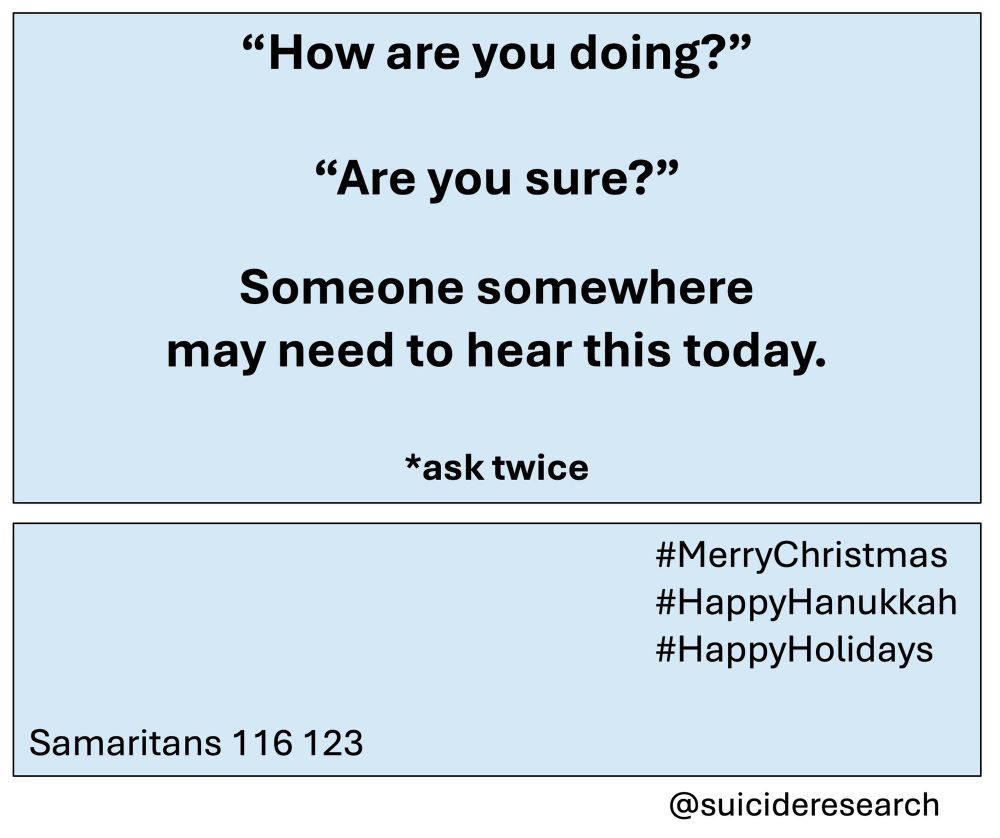
“How are you doing?”
“Are you sure?”
Someone somewhere may need to hear this today.
*ask twice
#MerryChristmas #HappyHanukkah #HappyHolidays
Samaritans 116 123
#24 Bluets by Maggie Nelson
What does blue has to do with depression? Is it depression? Or just an obsession with the colour blue? This book is a beautiful stream of thoughts, stories and emotions for those of us (or our clients) that have struggled with low mood & depression