I'm a member of the War On Cars because I want cities to be more like this.
02.05.2025 18:49
👍 261
🔁 21
💬 5
📌 1
It was right there!
29.01.2025 04:22
👍 5
🔁 0
💬 0
📌 0

A picture of a firefighter on a street with embers flying all around them, with the text saying “climate change will manifest as a series of disasters viewed through phones with footage that gets closer and closer to where you live until you’re the one filming it”
09.01.2025 07:14
👍 2
🔁 0
💬 0
📌 1

An image of raspberries, a variety knows as “rubus” creeping arctic raspberry
Brain: sleep
Also brain: hmm what variety of raspberry should order?
17.12.2024 18:54
👍 3
🔁 0
💬 0
📌 0

A picture of a peregrine falcon destroying a gray pick up truck with the word cars ruin cities at the bottom
Spotted in the wild
17.12.2024 17:53
👍 2
🔁 0
💬 0
📌 0

A graphic with two photos of Ontario Place before and during redevelopment with the text:
Therme Spa will cost $1.8 Billion more than original estimate.
per the Auditor General’s report.

A graphic with a photo of the Science Centre with the text:
Science Centre move will cost $400 Million more than estimated.
per the Auditor General’s report.
While people struggle to afford groceries, make rent, or find a doctor this government is spending billions of tax dollars to enrich corporations.
It's time for a government that puts people over the profits of billionaires.
03.12.2024 17:50
👍 9
🔁 5
💬 0
📌 1
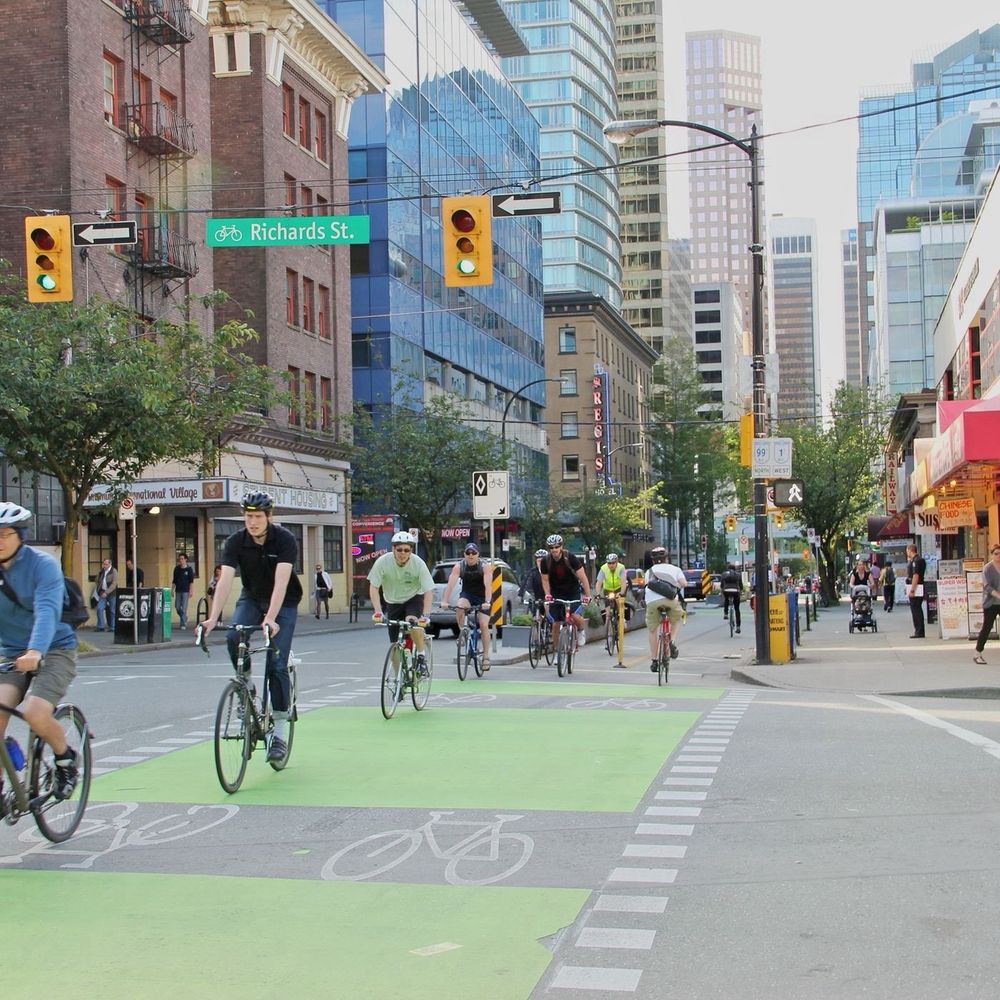
People riding in a safe bike-lane in downtown Vancouver
You don’t have to be a “cyclist” to support safe bike infrastructure in your city. You don’t have to ride bikes at all. You just have to understand the FACT that bike infrastructure makes getting around easier & safer for EVERYONE, saves us all public money, & makes cities generally more successful.
29.11.2024 20:07
👍 1137
🔁 265
💬 17
📌 26

Huge kissing canopies in downtown Brisbane, Australia

Kissing canopies in Vancouver

Kissing canopies in Vancouver

Kissing canopy over the sidewalk in Vancouver
Did you know that a “kissing canopy” is when trees above a street or sidewalk grow to touch overhead, creating a cool, shaded place? Despite it being colder and darker these days, let’s remember the beauty and value that #StreetTrees add to our cities, IF we design for them. #KissingCanopies
29.11.2024 03:28
👍 845
🔁 148
💬 23
📌 19
Independence and community are so important for our seniors’ physical and mental well-being.
We owe it to them to continue to build communities & infrastructure where their needs are safely fulfilled.
These seem like a wonderful was to help seniors get around in their communities.
29.11.2024 09:12
👍 1
🔁 0
💬 0
📌 0

A page showing various bike share usage statistics for the poster. This includes 2593 trips, 9406 kilometres travelled, 827 hours usage, and 2337kg of carbon reduced
My current Hamilton Bike Share (locally called SoBi) stats. Bike share is not all of my bike trips, but it does make up a good amount of them, simply because it is so convenient and I’m exceptionally bad at doing maintenance on my own bikes.
I’m hoping to break 10,000 km total next year!
29.11.2024 09:07
👍 1
🔁 0
💬 0
📌 0

Road Hazard: Evidence Mounts on Toxic Pollution from Tires
Researchers are only beginning to uncover the toxic cocktail of chemicals, microplastics, and heavy metals hidden in car and truck tires. But experts say these tire emissions are a significant source ...
Tire microplastics are bad enough, but research shows very troubling consequences when these microplastics interact with other forms of pollution.
One component, 6PPD, has been found to interact with ground level ozone, forming a toxin, 6PPDq, that kills fish.
e360.yale.edu/features/tir...
29.11.2024 05:55
👍 0
🔁 0
💬 0
📌 0
I remember this well, even if it had been scripted it couldn’t have gotten the point across more cleary!
28.11.2024 14:06
👍 7
🔁 0
💬 0
📌 0
I could only dream of the day where this type of infrastructure would even enter the realm of possibility here in Canada.
But that doesn’t mean I won’t stop working towards that future.
28.11.2024 13:27
👍 0
🔁 0
💬 0
📌 0
Very impressive. It’s wonderful to see what is possible when a society committed itself to a vision.
28.11.2024 13:26
👍 3
🔁 0
💬 0
📌 0
Looks beautiful!
28.11.2024 13:22
👍 1
🔁 0
💬 0
📌 0
Reported
28.11.2024 13:20
👍 0
🔁 0
💬 0
📌 0
If someone doesn’t support libraries, that person needs to be kept away from any position of decision making
28.11.2024 13:15
👍 1
🔁 0
💬 0
📌 0
Hard fought victory. Cheers to all.
28.11.2024 05:00
👍 3
🔁 0
💬 0
📌 0
It’s not just good transportation policy or economic policy. It’s also great health policy.
28.11.2024 01:36
👍 1
🔁 0
💬 0
📌 0
I wish BlueSky had the option to ‘pin’ Starter Packs.
There’s so many good packs out there but I can’t handle following several thousand accounts.
28.11.2024 01:01
👍 0
🔁 0
💬 0
📌 0
“Build it and they will come”
28.11.2024 00:44
👍 0
🔁 0
💬 0
📌 0
Just finished The Serviceberry, was a wonderful read.
28.11.2024 00:39
👍 0
🔁 0
💬 0
📌 0
Many great recommendations here.
Would love to hear of any others!
28.11.2024 00:39
👍 0
🔁 0
💬 0
📌 0

OPINION
The bike lane debate isn't a war on cycling - it's a war on data
SARAH ELTON AND MADELEINE BONSMA-FISHER
CONTRIBUTED TO THE GLOBE AND MAIL
PUBLISHED 3 HOURS AGO
A car stops halfway into the dedicated eastbound bike lane on Bloor St. West near Huron St., in Toronto, on July 9, 2018.
FRED LUM/THE GLOBE AND MAIL

く
Sarah Elton is an assistant professor at the University of Toronto's Dalla Lana School of Public Health and Eakin Chair in Critical Qualitative Health Research Methodology.
Madeleine Bonsma-Fisher is a Data Sciences
Institute postdoctoral fellow in civil and industrial engineering at the University of Toronto.
Innumerable studies conducted in cities around the world have found that safe bike infrastructure has many other benefits. For example, people arriving by car spend less money at main street businesses serviced by bike lanes in comparison to people arriving by bike - and cyclists also stop at these businesses more often than drivers do. This has been known for a long time. Ten years ago, a study from New York City's
Department of Transportation evaluated case studies where active transportation infrastructure was added and found higher sales relative to comparison sites. That's not to mention the individual benefits of improved health supported by safe infrastructure, as well as the money that people save when they replace car trips with cheaper transportation, or the shared benefits of reducing air pollution and helping to meet urban sustainability goals.

There is a lot of data to support expanding bike lanes. Yet the provincial government plans to destroy existing infrastructure, regardless of the cost to taxpayers, and prevent new safe cycling infrastructure investments if they take space away from drivers. What we see here is a contest over what informs transportation and infrastructure policy: either that irritated feeling you get when you're stuck in traffic, or actual data-driven evidence.
Ripping up bike lanes based on frustration is bad policy. Canadians may think that post-truth policy-making is a condition more prevalent south of the border, but buckle up:
With Doug Ford in the driver's seat, frustration - not data - is leading the way.
The facts don’t lie even as this government tries it’s best to do and say otherwise.
Fantastic deconstruction of Bill 212 in the @theglobeandmail.com via @sarahelton.bsky.social and @mbonsma.bsky.social
h/t @uoft.bsky.social www.theglobeandmail.com/opinion/arti...
27.11.2024 19:06
👍 35
🔁 11
💬 0
📌 0

Opinion: The bike lane debate isn’t a war on cycling – it’s a war on data
Ripping up bike lanes based on misplaced frustration is bad policy
"The bike lane debate is a war on data."
True. But it's *also* a War on Bikes. (Both things can be true at once...)
Important op-ed in @theglobeandmail.com about Doug Ford government's attack on bike infrastructure in cities of #Ontario.
www.theglobeandmail.com/opinion/arti...
27.11.2024 19:53
👍 20
🔁 2
💬 0
📌 0
Err… that should be “unmaintained paths”
27.11.2024 15:28
👍 0
🔁 0
💬 0
📌 0
Heartbreaking.
Just stunning callousness from the Ford government.
Not a thought or care to anyone outside a car.
27.11.2024 15:26
👍 1
🔁 0
💬 1
📌 0

The Vehicle of the Future Has Two Wheels, Handlebars, and Is a Bike
The future of transportation looks to be merging with sci-fi. But the bike-tech revolution reminds us that innovation isn’t always about the totally new.
“The most exciting form of transportation technology is more than 100 years old — and it’s probably sitting in your garage. It’s the bicycle.”
The vehicle of the future (& the present) has 2 wheels, Via @WIRED (2018):
Still accurate. #multimodalcities #driverlesscars
www.wired.com/story/vehicl...
27.11.2024 15:21
👍 293
🔁 58
💬 5
📌 4
I Debunked the Entire Manosphere
YouTube video by münecat
I’m sure you must have seen the excellent münecat video about the ‘manosphere.’
I’d encourage everyone who hasn’t seen it to check it out!
youtu.be/BgO25FTwfRI?...
27.11.2024 15:21
👍 1
🔁 0
💬 0
📌 0