
Neat ideas in this
22.09.2025 14:56
👍 2
🔁 1
💬 0
📌 0
Neat ideas in this
1. LLM-generated code tries to run code from online software packages. Which is normal but
2. The packages don’t exist. Which would normally cause an error but
3. Nefarious people have made malware under the package names that LLMs make up most often. So
4. Now the LLM code points to malware.
⚛️📝 New on Overreacted: JSX Over The Wire overreacted.io/jsx-over-the...

Deploying Distributed Apps (Spin + Dapr) on SpinKube (AKS) #spin #spinkube #aks #dapr /cc @technosophos.bsky.social @daprdev.bsky.social @fermyon.com
Check it out: dev.to/thangchung/d...
Orchestrating Distributed Apps (Spin/Rust-WebAssembly and .NET/C#) with .NET Aspire/Dapr
Check it out: dev.to/thangchung/o... @technosophos.bsky.social @davidfowl.com #dotnet #aspire #webassembly

This is a humorous diagram depicting common elements of cloud architecture, drawn in a casual sketch style. It's organized into several sections: At the top: "Global Assumptions" contains various services connected through a "Frickin' Slick Reverse Proxy" with "CIDR Shenanigans" and a "VPN of Sadness." Middle section: Features "CONTAINERS!!!" with stylized container icons and includes: "Cool Databases" "Event Bus" flowing directly into someone's "RÉSUMÉ" "Real Database" with "Midnight Heroics" and a complex pipeline labeled "The Data Engineers Got Very Excited Here" Bottom section: "Blame Radius" showing different service categories: "Services that Start Stuff" "Services that Stop Stuff" "Services that Like to Watch" "One Tiny Cron Job that Keeps Everything from Failing Apart" Ends with "Data Lake" flowing into "Data Swamp" The image is credited to @forrestbrazeal and uses a light-hearted tone to poke fun at typical cloud architecture complexities.
good morning and welcome to 2025

I didn't know about Neosync, but I might start mentioning it to some prospects.
It's an open-source platform that for data anonymization, synthetic generation, and environment synch - very useful for when you can't use real data for a PoC.
Other interesting ones too:
dev.to/bytebase/dat...
>My nervous system developed wrapped around a computer.

Mindmap illustrating Flink CDC pipelines, including components like schema evolution, streaming pipeline, and YAML configuration. Highlights benefits, core functionalities, and potential issues with examples of exceptions.
What *is* Flink CDC? Here's my updated mindmap with some clarity added around source connectors vs pipeline connectors.
tl;dr: Flink CDC Pipelines are *very* cool, but with limited support for connectors _currently_.
Stay tuned for detailed blog later this week!
#dataBS
Look at this! 🤩
@pydantic.bsky.social for AI Agents 🤖🚀

That stuff again? I have written about it in the past
hauleth.dev/post/beam-pr...
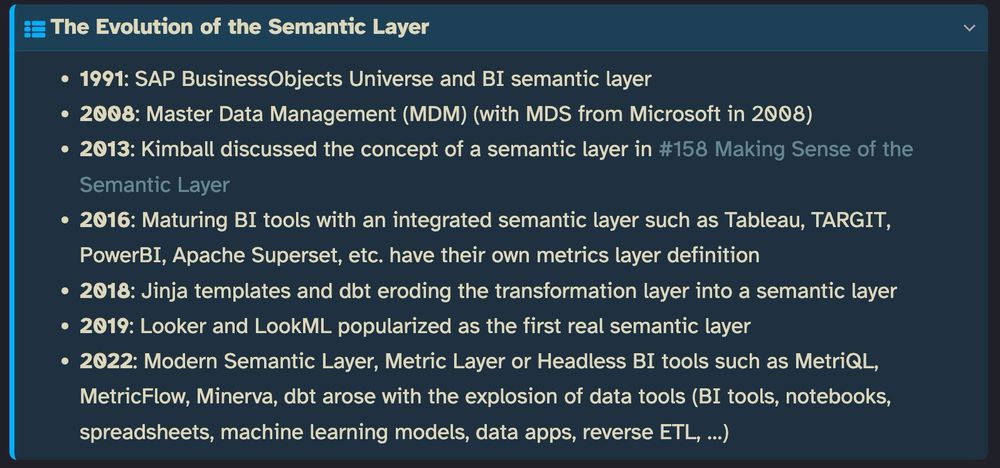
The evolution and history of semantic layer
Did you know that a semantic layer is not something entirely new? ↠ Is there any other semantic layer through the evolution that comes to mind?

The practical .NET Aspire 9 builds on the coffeeshop app business domain, check it out 👉 github.com/thangchung/p... #aspnetcore #dotnet
I'm currently exploring #SchemaEvolution. Very early WIP, but do you see other pointers that relate to the history of schema evolution?
#databs

New post! Materialized View turned one last week. 🎂 To celebrate, I wrote about what’s good and bad about DuckDB.
So you want to roll your own application platform. All you need is:
Linux
Docker
Kubernetes
Istio
Prometheus
Fluentd
Grafana
Jaeger
Harbor
Open Policy Agent
Vault
GitHub Actions and Argo CD
Oh, almost forgot, you're also going to need servers, people, and glue. Bring lots of glue.

👀 mooncake.dev launched today. Supports both read/write for data lake in PostgreSQL (and cross table joins). Lots of these lately (pg_analytics, pg_duckdb, pg_parquet), and still very much a WIP. They're already on Neon, though. ⚡

Just leaving this here for reference if someone wants to try gist.github.com/sspaeti/31d5...

In the database world the idea of OLTP vs. OLAP is a common one, but if you're not a database person what does that actually mean. While running the risk of oversimplifying there are two parts to this, the way data is stored and the type of queries you are running against it.
More details in 🧵

complex diagram of atproto network architecture
a favorite part of the pre-print published today is how few of these lines are dashed.
account migration and PDS federation are big, for sure, but much of the network is already open! nothing stopping somebody from running PDS+Relay+AppView today, w/ content from bsky PDS
arxiv.org/abs/2402.03239