A law was passed acknowledging that treaties drawn up in the original language were valid. The treaty has now been reclaimed as a tool to advocate for equal rights for indigenous communities.
17.09.2025 15:34
👍 1
🔁 0
💬 0
📌 0
It was drawn up in the indigenous language. However, translations resulted in alterations that changed the meaning of parts of the treaty and subsequent breaches. The treaty turned into a tool of oppression and colonisation.
17.09.2025 15:34
👍 1
🔁 0
💬 1
📌 0
The Treaty of Waitangi was signed between the indigenous community in New Zealand and the British to ensure that both parties coexisted on the land and entitled both parties to the same rights.
17.09.2025 15:34
👍 1
🔁 0
💬 1
📌 0
Emma is currently taking some questions from invitees.
17.09.2025 15:25
👍 0
🔁 0
💬 0
📌 0
Relationships are central to the development of equitable solutions (in health, human rights). To develop meaningful relationships, it is important to understand our context–who we are and where we are from.
17.09.2025 15:20
👍 0
🔁 0
💬 1
📌 0
Decolonisation 101 is about creating equity and balance. "Partnership, "Mana-aki-tanga", Authenticity, Listening to hear and not to respond, Be a good Ally, Know your context, Historical Literacy, Global Literacy, BE A GOOD HUMAN."
17.09.2025 15:11
👍 0
🔁 0
💬 1
📌 0
She moved on to the definition of decolonisation provided by the World Federation of Public Health Associations (WFPHA). This definition highlights the individual and collective efforts involved in decolonisation.
17.09.2025 15:10
👍 0
🔁 0
💬 1
📌 0
Emma emphasised the importance of cultural determinants of health.
17.09.2025 15:03
👍 0
🔁 0
💬 1
📌 0
The session started with Emma, the President of the World Federation of Public Health Associations, giving a brief history of "The Treaty of Waitangi" (Te Tiriti).
17.09.2025 15:03
👍 1
🔁 0
💬 2
📌 0
We will be posting some live updates from this event.
17.09.2025 15:03
👍 0
🔁 0
💬 1
📌 0

We are pleased to host the Inaugural Distinguished Honorary Scholar Series today at the University of Essex, Colchester Campus.
17.09.2025 14:37
👍 0
🔁 0
💬 1
📌 0
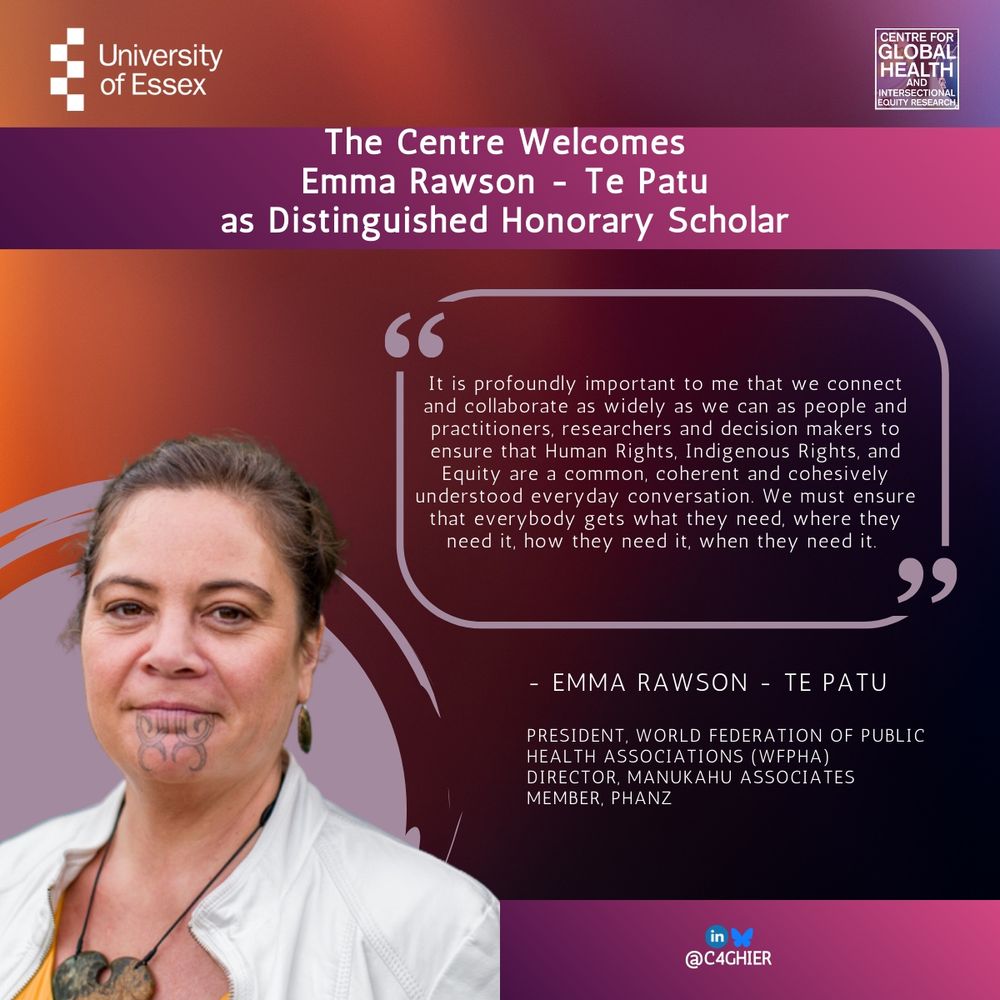
Portrait of Emma Rawson - Te Patu beside text quoting Emma, announcing her welcome as the centre’s first Honorary Distinguished Scholar
We are honoured to welcome Emma Rawson-Te Patu -newly elected President of the World Federation of Public Health Associations and the first Indigenous person to hold this role as Distinguished Honorary Scholar at the Centre for Global Health and Intersectional Equity Research, University of Essex.
12.08.2025 09:29
👍 1
🔁 0
💬 0
📌 0

We are thrilled to share that our GEMMS co-directors and team members will be leading a powerful panel this week at the 7th International Conference on Public Policy hosted by International Public Policy Association. Read more: www.ippapublicpolicy.org/conference/i...
04.07.2025 11:05
👍 0
🔁 1
💬 0
📌 0


Join us on the 27th for the third event in our Global Health Month Series. Register on Eventbrite: www.eventbrite.com/e/1281059646...
#healthequity #intersectionality #globalhealth #healthjustice
15.05.2025 11:05
👍 1
🔁 0
💬 0
📌 0

We remain committed to advancing equity through inclusive, rights-based, and context-driven global health research.
#HealthEquity #IntersectionalEquity #SocialDeterminants #CGHIER #GlobalHealth #UoEssex
Read the full @who.int report here: www.who.int/teams/social...
07.05.2025 11:27
👍 0
🔁 0
💬 0
📌 0

@who.int Health inequities don’t exist in isolation -they’re part of a vicious cycle of poverty, discrimination & poor access. But with inclusive policies, we can build a virtuous cycle of health, equity & sustainability. #HealthEquity #WHO #SDOH #globalHealth #intersectionality #healthjustice
07.05.2025 11:27
👍 0
🔁 1
💬 1
📌 0

@who.int report emphasize the role of structural factors including economic systems, social infrastructure, discrimination & climate change in shaping our health.
#HealthEquity #SocialDeterminants #WHO #SDOH #intersectionality #healthjustice
Video teaser: www.youtube.com/watch?v=mXCX...
07.05.2025 11:27
👍 0
🔁 0
💬 1
📌 0

@who.int recently launched World Report on Social Determinants of Health Equity is a powerful call to tackle the root causes of health inequities - beyond the clinic. #HealthEquity #SDOH #WHO #intersectionality #healthjustice
Full report here: www.who.int/teams/social...
07.05.2025 11:27
👍 0
🔁 0
💬 1
📌 0

Text reads '3.8 billion people don't have social protections like paid sick leave, because of under-resourced public services'. On white background, the image shows crumpled currency note. Text on the bottom reads 'Let's be all for equity'.
Health inequity shortens lifespans. Experiencing discrimination, income insecurity, and limited education opportunities leads to poorer health. Strengthening social protection can help end this cycle and improve lives.
Learn more: bit.ly/44qC4Oi
06.05.2025 14:36
👍 156
🔁 43
💬 3
📌 5

Last week, @universityofessex.bsky.social was represented @who.int Regional Office for Europe Symposium on Modelling & Optimizing the #HealthandCareWorkforce in #UNCityCopenhagen - with Prof Anuj Kapilashrami, Dr Vikki-Jo Scott and Dr Roomi Aziz sharing their work & contributing to global dialogues.
07.05.2025 11:07
👍 0
🔁 0
💬 0
📌 0

We are delighted to bring you you the third event in our Global Health Month Series. Join us for an afternoon focusing on bold ideas community power& action, bringing together leading voices exploring transformative community- driven approaches to health. Register: www.eventbrite.com/e/1281059646...
28.04.2025 17:22
👍 0
🔁 0
💬 0
📌 0

We are excited to continue the dialogue. Join Prof Reza Majdzadeh, Dr Mohammed Jama, Dr Haniye Sajadi , and Jacqueline Mallender as they share critical insights from the recently published Disease Control Priorities - 4th Edition (DCP 4), Volume 1.
Register www.eventbrite.com/e/1279164869...
25.04.2025 10:31
👍 1
🔁 1
💬 0
📌 0

A heartfelt thank you to our incredible speakers, facilitators, organisers, and participants whose insight and honesty shaped every session. Each dialogue affirmed the power of justice-rooted, lived experience. Join future events: cghier.eventbrite.com
#GlobalHealth #HealthEquity #Intersectionality
23.04.2025 12:31
👍 0
🔁 0
💬 0
📌 0

The in-person dialogue with progressive alliances HPA, Kampala Initiative, UKHACC, MedAct, GCI & Medico Int explored how colonial structures persist across Global North & South urging a shift from charity to solidarity, rethinking aid, and investing in systems grounded in justice & mutual benefit.
23.04.2025 12:22
👍 1
🔁 0
💬 0
📌 0

Session 2: Panellists Dr Judith Bueno de Mesquita, Prof Michael Knipper & Dr Jo Vaerey examined how global health is being destabilized by aid cuts and power imbalances. Reflections on colonial roots of aid sparked calls to reimagine global health governance through equity, inclusion, and dialogue.
23.04.2025 12:16
👍 0
🔁 0
💬 0
📌 0

Recap: (Re)Imagining Global Health, Decolonising Aid & (Re) Building Global Solidarity
Session 1: Prof Colin Samson with student discussants explored how colonial legacies continue to shape human rights, often silencing indigenous laws & values. #GlobalHealthMonthAtEssex #decolonisingglobalhealth
23.04.2025 12:09
👍 0
🔁 0
💬 0
📌 0

We kicked off Global Health Month at Essex with a powerful World Health Day event on (Re)imagining Global Health. Check out this sketchnote capturing key themes from the April 4 panels. What must change first? #GlobalHealthMonthAtEssex #decolonisingglobalhealth
Created by Dr Roomi Aziz at CGHIER
23.04.2025 11:51
👍 1
🔁 1
💬 0
📌 0