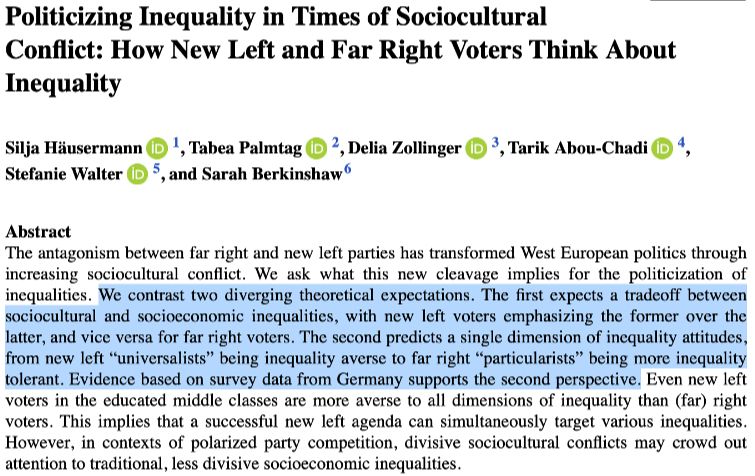
Even in times of sociocultural conflict, a progressive left electorate is more averse to sociocultural *and* socioeconomic inequalities than (far) right voters.
New paper with @siljahausermann.bsky.social Palmtag @tabouchadi.bsky.social @stefwalter.bsky.social Berkinshaw
tinyurl.com/d42wyb79
1/n
29.07.2025 12:19
👍 89
🔁 32
💬 4
📌 1
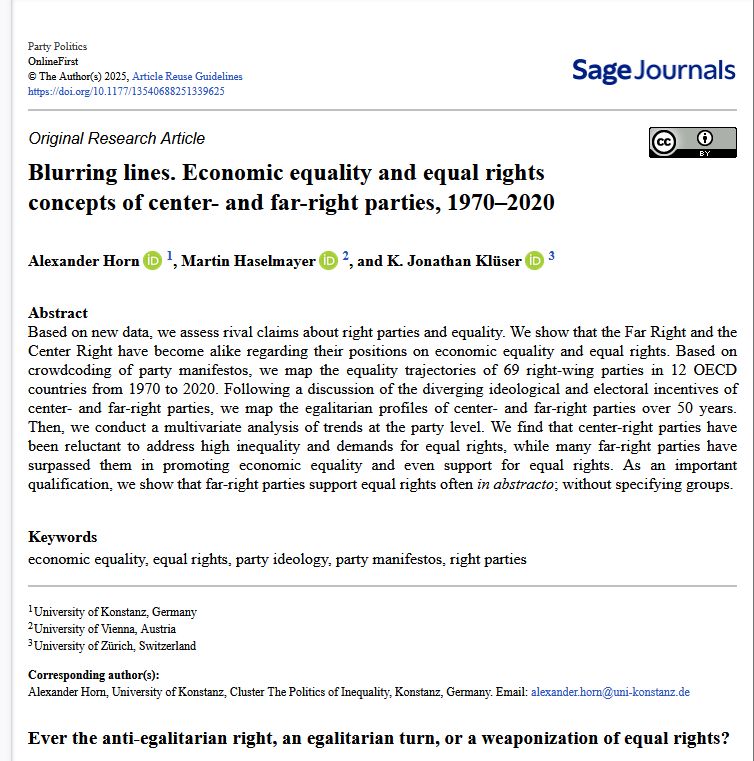
1/3) 📣Out in Party Politics:
We trace the equal rights and economic equality positions of 69 center-right and far-right parties since 1970 in 12 countries. We find that center right parties did not react to/address equal rights concerns and economic inequality
journals.sagepub.com/doi/epub/10....
04.07.2025 10:18
👍 45
🔁 16
💬 1
📌 0

New (first! 🥳) Publication 🚨
High-street retail vacancies, capturing economic decline, are linked to increased support of UK's populist party, UKIP (now Reform).
06.05.2025 11:41
👍 133
🔁 43
💬 10
📌 12
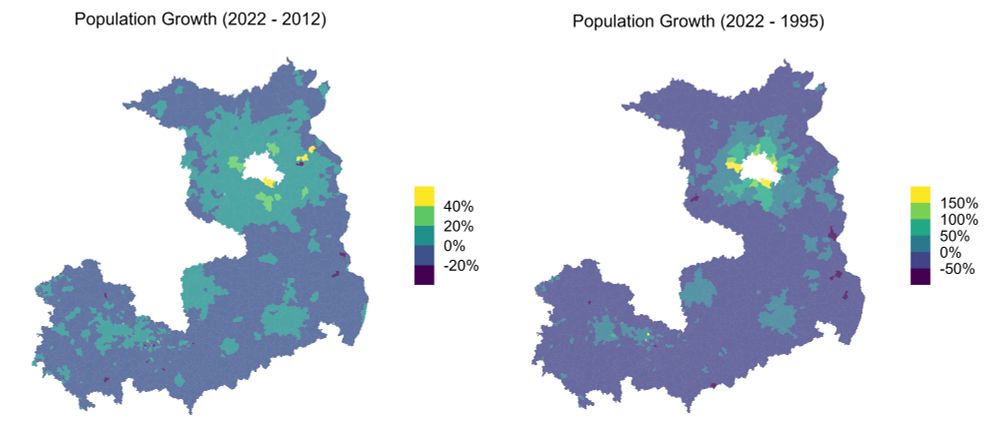
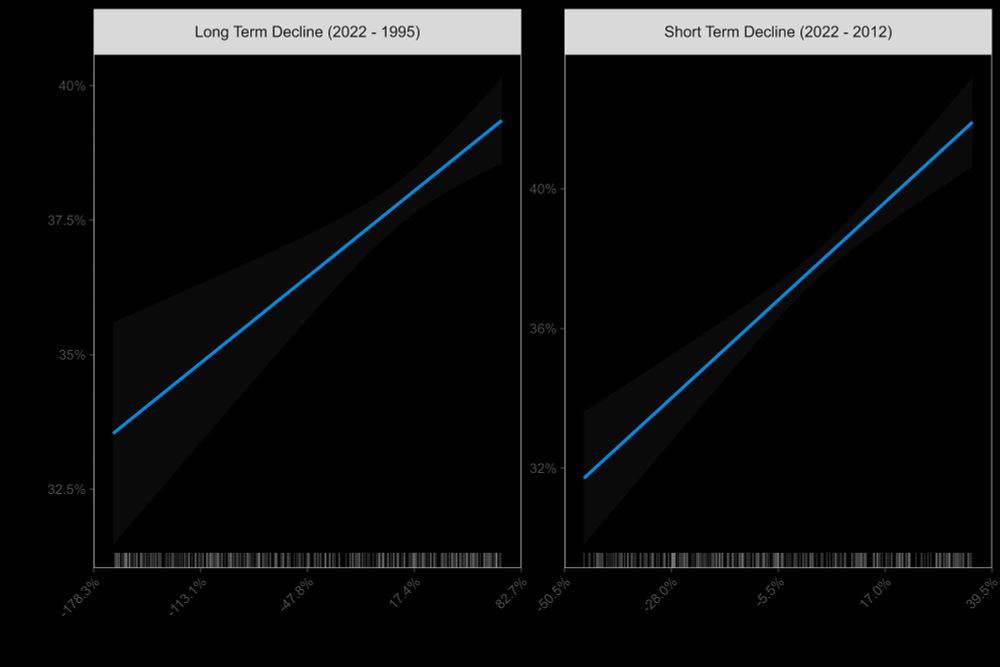
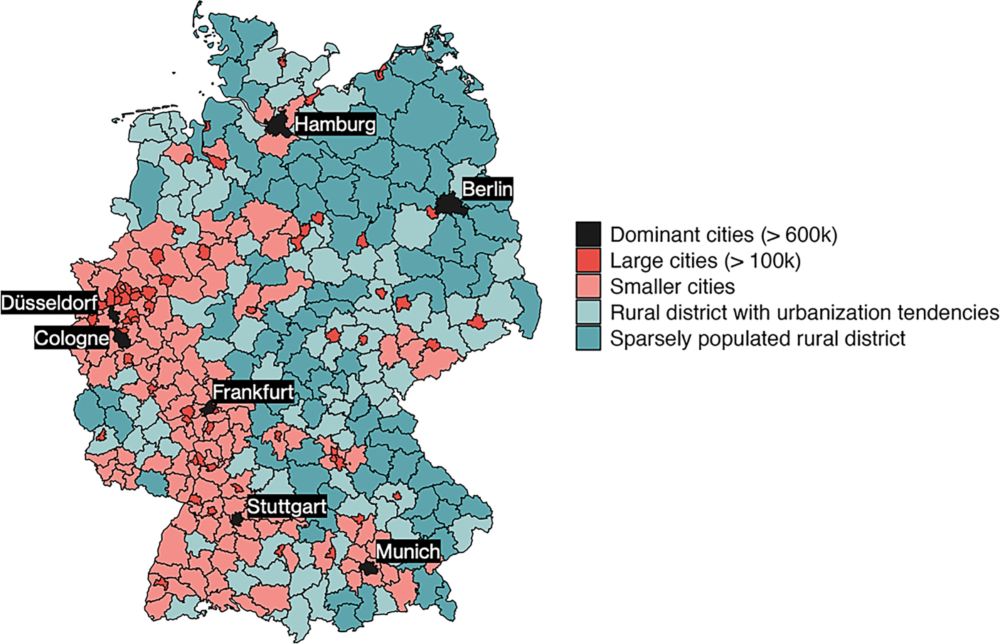
What are the political consequences of long-term population loss? In a new paper for German Politics @benjaminhoehne.bsky.social, Hendrik Träger and I find that East German places more affected by depopulation provided stronger support for the AfD in recent state elections.🧵👇
shorturl.at/cujwa
22.04.2025 07:24
👍 252
🔁 95
💬 13
📌 9
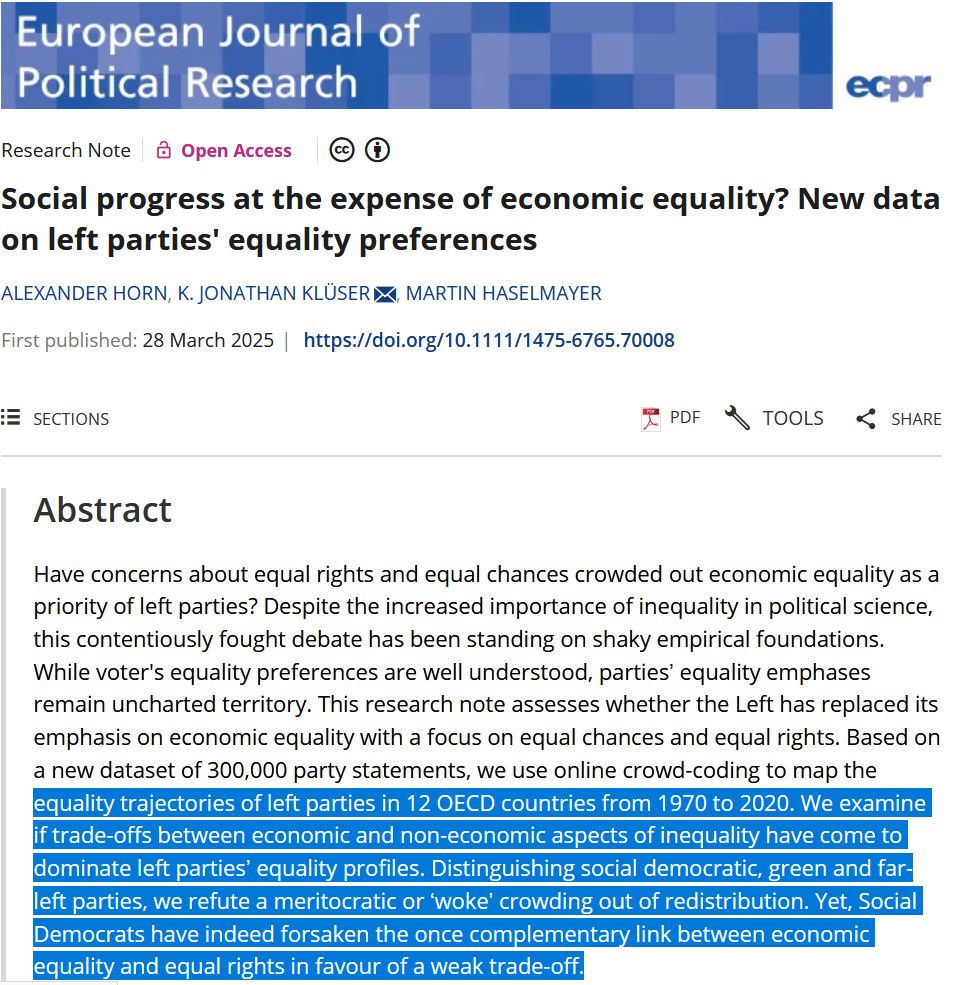
In Social progress at the expense of economic equality? we ask if equal rights or equal chances concerns crowded out economic equality as priority of the Left? Mapping equality concepts 1970-2020: not green or far-left parties. Yet, social democrats … 1/2
ejpr.onlinelibrary.wiley.com/doi/full/10....
11.04.2025 09:57
👍 29
🔁 5
💬 4
📌 1
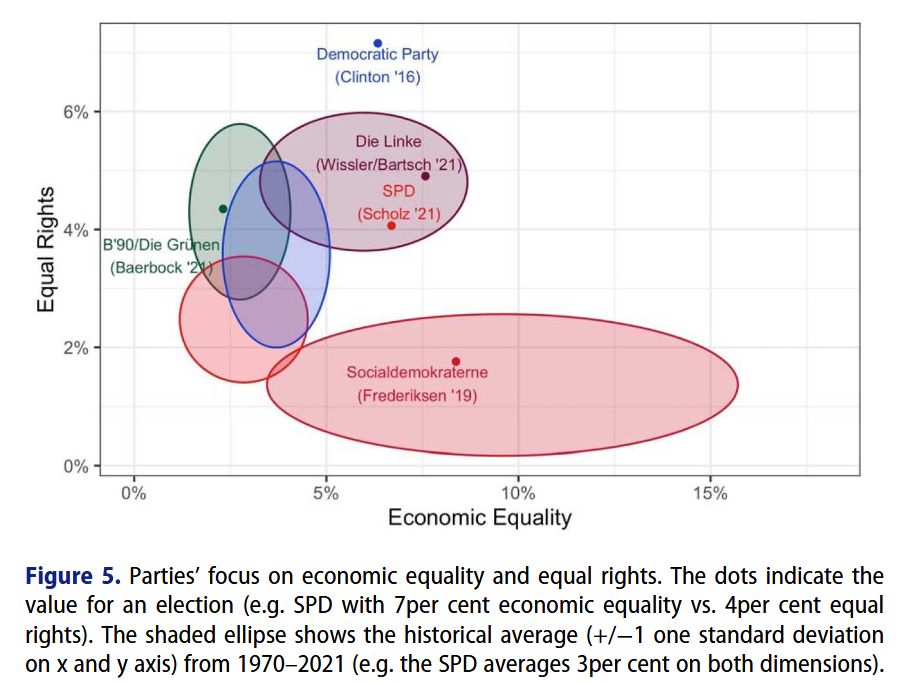
Did German left parties abandon economic equality in favor of equal rights, as the diagnosis of the "Lifestyle-Left" suggests? Analyzing party programs since 1970, we caution against sweeping claims in Unequal German Democracy (open access). 3 key qualifications👇
www.tandfonline.com/doi/full/10....
14.03.2025 11:20
👍 47
🔁 17
💬 1
📌 1
9/ Many thanks to @macarenaares.bsky.social, @alexanderhorn.bsky.social, @evehubscher.bsky.social and many others for providing invaluable feedback on previous versions of this paper.
04.03.2025 18:05
👍 1
🔁 0
💬 0
📌 0
8/ 🟢 Generational differences among GAL voters may reshape the future of social policies directed at the most vulnerable groups. If differences reflect cohort effects (as we assume but cannot empirically test), social assistance could soon lose one of its key support groups.
04.03.2025 18:05
👍 2
🔁 0
💬 1
📌 0
7/ What does this tell us?
🟢 The second dimension of political conflict matters for welfare preferences – it shapes which specific welfare programs are prioritized.
04.03.2025 18:05
👍 2
🔁 0
💬 1
📌 0
6/ These age difference findings are almost exclusively driven by West Germany (as we expected), where early GAL mobilization was more closely tied to left-wing, anti-capitalist movements than in East Germany.
04.03.2025 18:05
👍 2
🔁 0
💬 1
📌 0
5/ However, younger GAL voters, socialized in a context, in which the GALTAN cleavage is dominated by the radical right, do not attach particular importance to social assistance. What they really care about is social investment.
04.03.2025 18:05
👍 3
🔁 0
💬 1
📌 0
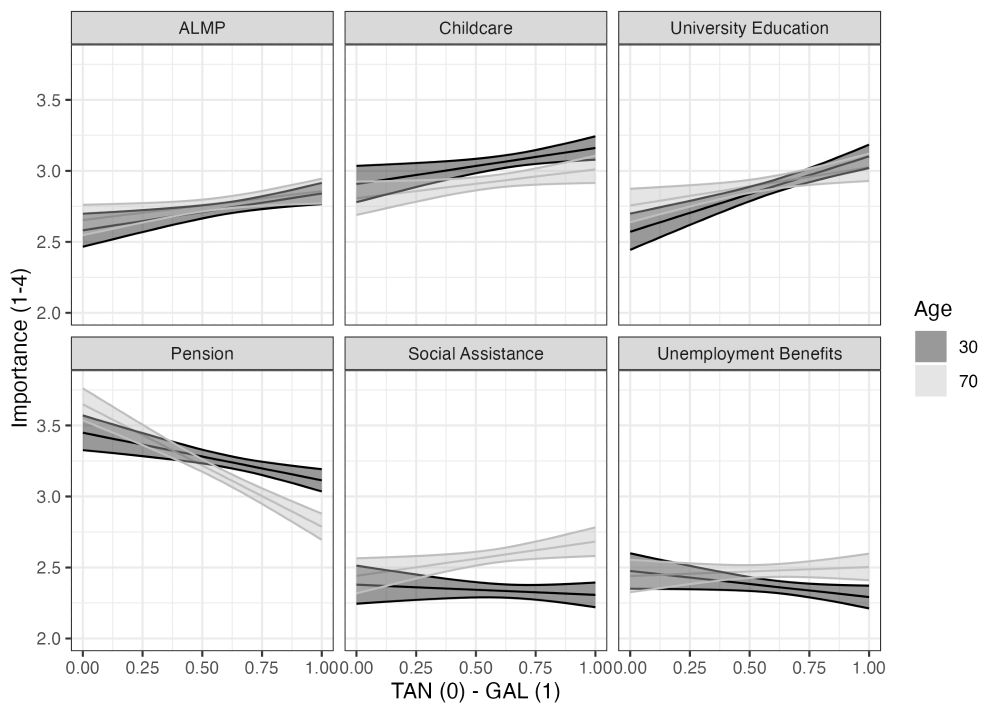
4/ Among elderly GAL voters, who were socialized into the GALTAN cleavage when it was dominated by post-1968 New Social Movements, the importance of social assistance benefits is higher than among TAN voters.
04.03.2025 18:05
👍 4
🔁 1
💬 1
📌 0
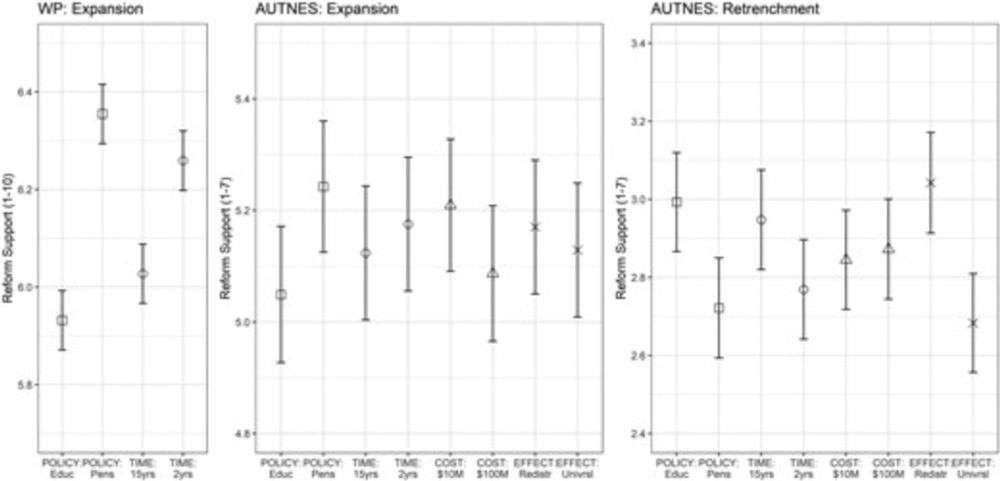
3/ Meanwhile, TAN voters strongly favor pensions – more so than GAL voters. The picture is less clear for social assistance and unemployment benefits, but we uncover important age differences in how GAL voters see social assistance.
04.03.2025 18:05
👍 2
🔁 0
💬 1
📌 1
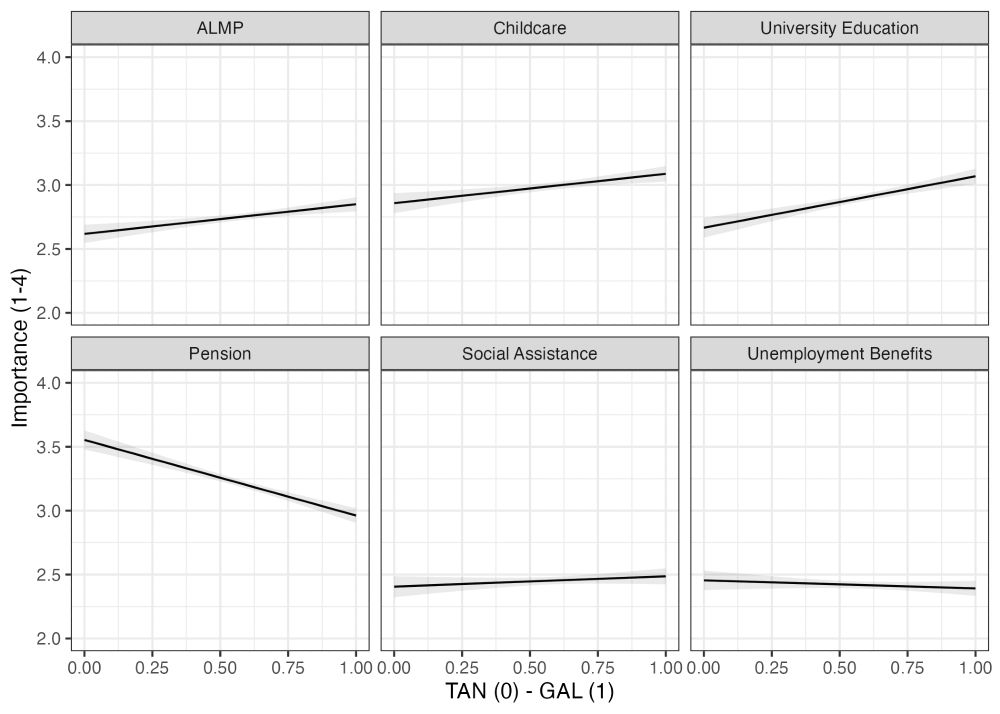
2/ In line with previous research (e.g. @garritzmannj.bsky.social, @mbusemeyer.bsky.social, @eneimanns.bsky.social), we show that GAL voters are more supportive of and find expansion more important for social investment policies (university education, childcare, active labour market policies).
04.03.2025 18:05
👍 3
🔁 0
💬 1
📌 0
1/ Using original survey data from 🇩🇪, we show that GAL and TAN voters differ in their welfare preferences (measured by positions, importance and conjoint experiments) - even when controlling for first dimension, economic attitudes.
04.03.2025 18:05
👍 2
🔁 0
💬 1
📌 0
New publication in @wepsocial.bsky.social with @retobuergisser.bsky.social, @siljahausermann.bsky.social, and Michael Pinggera. We map the welfare preferences of voters at the poles of the second, GALTAN dimension of political conflict. 🧵
04.03.2025 18:05
👍 61
🔁 21
💬 2
📌 0
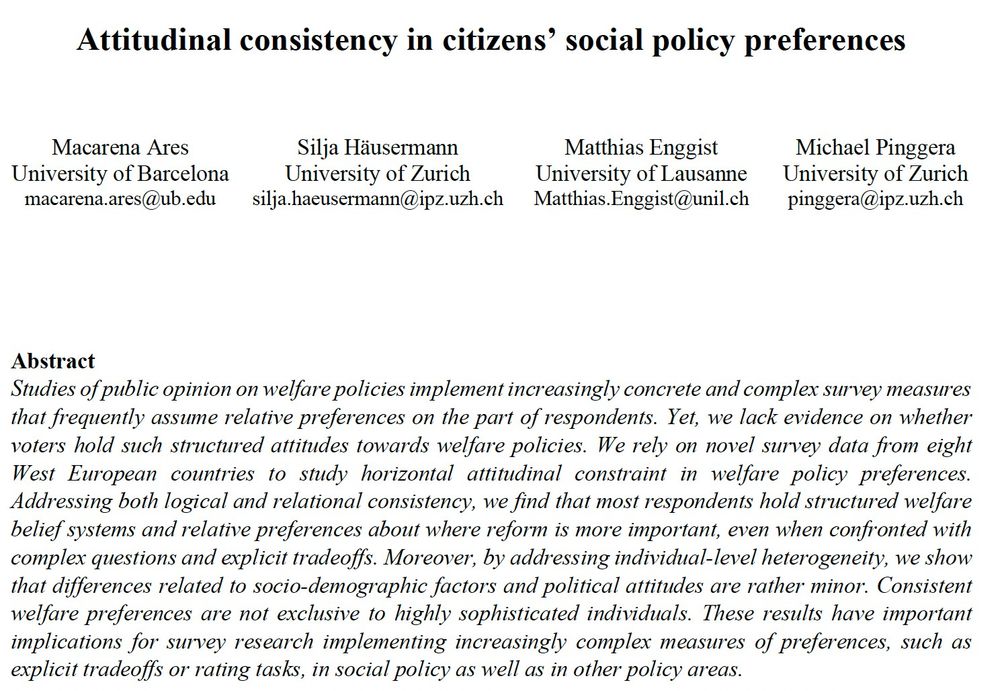
Happy to share this paper, now online at the JoP
about attitudinal consistency in welfare reform preferences with Silja Häusermann @matthiasenggist.bsky.social & Michael Pinggera
👉 journals.uchicago.edu/doi/10.1086/...
20.02.2024 08:32
👍 7
🔁 2
💬 3
📌 0
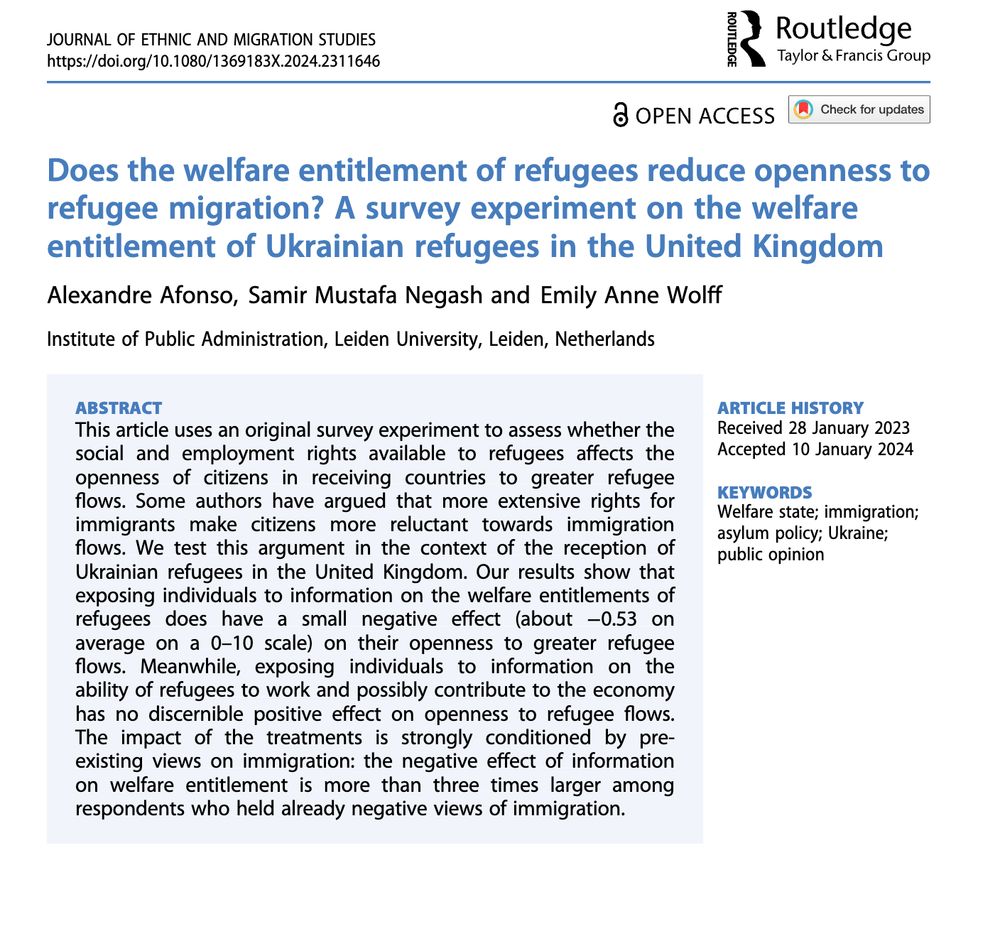
New in the Journal of Ethnic and Migration Studies: we find that telling people that refugees have access to welfare makes them a bit less open to refugee migration, but only a bit, and it's mostly driven by people who didn't like migration in the first place.
www.tandfonline.com/doi/full/10....
07.02.2024 20:44
👍 21
🔁 8
💬 0
📌 0

Socialized with "old cleavages" or "new dimensions": An Age-Period-Cohort analysis on electoral supp...
Across Western Europe, the electoral base of formerly dominating parties on the left and the right has been eroding in the past decades. In contrast, …
sciencedirect.com/science/arti...
New publication out in Electoral Studies!
In this study, I analyze generational voting differences in Western European multiparty systems - focusing on generational realignment *within* political blocs and using individual survey data spanning over 70 years.
19.01.2024 11:02
👍 32
🔁 18
💬 0
📌 2
OSF
New paper (*explosion-emoji-bam!-pow!*) forthcoming with the Journal of Ethnic and Migration Studies: we test whether granting welfare access to refugees changes people's attitudes towards refugee migration. Preprint: osf.io/preprints/os...
15.01.2024 12:41
👍 19
🔁 9
💬 3
📌 1
We measure welfare chauvinism policies using ImmigSR data, which Eloisa collected w/Friederike Römer and Jakob Henninger.
Thanks to European Political Science Review for giving us a home & those who gave feedback on drafts: @julianachueri.bsky.social , Silja Häusermann, Samir Negash, Leonce Röth.
06.12.2023 11:05
👍 1
🔁 0
💬 0
📌 1
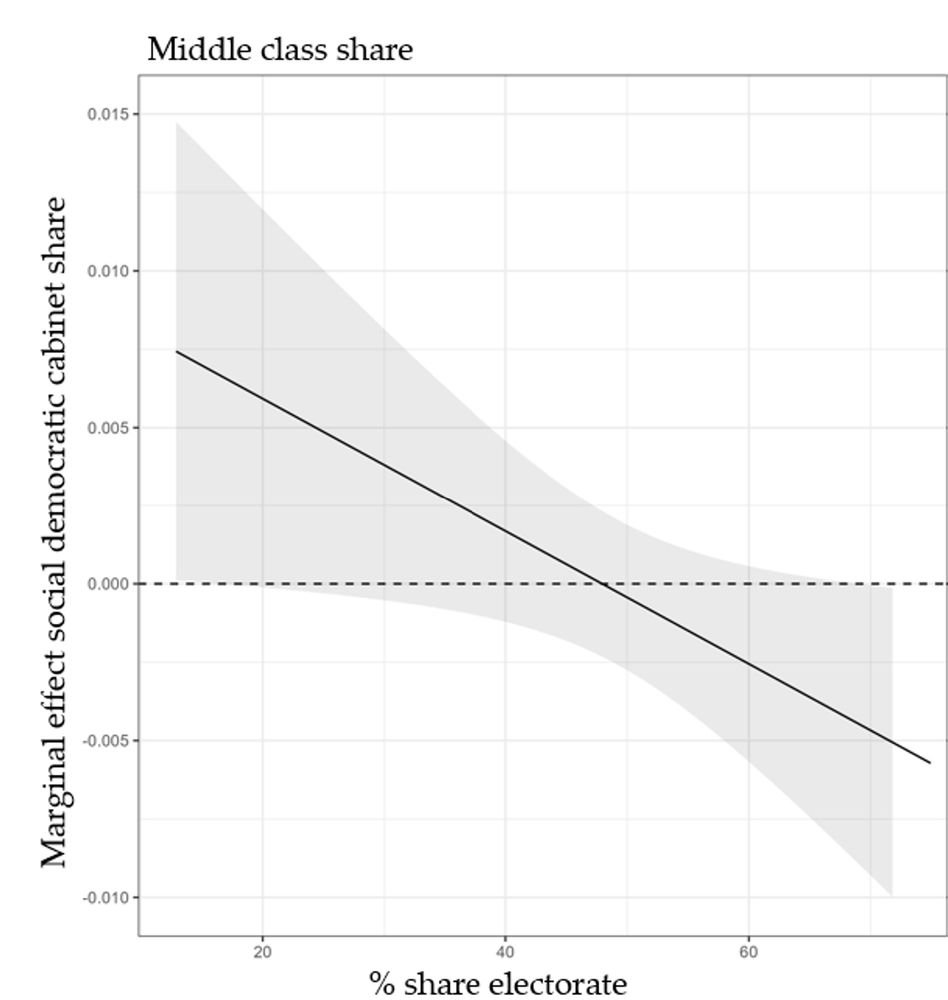
Class realignment of left-wing voters has indeed had a progressive effect on policies. As middle-class individuals with pro-immigrant attitudes come to dominate SD electorates, SD welfare policies towards immigrants become more inclusive. (4/5)
06.12.2023 11:04
👍 0
🔁 0
💬 1
📌 0
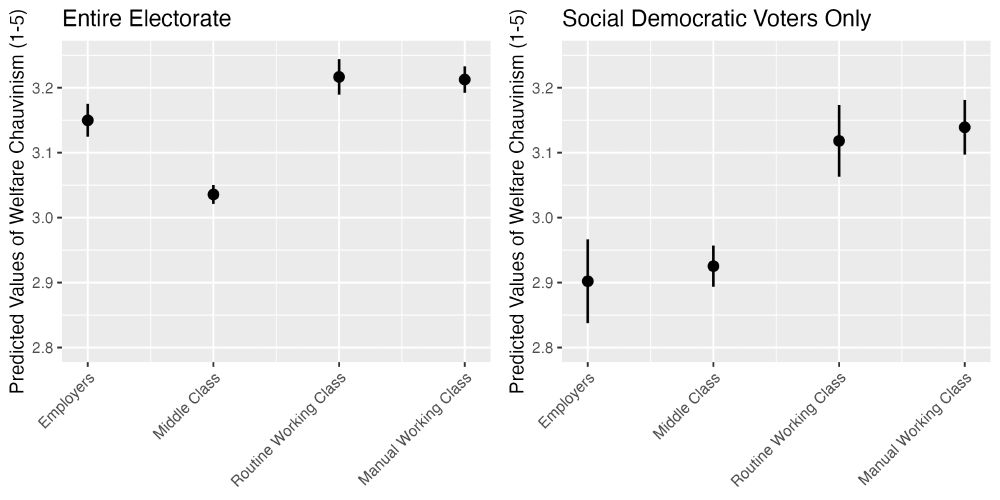
We tested whether such realignment incentivizes parties to adapt their stances on issues where working-class & middle-class voters hold different views. Using ESS data we show that support for welfare chauvinism is clearly structured by class, even within SD electorates. (3/5)
06.12.2023 11:03
👍 0
🔁 0
💬 1
📌 0
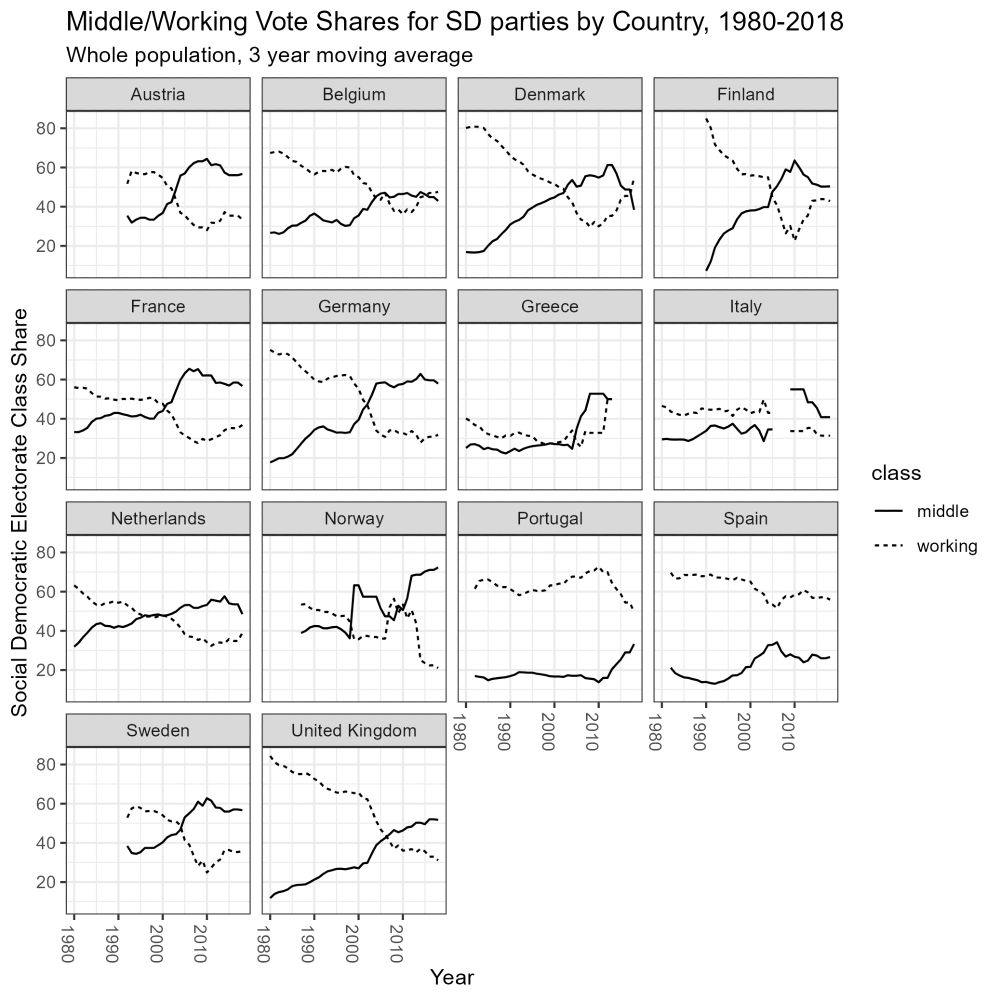
We know from previous research that the class make-up of the SD electorate today is vastly different to the 1980s. In many countries, SD parties have become parties of the middle classes. (2/5)
06.12.2023 11:03
👍 0
🔁 0
💬 1
📌 0
Do shifting patterns of class-voting affect welfare chauvinism policies? In a new paper OA at the EPSR, Eloisa Harris & I show that for social democratic parties, the changing face of their electorate goes hand in hand w/ their policy choices (1/5)
doi.org/10.1017/S175...
06.12.2023 11:02
👍 11
🔁 3
💬 2
📌 0