


This Barbie is officially Dr. Natasha Latouf, Ph.D. Astrobiologist 💕
06.04.2025 20:38
👍 20
🔁 0
💬 2
📌 0
This Barbie is officially Dr. Natasha Latouf, Ph.D. Astrobiologist 💕

Hey #AAS245 exhibitors! 👋
Got any extra, cumbersome swag you don't want to take back? TNI will gladly take it off your hands! 🙋
We'll use these donations for events with kids and to help further our mission 🖖🤓
Reach out to us or:
@jesstella.bsky.social
@nertushka.bsky.social
MY BRAAAAAAND 😂
AHH thanks for stopping by!! Love seeing people love BARBIE 💕
It me!!! Come find me to learn more about BARBIE :)
💕💕💕 thanks for stopping by!! BARBIE always wins 💪
Today is a day of hope. Bashar Assad has left Syria. It’s hard to know what’s next, but for now, we can revel in newfound freedom 🇸🇾

A black mug, with blue text. The text reads "Davey Lab Coffee Coop, since JD 2,455,131", with a blue image of a cartoon galaxy with a coffee bean
Colloquium time at PennState - but more importantly, free mug

an excerpt from the science paper linked above, reading "Our newly built grid set, hereafter the KEN grids (no acronym; they’re just Ken), allow for a direct comparison between grids since they cover the same wavelength range and three base parameters of P0, As, and g"
Perfection

Have you been wondering when you’ll get the finale of BARBIE? Lament no further! BARBIE3: Introducing the KEN is on arXiv now - check it out! We introduce a new grid set, the KEN, and investigate CH4 and H2O detectability. Any questions? Reach out to me!
arxiv.org/abs/2411.15089

Ken-tastic talk on BARBIE (Bayesian Analysis...exo-Earths) from @nertushka.bsky.social 🩷🩷🔭🪐
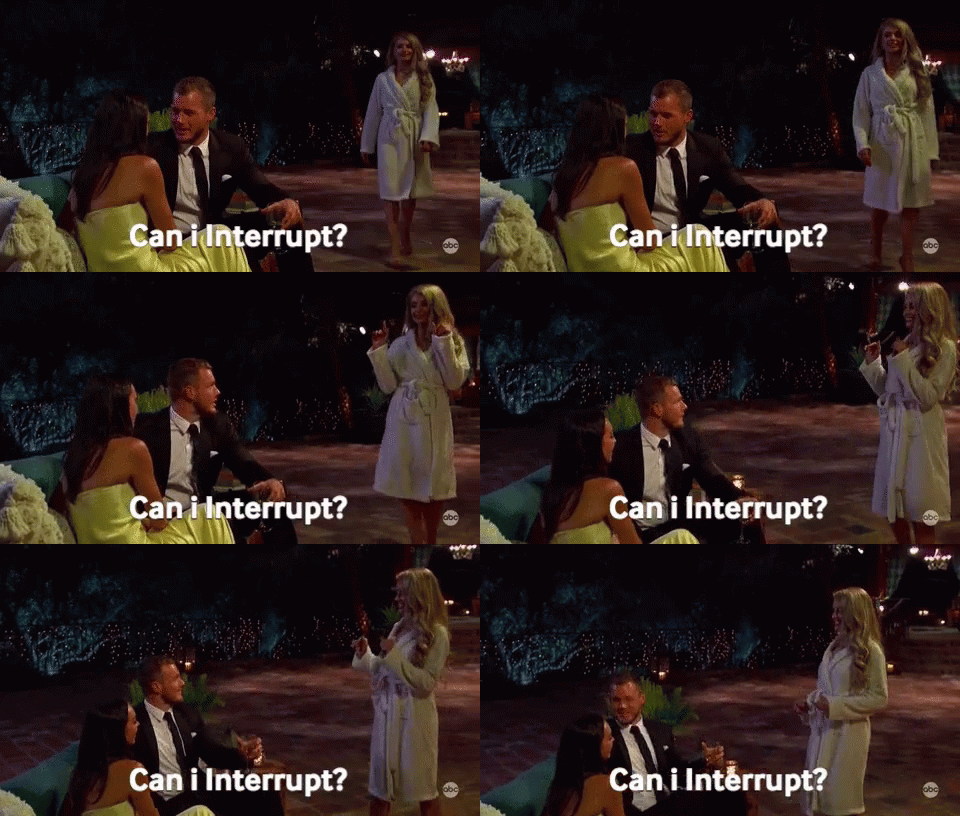
Spending a week in Lindau for #lino24 is just like Science Bachelor.
Laureates are the bachelors and young scientists the contestants. "Can I steal you for a second?"
Gotta know @nertushka and I are getting all the roses with our loud mouths. 😉😉🌹🌹


10.28.23.
Curious about how I found these results? Of course you are, it's fascinating, so go check out my paper! Contact me with any questions, comments, or suggestions. Thanks Barbies! 🩷
We find that H2O can be detected down to 0.74 micron with moderate-SNR data at the upper end of presumed historical values, and H2O can be detected at 0.9 micron with low-SNR data.

Using a grid of 1.4 million pre-computed geometric albedo spectra, calculated by Nick Susemiehl (also on arXiv today!! arxiv.org/abs/2308.00057), we study how SNR and varying abundance can impact the detectability of H2O on exoEarths
IT'S PAPER DAY!! #BARBIE is accepted for publication and up on arXiv (arxiv.org/abs/2308.00648). Let's dive in, shall we?